


In late May, I spent three days at the BARC Data and Analytics Retreat at Devil’s Thumb Ranch in Colorado. It’s a unique event. Instead of a big stage and a passive audience, you get a room of twenty-five or thirty data and AI leaders who interrupt each other, disagree out loud, and keep the conversation honest. Five minutes into the first presentation, someone already said, “I don’t agree with that,” and that set the tone for the whole retreat.
I wasn’t the only one who noticed. “You’re with a group of twenty or thirty people who have been in this vertical for a long time, and the discussion opens up in both directions,” Shree Neve of ClicData told me. John Colthart of Una AI pointed at the mix of people in the room. “When you look at the people here, the different types of businesses, it gives you such a rich context arena to throw around ideas. That level of diversity of opinion and thought, that part’s really cool.” And Ben Schein of Domo named something you rarely see at a vendor event, competitors trading notes in good faith. “Some of these people we’re competing with on deals and for customers, but it’s nice to come together and learn in a way that’s not giving away any secrets.”
Between sessions, I pulled a handful of people aside for short on-location conversations for the Data Faces Podcast. The topics ranged from data sovereignty to financial planning to the future of business intelligence, but one theme kept surfacing across every conversation. What decides whether AI delivers value right now is governance and control, plus context and a clear point of view about what you are building, far more than any model feature.
So I did what you do after a few days on a Colorado ranch. I rounded up the six conversations that stuck with me. Here they are.
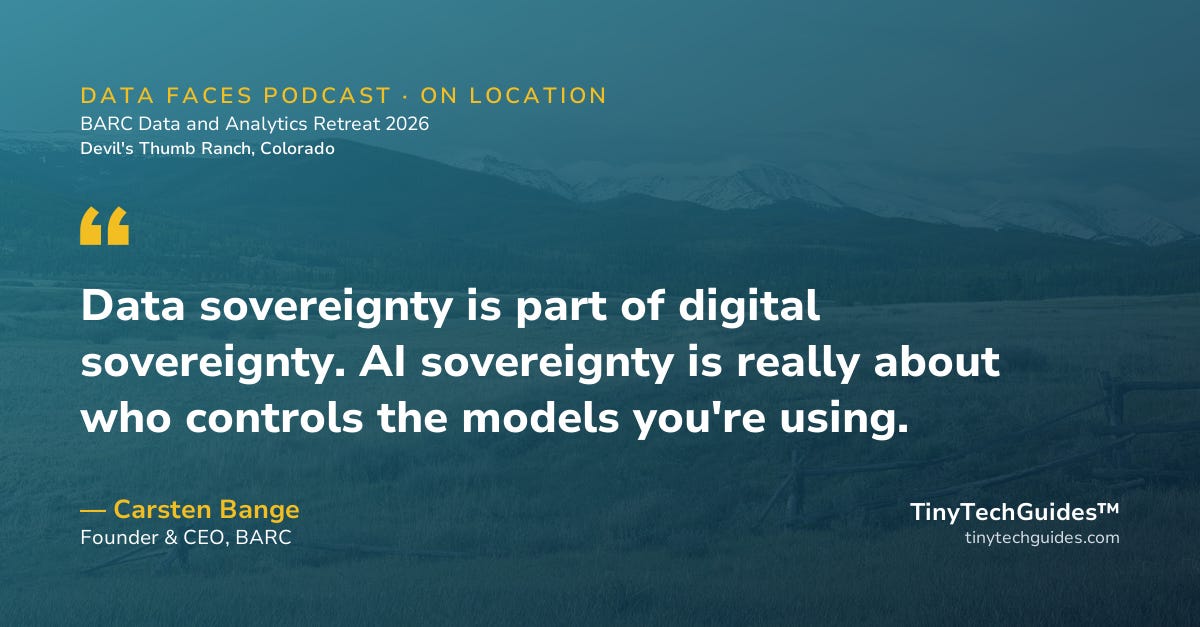
Carsten Bange on why sovereignty is really about control
Dr. Carsten Bange, founder and CEO of BARC, gave one of the retreat’s first sessions, a talk on data sovereignty. The term gets used loosely, so he separated it into three nested ideas. Data sovereignty sits inside digital sovereignty, which also covers processes and technology, and AI sovereignty is the newer layer focused on who controls the models you run. BARC’s own Data Sovereignty 2026 survey found that 89% of organizations now call sovereignty important, with “very important” climbing from 42% to 51% in a single year, and US political developments jumping to a top-three driver at 54%.[1] The headline that surprised even Carsten was geographic. US companies rate sovereignty as more important than European ones, and they are investing more in it, even though Europe wrote most of the rules.
Shawn Rogers on innovation outpacing governance
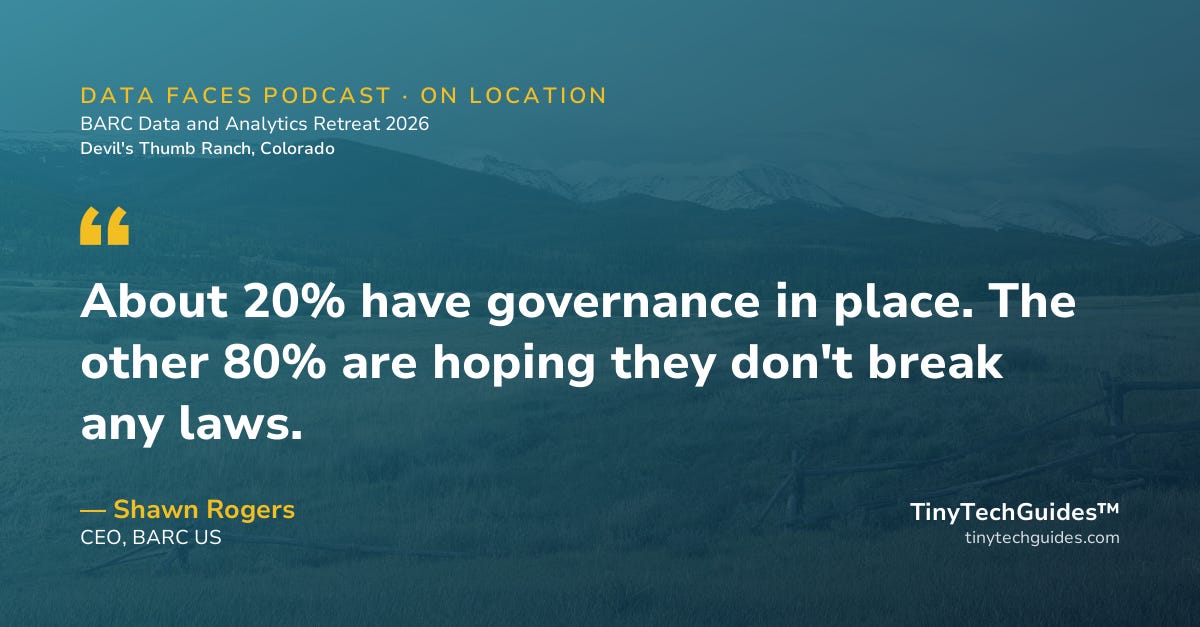
Shawn Rogers, CEO of BARC US, has a blunt read on where most companies sit with AI governance. He described a talk where he asked a few hundred people whether they had launched an AI agent, and every hand went up. When he asked who felt comfortable with how they govern it, almost every hand dropped. He puts roughly 20% of the organizations he talks to in the category of having real governance in place, which leaves the other 80% moving fast and hoping nothing breaks. He also walked through the financial side that catches teams off guard, the surprise bills that land on Monday morning after someone launches an agent on Friday afternoon, including one company that handed Claude to 12,000 employees with no budget at all.
Ben Schein on the question most teams skip
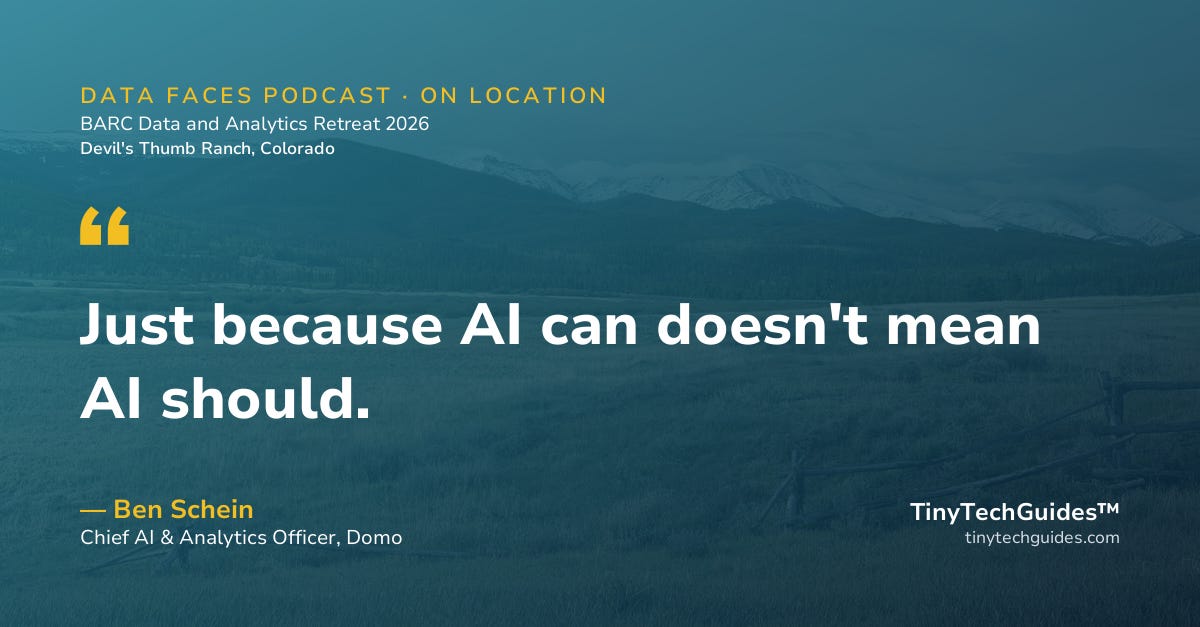
Ben Schein, Chief AI and Analytics Officer at Domo, framed the smartest filter for any AI decision around whether you should act, even when you can. With a general-purpose model, almost anything is technically possible, so the harder and more useful question is whether you should once you weigh governance, cost, and risk. He also reframed sovereignty in a way that stuck with the room, describing it as control and visibility over your data and what it is doing, rather than a question of where the data center physically sits. Token cost ran underneath the whole conversation, shaping which AI projects are worth running and which ones burn budget for little return.
Shree Neve on confidence outrunning capability
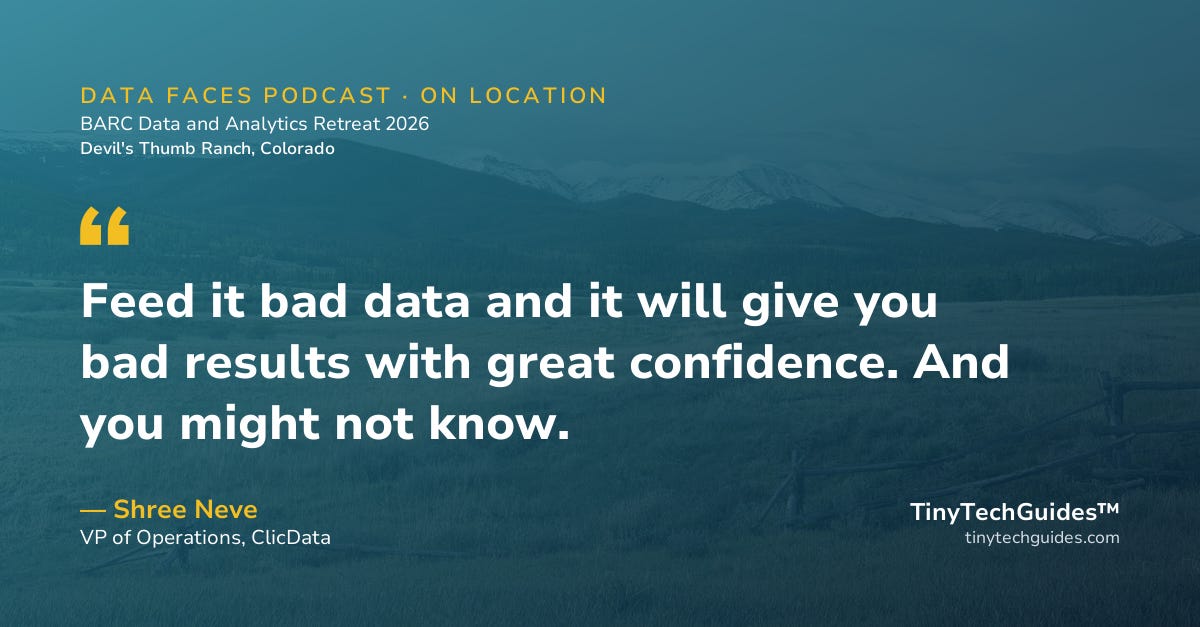
Shree Neve, VP of Operations at ClicData, gave the sharpest warning of the retreat for anyone rushing to bolt AI onto their data. Bad inputs do not produce obviously bad outputs. They produce confident, well-formatted, completely wrong answers, and you might not catch the problem until it has already shaped a decision. That same disconnect between confidence and capability showed up in BARC’s research too. In the Unstructured Data for AI study, 71% of leaders said they were confident they could extract value from their data, yet one in three admitted to lineage and control gaps, and data quality has now climbed to the single most cited measure of AI success at 48%.[2] She pushes a refreshingly old-fashioned sequence. Start with the business decision you want to make, work backward to the question, and only then go find the data and the tool.
John Colthart on the number finance forgets
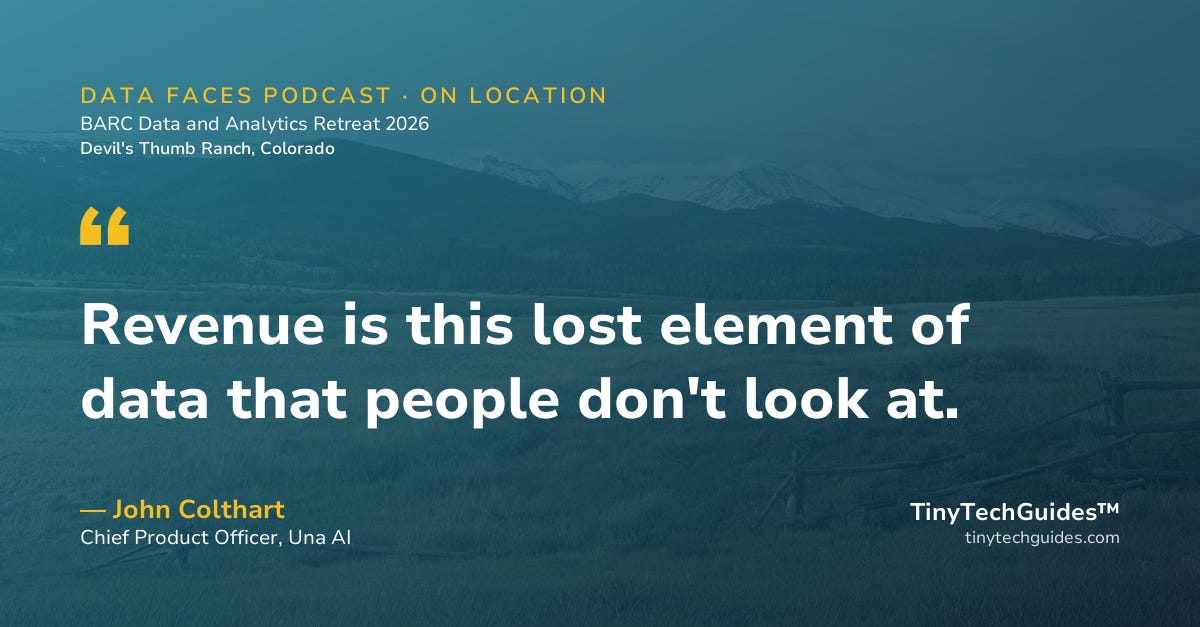
John Colthart, Chief Product Officer at Una AI, came into financial planning with a contrarian view after a long career across sales, marketing, and product. Most planning tools obsess over controlling spend, and in doing so they ignore the number that tells you whether the business is growing. He also refuses to force a false choice between Excel, a web portal, and AI, since most companies still run real planning in spreadsheets and probably always will. His foundation-first instinct matches what BARC sees across the office of finance. Data management ranks as the top corporate performance management priority at 8.2 out of 10, while generative AI for planning sits near the bottom at 4.6, and only 6% of organizations have AI in active production for performance management.[3]
Ivan Vakhmyanin on building for trust
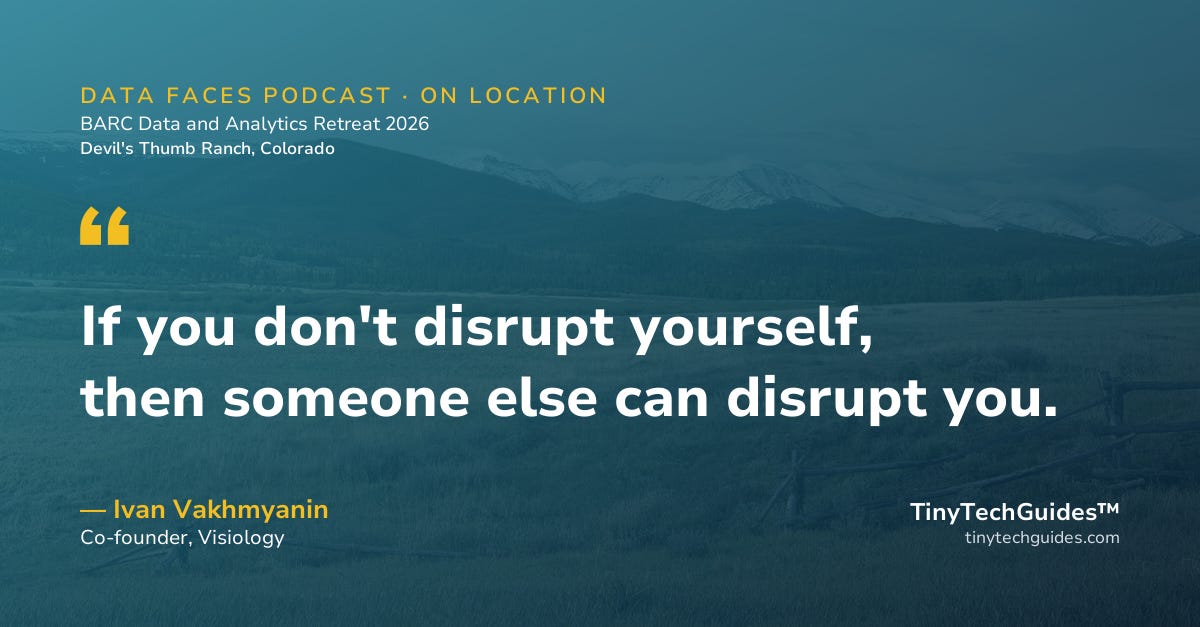
Ivan Vakhmyanin, co-founder of Visiology, is doing the uncomfortable thing on purpose. Ten years into building a business intelligence company, he is rebuilding the product from scratch as an AI-first system rather than bolting assistants onto the old one. His reasoning is direct. If he does not disrupt his own product, a competitor eventually will. The harder engineering choice underneath that is trust. He kept Visiology’s tested data engine and methodology on the back end, gave users a familiar chat-style experience on the front, and made every step traceable so people can verify how the system reached an answer. That instinct lines up with what Kevin Petrie called “vibe slop” in his retreat session, the failure that happens when teams deploy agents on shaky foundations without the governance and context to back them up.
Rounding up what I heard
Six conversations, six corners of the industry, and the same idea underneath each one. Carsten framed sovereignty as control. Shawn weighed how fast companies launch AI against how slowly they govern it. Ben asked whether you should, even when you can. Shree showed how confidence outruns capability when the data is weak. John argued for the foundation before the AI layer. Ivan engineered for trust so people can rely on what the system tells them. None of them led with model features, because features are no longer where the value or the risk lives. What separates teams getting real returns from teams burning budget is governance and control, plus the context and point of view behind what you build.
If you want the full conversations, all six are on the Data Faces Podcast. New episodes drop every couple of weeks, and the on-location interviews like these land between the studio conversations.
If you’d like to learn more about BARC, its research, and the retreat, visit barc.com.
Frequently asked questions
What is the BARC Data and Analytics Retreat?
The BARC Data and Analytics Retreat is an invitation-only event hosted by the analyst firm BARC, held in 2026 at Devil’s Thumb Ranch in Colorado. It gathers a small group of data, analytics, and AI vendor leaders for working sessions and open debate rather than stage presentations. The intimate format encourages the kind of disagreement and discussion that larger conferences rarely produce.
What is the difference between data sovereignty, digital sovereignty, and AI sovereignty?
According to Carsten Bange of BARC, the three are nested. Data sovereignty is part of digital sovereignty, which is broader and also covers processes and technology. AI sovereignty is a newer layer that focuses on AI-specific questions, most importantly who controls the models an organization uses. All three center on control and visibility rather than only the physical location of data.
Why is AI governance such a concern right now?
Adoption is moving faster than control. Leaders at the retreat described companies launching AI agents widely while only a minority have real governance over the underlying data, models, and agents. The result is uncontrolled risk and surprise costs, including organizations that gave large groups of employees access to AI tools with no budget or oversight in place.
Where should a team start with AI on their data?
Start with the business decision you want to make, not the tool. As Shree Neve of ClicData put it, work backward from the question to the data and only then choose the AI tool. Feeding AI weak data produces confident but wrong answers, so fixing data quality and governance first matters more than picking a model.
About David Sweenor
David Sweenor is the founder and host of the Data Faces podcast, where he talks with the people who are making data, analytics, AI, and marketing work in the real world. He is also the founder of TinyTechGuides and a recognized top 25 analytics thought leader and international speaker who specializes in practical business applications of artificial intelligence and advanced analytics.
With over 25 years of hands-on experience implementing AI and analytics solutions, David has supported organizations including Alation, Alteryx, TIBCO, SAS, IBM, Dell, and Quest. His work spans marketing leadership, analytics implementation, and specialized expertise in AI, machine learning, data science, IoT, and business intelligence. David holds several patents and consistently delivers insights that bridge technical capabilities with business value.
Books
- Artificial Intelligence: An Executive Guide to Make AI Work for Your Business
- Generative AI Business Applications: An Executive Guide with Real-Life Examples and Case Studies
- The Generative AI Practitioner’s Guide: How to Apply LLM Patterns for Enterprise Applications
- The CIO’s Guide to Adopting Generative AI: Five Keys to Success
- Modern B2B Marketing: A Practitioner’s Guide to Marketing Excellence
- The PMM’s Prompt Playbook: Mastering Generative AI for B2B Marketing Success
Follow David on Twitter @DavidSweenor and connect with him on LinkedIn.
Footnotes
[1]BARC. “Data Sovereignty 2026: Reality, Relevance, Roadmap.” BARC, 2026.
https://barc.com/
[2]Adrian, Merv, and Kevin Petrie. “Harnessing Unstructured Data for AI Innovation.” BARC Research Study, 2026.
https://barc.com/
[3]BARC. “CPM Trend Monitor 2026 / The Planning Survey 26.” BARC, 2026.
https://barc.com/