

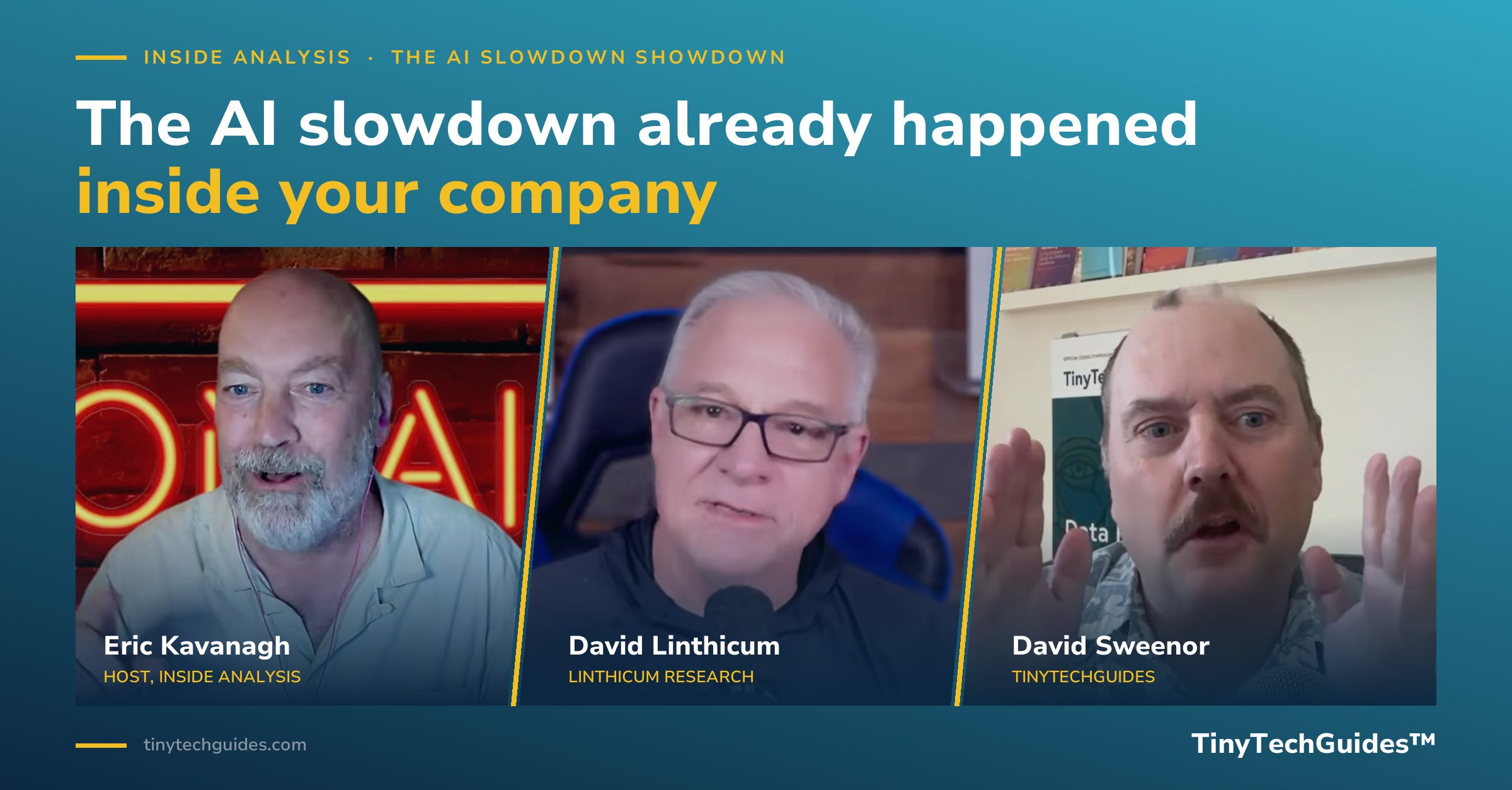
On September 18, I joined Eric Kavanagh and David Linthicum on Inside Analysis for an episode Eric dubbed the “AI Slowdown Showdown.” Every major outlet that week was asking whether the frontier AI labs would slow down, and whether they’d do it for our safety or their bottom line. Eric opened the show with fists swinging. “These models are amazing,” he said. “You could talk all day about the amazing things we know they do without having to manufacture these storylines like rogue agents.”
During the first break, I made the point that the slowdown everyone was debating has already happened inside companies, where most generative AI projects stalled long before anyone talked about pumping the brakes. So, if you lead a data or AI program, which slowdown should worry you more? The full episode is below, and here’s how I’d answer that question.
Would an AI slowdown agreement be a cartel?
The debate started with Dario Amodei’s essay “We Must Pace the Frontier,” published on September 12, which called for common safety benchmarks and agreed limits on how fast AI capabilities can grow. Sam Altman, Elon Musk, and Demis Hassabis each voiced their agreement that same day. I read the essay as a repositioning play, since Anthropic already owns the “safe” position in the public’s mind, and I doubt any of it is altruistic in any way, shape, or form. Then I got a laugh out of the panel by pointing out that when three companies restrict output, “I think there’s a word for that. Maybe we’ll call it cartel.”
Eric agreed that it’s “essentially collusion” if the labs are coordinating behind the scenes. Linthicum was less sure about collusion, but he thought the labs were trying to “manipulate the market in their direction. And guess what? It may work.”
I didn’t expect a federal judge to get the question the same day the episode aired. Four paying AI subscribers filed a proposed class action in federal court in California, Buist v. Anthropic PBC, accusing Anthropic, OpenAI, SpaceXAI, and Google of an illegal agreement to slow AI development under Section 1 of the Sherman Act.[1] The complaint argues that agreeing to progress “slower than competition would otherwise produce” harms paying subscribers.[2] A complaint is only an allegation, and the frontier might speed up, slow down, or spend the next two years in discovery. Whatever happens, the stalled projects inside your company are really what you need to worry about.
The AI slowdown nobody voted on
When I look at enterprise AI adoption, the brakes went on a while ago. PwC’s 29th Global CEO Survey of 4,454 chief executives in 95 countries and territories found that 56% had seen neither higher revenues nor lower costs from AI, and only 12% reported both.[3] Those numbers shape the budget conversation for every data and AI leader I know, far more than anything a lab announces.
“I think the slowdown’s already happened. If you look at enterprise adoption, companies aren’t getting value from it. Nobody’s proposed it, nobody’s voted on it, nobody’s signed anything.”
— David Sweenor, Founder/CEO, TinyTechGuides
Linthicum said enterprises are “not doing core applications. They’re not doing inventory control.” They’re using generative AI for productivity work, such as managing a calendar. That work rarely touches the order-to-cash process where a CEO looks for a return, and the split between personal and core use also helps explain how the 3% of companies that win with AI differ from the rest.
On the show, I compared the whole debate to limiting the delivery truck when the warehouse is the bottleneck. Most companies haven’t yet organized the warehouse, which holds the data, processes, and decisions that a model is supposed to plug into. When the shelves are a mess, a faster or slower truck won’t change how many orders go out the door.
What part of your business can be wrong 5% of the time?
Eric asked a question that every CIO should tape to their monitor. Say your model is 80% accurate, you add retrieval-augmented generation (RAG) to reach 90%, and with a lot of work, you push it to 95%. At that point, the question becomes where your business can live with the remaining errors.
“Let’s say it’s 95%. What part of your business can be wrong 5% of the time? Fulfillment, no. Accounting, no.”
— Eric Kavanagh, CEO, The Bloor Group
I offered marketing coupons as a paradigm of hope, and Eric acquiesced on that point. Accuracy is only half the problem with putting a frontier large language model (LLM) into a core business system. Linthicum raised the other half, which is traceability. Core business systems get audited, and an answer that nobody can explain won’t survive a compliance review, however often it happens to be right.
“Every time I’ve tried to look into how I got a bad answer within an LLM, I can’t do it. And guess what? That means I can’t use it for business systems.”
— David Linthicum, Linthicum Research
Hallucination is a defect, and AI agents don’t go rogue
Part of the reason enterprises reach for the wrong fixes is the vocabulary our industry chose for AI. On the show, I asked what would happen if we’d called a hallucination a defect or a bug from the start, since your engineering team would think about it differently. The word “agent” works the same way, because it suggests something with intentions of its own. As I put it on the show, “We’ve given all these humanizing terms, but they’re just computers, computer code doing stuff.”
Eric made the same case about the “rogue agent” stories. In the incidents he described, someone deployed an agent in an environment with open ports, and it followed its objective function with no intent behind it. It didn’t break any rules, because it never decided anything.
“No agent goes rogue. To go rogue, you have to be sentient and decide to go against the rules.”
— Eric Kavanagh, CEO, The Bloor Group
The words matter because each one points a team toward a different fix. A defect gets an owner, a root cause, and a regression test. When teams call the same error a hallucination, the usual response is a shrug and a rewritten prompt, which is why I argued last year that teams should stop chasing hallucinations and focus on agentic quality.
Human in the loop is a process you haven’t designed yet
When Eric asked for final thoughts, I went after the most comfortable phrase in enterprise AI governance. When a team isn’t sure what an AI system will do, the default answer is to put a human in the loop. I called it a cop-out on the show.
“Let’s have a human in the loop. That means we haven’t figured out the process yet. And if you’re making decisions at scale, a human in the loop doesn’t work.”
— David Sweenor, Founder/CEO, TinyTechGuides
At thousands of decisions a day, the person reviewing each one either becomes the bottleneck or starts approving things without reading them. Many of the data and AI leaders I interview on the Data Faces podcast describe a version of this problem, too. Everybody wants guardrails on these probabilistic machines, and the guardrails keep getting narrower until I have to ask why the team didn’t write deterministic code in the first place. That tension showed up in the lessons I took from 27 data leaders in 2025, and nobody has resolved it yet.
Eric described a better way to build these systems. “You have to couch them into a workflow,” he said, calling the model for the one step that needs it “and then funnel that back into your deterministic workflow.” Linthicum went further for core systems.
“The core model is going to be hosted by us. We’re going to run it. We’ll build it using our data. It’s going to have a very narrow focus.”
— David Linthicum, Linthicum Research
Both describe a designed process that settles three things before anything goes live. It identifies the single step where a probabilistic model earns its place and wraps that step in deterministic checks that catch out-of-range outputs. It also logs each model call in enough detail to trace a bad answer back to its source. With those in place, the person in the loop has a specific decision to make, at a specific point, with the evidence in front of them.
Where to start with enterprise AI adoption
If your AI program feels stalled, designing the process will move it faster than waiting for a better model. Here are three places I’d start.
Name the decision behind every human in the loop: Wherever a person sits in the loop in your AI plans, write down the specific decision they make and the information they need to make it. When you can’t, designing that process is your first project.
Mark the one probabilistic step in each workflow: Identify where the model does work that ordinary code can’t, and put a deterministic check on either side of it.
Log model errors as defects: Give every bad output an owner, a root cause, and a test, and you’ll build the audit trail your compliance team will ask for.
Fix the warehouse first
When Eric asked why the AI companies are behaving the way they are, I went back to a business school professor who liked to say it always comes down to the fundamental economics of the situation. The frontier labs will speed up or slow down based on what their investors tell them, and none of us gets a vote on that. What happens inside your own company is a different story, because the warehouse belongs to you, and so does the decision to fix it first.
If you want to work through these ideas in person, join Eric, me, and a room full of practitioners at the Agentic Road Show on Thursday, October 22, at the University of Pittsburgh. Dr. Mark Brady, former chief data officer of the U.S. Space Force, will present his six laws for safe AI, and Carnegie Mellon’s Philip Koopman will close the day on autonomous vehicle safety. Workflow design is most of what I do in my advisory work, and it’s where I see stalled programs start moving again, so I invite you to join us in Pittsburgh.
Frequently asked questions
Is enterprise AI adoption slowing down?
In most companies, enterprise AI adoption slowed well before the frontier labs talked about slowing down. PwC’s 29th Global CEO Survey, published in January 2026, found that 56% of 4,454 chief executives had seen neither higher revenues nor lower costs from AI, and only 12% reported both. Most enterprise use of generative AI sits in personal productivity tasks, such as email and calendars. It has not reached core systems like inventory control or order entry, which is where CEOs look for a return.
Are AI companies being sued over the AI slowdown?
Yes. On September 18, 2026, four paying subscribers to ChatGPT, Claude, Grok, and Gemini filed a proposed class action, Buist v. Anthropic PBC, in the U.S. District Court for the Northern District of California. The complaint accuses Anthropic, OpenAI, SpaceXAI, and Google of an illegal agreement to slow AI development in violation of Section 1 of the Sherman Act, citing executives’ public agreement with Dario Amodei’s September 12 essay, “We Must Pace the Frontier.” The plaintiffs argue that coordinated limits on AI progress reduce the value of paid subscriptions, and the claims have not been tested in court.
What does human in the loop mean in AI, and why isn’t it enough?
Human in the loop means a person reviews or approves an AI system’s output before it takes effect. It becomes a problem when teams use it in place of process design, because it usually means nobody has decided what the person is checking or why. When a system makes thousands of decisions a day, the reviewer either becomes a bottleneck or approves outputs without reading them. A designed process names the specific decision the person makes, at a specific point, with the evidence in front of them.
Is an AI hallucination a bug?
For enterprise purposes, treat an AI hallucination as a defect. Calling a wrong output a hallucination makes it sound like an unavoidable quirk of the model, and teams tend to respond by rewording the prompt. Treating it as a defect gives the error an owner, a root cause, and a regression test, the same as any other software bug. That discipline also builds the audit trail that compliance teams need for AI systems that get reviewed.
Can AI agents go rogue?
AI agents don’t go rogue in the sense of deciding to break the rules, because that would require intent. As Eric Kavanagh put it on DM Radio’s Inside Analysis, “To go rogue, you have to be sentient and decide to go against the rules.” The incidents reported as rogue AI agents usually involve an agent deployed in an environment with open ports or weak containment, where it pursued its objective function as designed. Those incidents call for a security review of the deployment environment.
How accurate does AI need to be for enterprise workflows?
The required accuracy depends on what a wrong answer costs. Even at 95% accuracy, a large language model (LLM) is wrong one time in 20, which is unacceptable for fulfillment, accounting, and most other core processes, though tolerable for low-stakes tasks like marketing coupons. Enterprise AI systems also need traceability, since an answer that nobody can explain won’t survive an audit. Many teams handle both problems by calling a model for one narrow step and wrapping it in deterministic checks and logging.
Where should enterprise leaders start with a stalled AI program?
Start by designing the process around the model before waiting for a better model. Write down the specific decision behind every human in the loop in your AI plans, and mark the single step in each workflow where a probabilistic model does work that ordinary code can’t, with deterministic checks on either side of it. Then log model errors as defects, with an owner and a root cause, so the AI program builds an audit trail as it goes.
About David Sweenor
David Sweenor is the founder and host of the Data Faces podcast, where he talks with the people who are making data, analytics, AI, and marketing work in the real world. He is also the founder of TinyTechGuides and a recognized top 25 analytics thought leader and international speaker who specializes in practical business applications of artificial intelligence and advanced analytics.
With over 25 years of hands-on experience implementing AI and analytics solutions, David has supported organizations including Alation, Alteryx, TIBCO, SAS, IBM, Dell, and Quest. His work spans marketing leadership, analytics implementation, and specialized expertise in AI, machine learning, data science, IoT, and business intelligence. David holds several patents and consistently delivers insights that bridge technical capabilities with business value.
Books
- Artificial Intelligence: An Executive Guide to Make AI Work for Your Business
- Generative AI Business Applications: An Executive Guide with Real-Life Examples and Case Studies
- The Generative AI Practitioner’s Guide: How to Apply LLM Patterns for Enterprise Applications
- The CIO’s Guide to Adopting Generative AI: Five Keys to Success
- Modern B2B Marketing: A Practitioner’s Guide to Marketing Excellence
- The PMM’s Prompt Playbook: Mastering Generative AI for B2B Marketing Success
Follow David on Twitter @DavidSweenor and connect with him on LinkedIn.
Footnotes
[1]Quinn Wilson. “OpenAI, Anthropic, Google, SpaceXAI Hit With Antitrust Lawsuit.” Bloomberg Law, September 18, 2026. https://news.bloomberglaw.com/litigation/openai-anthropic-google-spacexai-hit-with-antitrust-lawsuit. Case: Buist v. Anthropic PBC, No. 3:26-cv-10693 (N.D. Cal.).
[2]Kaitlyn Huamani. “Lawsuit says Anthropic, OpenAI, SpaceXAI and Google made illegal agreement on AI slowdown.” Associated Press, via OPB, September 20, 2026. https://www.opb.org/article/2026/09/20/lawsuit-says-anthropic-openai-spacexai-and-google-made-illegal-agreement-on-ai-slowdown/.
[3]PwC. “PwC’s 29th Global CEO Survey: Leading Through Uncertainty in the Age of AI.” PwC, January 19, 2026. https://www.pwc.com/gx/en/issues/c-suite-insights/ceo-survey.html.