


Over the past couple of years, I’ve built more or less the same thing for five different clients, and not one of them called it AI GTM engineering. As each company got further along with AI, the work still showed up on the invoice as product marketing. The work was building AI systems into how a marketing team operates, which I have been writing about for a year.
So I went looking for what the rest of the market calls this. I found three perspectives on the same question, published within seven months of each other, pointing in different directions. Each of them had counted something real.
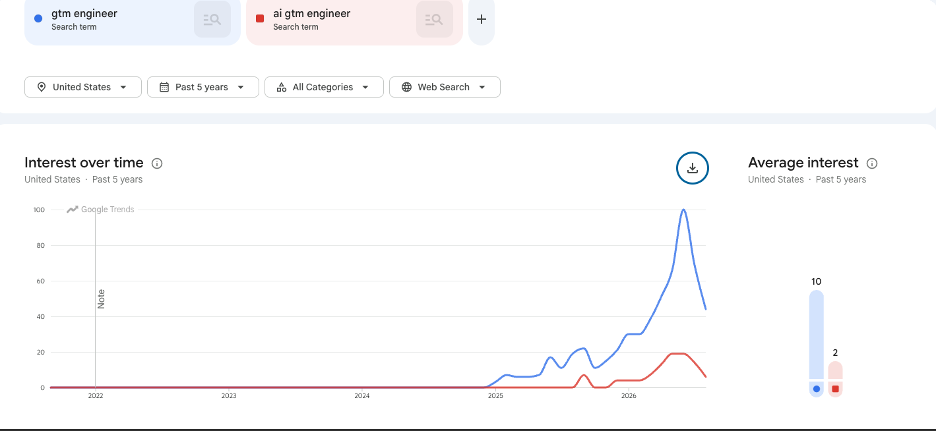
In September 2025, Kyle Poyar counted job postings for his Growth Unhinged newsletter and found 45 GTM engineer listings in a month, 128 over a quarter, and one for every 92 openings for a sales development rep.[1] He noted the title barely registers in Google Trends. Poyar spent eight years at OpenView, so when he called the buzz well ahead of the hiring, he was right for the moment.
A month later, Henley Wing Chiu reached a blunter conclusion from a bigger sample. He co-founded BuzzSumo and now runs a job-postings index called Bloomberry, and he pushed a thousand GTM engineer postings through it. Nine out of ten responsibilities also turn up in RevOps postings, which led him to write that “GTM Engineering and RevOps jobs are essentially the same.”[2]
Then in April 2026, Brendan Short came at it from the company side. He writes The Signal, and rather than counting job ads, he went through 63 of the fastest-growing SaaS companies. He found 54% had somebody doing the job, against 3% to 7% of private B2B SaaS overall.[3]
So the category barely exists, already exists under an older name, or is standard equipment at the fastest-growing companies. They disagree because each is measured against a definition somebody else wrote, and nearly every definition in circulation comes from a company that sells the tools the job operates. Poyar and Short even drew on the same job-postings index and still reached opposite conclusions.
“AI GTM engineering builds AI systems into how a go-to-market team works. Write down the data and the voice first, then build workflows that run without anyone starting them, then hand the whole thing to your own team to operate.”
— David Sweenor, Founder/CEO, TinyTechGuides
That is the definition I have worked from on those five engagements, and the order is the point. Skip the first step and the other two inherit its absence, which is why so much AI output reads as though it came from a company with no particular opinion.
Every definition on offer was written by a vendor
Every GTM engineer definition I could find was published by a company that sells the tools the role operates. The cleanest comes from ZoomInfo, which describes a GTM engineer as someone who designs, builds, and operates the data pipelines, enrichment workflows, and automated plays behind how a company sells and markets.[4] Clear thinking, from a company whose product is data pipelines and enrichment.
The job postings tell the same story. In Chiu’s sample, HubSpot appears in 52% of them, Outreach in 49%, and Salesforce in 45%, with Clay leading the list. Every tool named there either sells to a prospect or moves data between the systems that do.
Agencies sell the same picture. Poyar counted more than 120 agencies in Clay’s partner directory alone, and he passes along an estimate, his word rather than mine, that 45% of the people carrying a GTM engineer title work at agencies or consultancies. Most of those shops are built on the same enrichment and outbound tooling.
So the companies selling the software describe the role, and every description ends at outbound prospecting. That work is real, and somebody should own it. What none of it describes is marketing, by which I mean positioning and launches, competitive analysis and the content a buying committee reads, and the judgment about which of those is worth automating at all.
The three components, and why the order matters
AI GTM engineering starts underneath the marketing work, in what a model knows before it writes anything. The first of its three components covers the environment, the data, and your voice and editorial standards, written down where an AI model can read them. Teams skip this because it feels like preparation rather than progress, and everything built on top of it inherits that shortcut.
Workflows come second, and my test for whether one is finished is whether it runs without anyone starting it. A prompt somebody keeps in a document and pastes into a chat window on Tuesdays is a habit with extra steps. Something that wakes on its own, runs the competitive scan, and files the result where the team already looks still works the week its builder is on holiday.
Enablement comes third, and most engagements drop it. When you hand over a system nobody understands, you create a dependency rather than a capability. Ask who fixes it at 4 pm on a Friday, and if the answer is the consultant, you bought a subscription to a human being.
None of this belongs to any vendor. When an outage hit me mid-deadline earlier this month, switching models cost almost nothing, because the rules, the workflows, and the accumulated context were all files on a disk. Build this way, and you can change models or consultants without starting over.
The scarce skill is not the engineering
Here is where I part company with almost everyone. People hear the word engineering and assume the hard part is building the system, so they hire somebody who can wire tools together and write a little Python. That person is easy to find now, and the tools have gotten good enough that building became the cheap part.
Choosing what to build stayed hard. Knowing what a battlecard has to say is a different skill from knowing how to generate one. Understanding how a buying committee reaches a decision, which competitive claims a seller will use on a call, and which content exists only because somebody asked for it once, none of that comes from automation experience. It comes from more than two decades of doing the work and watching which parts of it mattered.
“Knowing which hours of a marketing week are worth taking back, and which ones would break something if you automated them, is the part that stayed expensive.”
— David Sweenor, Founder/CEO, TinyTechGuides
This explains why the two obvious places to buy each solve one half. AI implementation consultants integrate anything you point them at and hold no view on which marketing work is worth the effort, so they will cheerfully automate a process that should have been deleted. Marketing advisors have that judgment and cannot configure an environment or leave behind something that runs on its own. You buy twice and integrate the purchases yourself.
The expensive route is automating inside your tools
Under pressure, every team automates inside the tool it already controls. Marketing builds in the automation platform, sales in the CRM, and support in the ticketing system, because that is the cheapest move available without asking permission. A year of that produces visible progress and a real problem, since nobody owns what happens between those systems.
Other people are already measuring the cost. Forrester projects that 75% of technology decision-makers will see their technical debt reach moderate or high severity by 2026, driven by how fast AI development is adding complexity.[5] Every tool-by-tool automation built this year is an entry on that ledger.
Reaching the next rung means pulling apart what each team built alone. The three components map onto the ladder below. Standards and unattended workflows get a team to the delegated stage, and enablement is what makes the connected stage possible.
Here’s a maturity model:
1. Personal
What it looks like: People use AI on their own work, on whatever they paste in
Who owns it: Nobody, since a habit cannot be handed over
What it’s worth: Hours back for one person
2. Delegated
What it looks like: A step runs without a person starting it, inside one tool
Who owns it: Each team owns its tools, nobody owns what sits between them
What it’s worth: A process metric moves
3. Connected
What it looks like: Marketing, sales, and CS work from the same context
Who owns it: A named owner of that shared context
What it’s worth: Unit economics move
4. Self-correcting
What it looks like: The system improves from outcomes without being rebuilt
Who owns it: A dedicated role
What it’s worth: Unit economics compound
Three questions move you between the rungs. Does anything run when nobody starts it? Do marketing, sales, and customer success work from the same context? Does it improve next quarter without somebody rebuilding it? Score an average week rather than the best example anyone can point to, because a company sits at its lowest rung, no matter how good that example is.
Where you probably score, and what to do about it
Almost every team I talk to sits at the personal stage, where AI is somebody’s habit, with one delegated-stage anecdote attached, and saying so out loud is usually the most useful ten minutes of the conversation. Between 3% and 7% of private B2B SaaS companies have anyone doing this job, so being behind is the ordinary condition. The 54% figure at the fastest-growing companies is the part worth staring at, because those companies did not grow faster by accident and staffed this before anyone had agreed what to call it.
So start with a question, and leave the hire for later. Picture your primary model going dark tomorrow, then picture your best prompter taking a two-week holiday, and ask what would still run. Write down the standards first, automate one thing that runs unattended second, and hand it to your team third.
If you want a second opinion, I am happy to spend thirty minutes walking the ladder against your situation and naming the one thing worth building first. No slides, and it is useful whether or not you hire anybody.
Vendors define this work as plumbing because plumbing is what they sell. What they left out is the part that was always hard: knowing what deserves to be built at all.
Interested in learning more? Book a meeting.
Frequently asked questions
What is AI GTM engineering?
AI GTM engineering builds AI systems into how a go-to-market team works, rather than handing individuals a chat window and hoping the way work moves changes on its own. It covers three components in order. First comes the environment, data, and voice standards written down where a model can read them. Second come workflows that run without a person starting them. Third comes the enablement that leaves your own team operating, extending, and repairing what got built.
How is AI GTM engineering different from RevOps?
An analysis of a thousand GTM engineer job postings found that nine out of ten listed responsibilities also appear in RevOps postings, so as those roles are currently written, the difference is thin. The distinction worth keeping is scope. RevOps maintains and optimizes the systems a company already runs, mostly inside sales and prospecting tools. AI GTM engineering covers the marketing work those definitions leave out, including positioning and launches, competitive analysis, and the content a buying committee reads.
Should we hire a GTM engineer or use a consultant?
Most teams are not ready to hire. Under one percent of seed and Series A B2B SaaS companies have anyone in this role, and a common recommendation is to prove the value with a consultant or agency on a specific use case before opening a headcount. An estimated 45% of the people carrying the title already work as agencies or consultants. If you decide the capability is permanent, hire, and let what the consultant built become the job description.
How do I know whether our AI work is a system or a habit?
Ask whether anything runs when nobody starts it. A prompt somebody keeps in a document and pastes into a chat window on Tuesdays is a habit, and it disappears the week that person gets busy. Something that wakes on its own, does the work, and files the result where the team already looks is a system. Score what most of your team does in an average week rather than the best example anyone can point to.
What should a small marketing team automate first?
Write down your standards before automating anything. The environment, the data, and your voice and editorial rules have to live in files a model can read, because everything built on top of them inherits that judgment about what good looks like. After that, pick one workflow that currently eats a repeating block of somebody’s week, build it so it runs unattended, and hand it to the person whose time it gives back.
Does this require a specific AI vendor?
No, and building it that way is a mistake. When your rules, workflows, and accumulated context live as files on a disk rather than inside one vendor’s product, any capable model can read them, and switching costs almost nothing. That property is what lets a system survive an outage, a price increase, or a procurement decision made above your head.
About David Sweenor
David Sweenor is the founder and host of the Data Faces podcast, where he talks with the people who are making data, analytics, AI, and marketing work in the real world. He is also the founder of TinyTechGuides and a recognized top 10 AI thought leader and international speaker who specializes in practical business applications of artificial intelligence and advanced analytics.
With over 25 years of hands-on experience implementing AI and analytics solutions, David has supported organizations including Alation, Alteryx, TIBCO, SAS, IBM, Dell, and Quest. His work spans marketing leadership, analytics implementation, and specialized expertise in AI, machine learning, data science, IoT, and business intelligence. David holds several patents and consistently delivers insights that bridge technical capabilities with business value.
Books
- Artificial Intelligence: An Executive Guide to Make AI Work for Your Business
- Generative AI Business Applications: An Executive Guide with Real-Life Examples and Case Studies
- The Generative AI Practitioner’s Guide: How to Apply LLM Patterns for Enterprise Applications
- The CIO’s Guide to Adopting Generative AI: Five Keys to Success
- Modern B2B Marketing: A Practitioner’s Guide to Marketing Excellence
- The PMM’s Prompt Playbook: Mastering Generative AI for B2B Marketing Success
Follow David on Twitter @DavidSweenor and connect with him on LinkedIn.
Footnotes
[1]Poyar, Kyle. “Do you need a GTM engineer?” Growth Unhinged, September 10, 2025.
https://www.growthunhinged.com/p/do-you-need-a-gtm-engineer
[2]Chiu, Henley Wing. “I analyzed 1000 GTM Engineering jobs - here is what I learned.” Bloomberry, October 3, 2025. https://bloomberry.com/blog/i-analyzed-1000-gtm-engineering-jobs-here-is-what-i-learned/
[3]Short, Brendan J. “54% of the Fastest Growing B2B SaaS Companies have a GTM Engineer.” The Signal, April 23, 2026.

[4]Woodward, Curt. “GTM Engineers: The Real Trends Behind the Hype.” ZoomInfo Pipeline, updated July 7, 2026. https://pipeline.zoominfo.com/sales/gtm-engineer-hype
[5]Forrester Research, Predictions 2025, reported in Alexis, Alexei. “AI rush is fueling tech debt ‘tsunami’: Forrester.” CFO Dive, November 26, 2024. https://www.cfodive.com/news/tech-debt-tsunami-building-amid-ai-craze-forrester/733984/