

Listen now on YouTube | Spotify | Apple Podcasts | Amazon Music
▶ Watch the full episode and read the transcript: No Business Value From AI? Shut It Down | Randy Bean
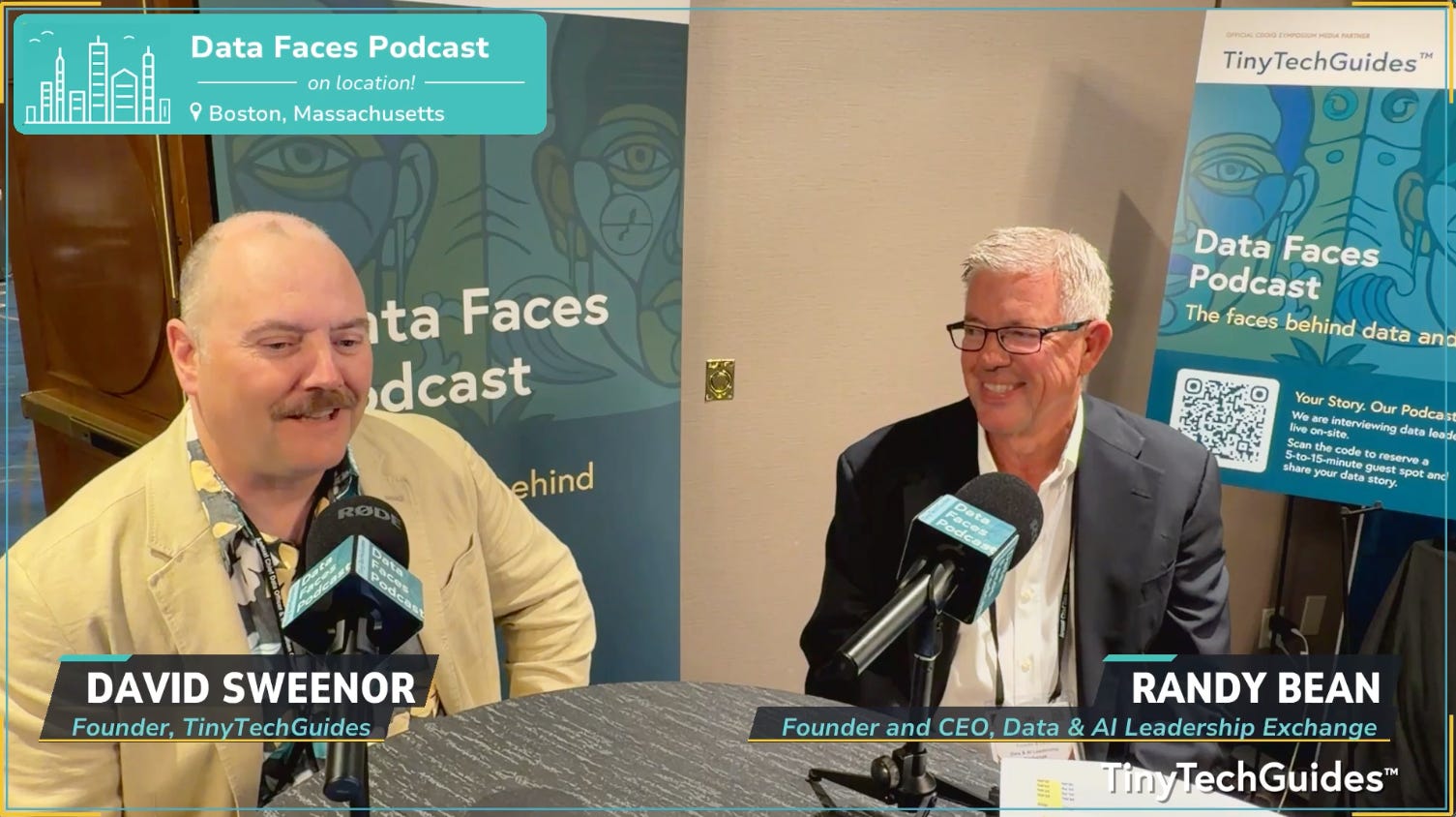
Randy Bean has been asked where the data function should sit for 45 years, and he has an answer that makes technology leaders wince. Put the chief data officer under the chief sales officer. He tells it as a joke on stage, and the audience usually reacts the way you just did, but the reasoning underneath it is serious. The chief sales officer owns revenue and customer responsibility, and in Randy’s view, those two things are the whole reason a data function exists.
I caught up with Randy on location at the CDOIQ Symposium in Cambridge, Massachusetts, a few hours after he moderated the chief data officer panel that he has organized for the event for 12 years running.[1] He was a guest on the show back in January, when we talked about why culture eats AI for breakfast, so this was a mid-year check on the role he has watched longer than almost anyone. A few of his lines from this conversation made it into my field notes on the CDO role at 20 years, and this is the fuller version.
“If you’re not getting measurable business value or have a clear path to measurable business value from your data and AI investments, I suggest you go back to the office this afternoon and shut them down.”
— Randy Bean, Founder and CEO, Data & AI Leadership Exchange
Companies are asking the same questions that they asked when he started his career, and he means that as an observation rather than a complaint. So, why is the reporting-line debate still unresolved after two decades of chief data officers? I think it’s because the debate is really about what the function is for, and Randy has an unusually clear answer.
About Randy Bean
Randy Bean is the founder and CEO of the Data & AI Leadership Exchange and one of the longest-serving chroniclers of the chief data officer role. He founded the consultancy NewVantage Partners, wrote Fail Fast, Learn Faster: Lessons in Data-Driven Leadership in an Age of Disruption, Big Data, and AI, and publishes the annual AI & Data Leadership Executive Benchmark Survey, now in its 15th year.[2][3] He has organized the CDOIQ Symposium’s chief data officer panel for 12 years, which gives him a front-row view of how the job has changed.
He was trained as a COBOL and assembler programmer, and he told me that he wanted to be a poet or a rock star before he found that he was more interested in data and how organizations could use it to make better decisions. Four and a half decades later, that interest is still what he does for a living.
In this episode, Randy and I discuss:
- The business-value test that he uses to provoke data leaders, and what to do if your investments fail it
- Why technology transformations only get serious when an organization has an existential reason to change
- Where chief data officers actually report today, and why he argues for the business side anyway
- Why every chief data officer from last year’s CDOIQ panel will be out of the role by the end of this year
- His mid-year read on the AI bubble, overestimated in the short term and underestimated in the long term
Watch the full conversation here:
The same questions, 45 years later
I asked Randy for a letter grade on the industry’s data quality, since we have been talking about it for as long as I have been in the business. He declined to grade it, and the reason is instructive. You can spend all the time in the world on data quality, but the only measure that he cares about is the business value that investments in data, analytics, and AI deliver. That’s why he tells organizations to shut down anything without measurable value or a clear path to it, and he admits that he says it partly to provoke a conversation.
The value question has only gotten more pointed since AI arrived. This year’s panel featured chief data officers from Lowe’s, Ford, and Humana, and Randy traced the role’s arc from a defensive mandate built on risk, regulation, and compliance toward an offensive, business-focused one. Then AI showed up over the past four years and changed more than the focus. It changed how organizations structure data management as an asset and where AI fits in that picture. Plenty of data leaders have a value story for their AI work. How many could defend it if the CFO asked them to shut down everything that couldn’t?
Transformation waits for an existential reason
When I asked whether companies are using AI for productivity or to reinvent their business, Randy said they are all over the place, then explained why most stay there. Technology transformations take time because they involve organizational change, people change, and changes to roles and processes. During the pandemic, the chief digital officer of the nation’s largest insurer told him that the company had done more to execute on its digital transformation in six months than in the previous 20 years.
“It’s often not until there’s an existential requirement to do something that organizations really fundamentally undergo the transformation that they need to do. Otherwise, it’s experimentation, lip service, carving off pieces that are low-hanging fruit.”
— Randy Bean, Founder and CEO, Data & AI Leadership Exchange
I recognized all three from my own career. Experimentation looks like progress on a slide, lip service satisfies the leadership offsite, and low-hanging fruit produces a case study that never scales. None of them touches how the company operates. Randy’s point is that AI should be an occasion to reinvent the business from top to bottom, and that most companies won’t do it until something forces them to.
Where the CDO reports, and where Randy would put it
Randy asks about the reporting line in his benchmark survey every year, and this year’s numbers are a three-way split. Thirty-three percent of chief data officers report into business leadership, 42 percent report into technology leadership, and another 23 percent report somewhere else entirely.[4] Technology is the plurality, and it isn’t where he would put the job.
“The closer you are to the end business and the end customer, the more value you can deliver when the day’s done.”
— Randy Bean, Founder and CEO, Data & AI Leadership Exchange
He argues that technology, data, and every function like them exist to serve the business and its customers, and if they don’t improve the customer experience, then why are they there? He carefully adds that technology leaders can be business leaders, so this isn’t a swipe at CIOs. It’s a claim about proximity, and it’s where the chief sales officer joke comes from.
That joke has a backstory. As a young programmer, Randy listened to his colleagues complain that the business people could never articulate their requirements, until he finally told them to stop, because the business people were the reason any of them had a job. I sat on the IT side of that conversation for the first half of my career, and the complaint was just as common at IBM in 1999 as it was for him in the early 1980s. My own reason for agreeing with Randy is a little different. IT is built to be risk-averse, with processes and controls that make sense for systems of record, and models, analytics, and AI don’t work that way. They fail, and a failed model should be a normal part of the process, not an incident. The business side can tolerate that, and IT is structurally set up to treat it as a problem.
A role being rewritten in real time
Last year’s CDOIQ panel included Teresa Heitsenrether, the chief data and analytics officer at JPMorgan Chase, and Randy held her up as a model for what the role can be. She sat on the bank’s operating committee, reporting to Jamie Dimon, which put data and AI at the top table of the largest bank in the country. She is retiring at the end of this year, and her responsibilities will move back under the technology organization.[5] Randy’s larger point was about the panel as a whole. A year ago, he had four chief data officers on stage, and by the end of this year, none of them will be in those roles. Three have already gone.
“There’s a battle, a fight going on to control AI and shape the AI future of organizations, and data is a component of that. I think the next year to two years will be very interesting, and I think the role could look very different in a way that I don’t really imagine right now.”
— Randy Bean, Founder and CEO, Data & AI Leadership Exchange
When we spoke in January, Randy was advocating for the combined chief data and AI officer role, and I wanted to know how that debate had moved in six months. He said things are changing in real time, and he declined to predict where the role will end up. That restraint is notable coming from someone who has watched the job for 12 years of panels. When the person with the longest view says that he can’t picture the role two years out, the safe assumption for anyone in the seat is that the job description is being written by whoever wins the fight over AI.
Overestimated now, underestimated later
I closed with the question that everyone asks at conferences this year. Is there an AI bubble? Randy answers that AI is real and inevitable, but its expectations and valuations are overinflated. He sums it all up in one line. AI is overestimated in the short term and underestimated in the long term. Its transformational effect on society, on jobs, and on how the world operates will exceed what most people can imagine today.
I told him my own version of the short-term half. The promised 100x productivity mostly looks like work being moved around: someone hands you AI-generated content to review, and the labor ends up on your desk rather than theirs. Randy agreed that the productivity story has been more personal than corporate so far, and then he widened the lens. Technology is a tool, and every transformational technology in history has been disruptive in positive and negative ways. He sees enormous upside in health care and human longevity, and real harm in kids glued to AI and phones. He was candid that after a movie like Oppenheimer, the jury is still out on whether the benefits of a technology this powerful outweigh the downside.
If you take one thing from Randy’s 45 years, take the test, not the joke. Everything in your data and AI portfolio should have measurable business value or a clear path to it, and the reporting line that gets you closest to the customer is the one most likely to keep it that way.
Listen to the full conversation with Randy Bean on his Data Faces Podcast episode page.
Based on insights from Randy Bean, Founder and CEO of the Data & AI Leadership Exchange, featured on the Data Faces Podcast.
Podcast highlights
- [0:07] David welcomes Randy Bean back to Data Faces, on location at the CDOIQ Symposium in Cambridge, Massachusetts
- [0:50] Randy on wanting to be a poet or a rock star, and 45 years of caring about the data instead
- [2:07] Randy on 12 years of CDOIQ panels, this year’s Lowe’s, Ford, and Humana lineup, and the role’s move from defensive to offensive
- [3:47] The business-value test, and why he tells data leaders to shut down what doesn’t deliver
- [4:57] Why transformation waits for an existential requirement, and the insurer that did 20 years of work in six months
- [6:33] Panels from A to Z, and Teresa Heitsenrether on JPMorgan’s operating committee
- [7:50] The survey split, 33 percent business, 42 percent technology, and 23 percent elsewhere, and why Randy argues for the business
- [9:21] The chief sales officer joke, and the young programmer who told his colleagues to stop blaming the business
- [10:56] Every chief data officer from last year’s panel will be gone by year end, and the fight to control AI
- [12:07] Overestimated in the short term, underestimated in the long term
- [13:21] Health care, human longevity, kids and phones, and the Oppenheimer question
About David Sweenor
David Sweenor is the founder of TinyTechGuides and host of the Data Faces Podcast. He is an international speaker, advisor, and the author of eleven books on artificial intelligence, analytics, and B2B marketing, including Generative AI Business Applications, The CIO’s Guide to Adopting Generative AI, and Modern B2B Marketing. With more than twenty-five years in analytics and AI at companies including Alteryx, Tableau, TIBCO, SAS, IBM, and Dell, David advises technology companies on product marketing, content strategy, and go-to-market execution. He holds several patents and has been named a top influencer in data and analytics by Onalytica, Thinkers360, and Analytics Insight.
Connect with David on LinkedIn and subscribe to the Data Faces Podcast for conversations with the people shaping enterprise data and AI.
Footnotes
[1]CDOIQ Symposium. “The 20th Annual CDOIQ Symposium.” July 21–23, 2026, Hyatt Regency Cambridge, Massachusetts.
https://2026cdoiq.org/
[2]Bean, Randy. Fail Fast, Learn Faster: Lessons in Data-Driven Leadership in an Age of Disruption, Big Data, and AI. Wiley, 2021. https://www.wiley.com/Fail+Fast%2C+Learn+Faster%3A+Lessons+in+Data-Driven+Leadership+in+an+Age+of+Disruption%2C+Big+Data%2C+and+AI-p-00310033
[3]Data & AI Leadership Exchange. “2026 AI & Data Leadership Executive Benchmark Survey.” https://www.dataaiex.com/leadership
[4]Data & AI Leadership Exchange. “2026 AI & Data Leadership Executive Benchmark Survey.” https://www.dataaiex.com/leadership
[5]Bloomberg. “JPMorgan AI Chief, Longtime Top Trader Exits After Four Decades.” July 1, 2026. https://www.bloomberg.com/news/articles/2026-07-01/jpmorgan-ai-chief-longtime-top-trader-exits-after-four-decades


