

Listen now on YouTube | Spotify | Apple Podcasts | Amazon Music
Kate Strachnyi has a habit of calling people out on LinkedIn. When she spots a post that’s been run through an AI rewriter, she’ll send the person a direct message. “Hey, I could tell you used AI,” she’ll say. The usual response is some version of “but these are my thoughts,” and her advice back is to keep them that way and stop running them through the machine. She calls that keeping your content “non-GMO,” unmodified, and authentic.
It’s a funny line, and it also describes her entire business model. Kate is the founder of DATAcated, a media company that partners with brands in data, analytics, and AI to reach their audiences through real content creators and thought leaders. In a market where AI-generated posts are flooding every feed, and ironically, LinkedIn itself has a “rewrite with AI” button baked into the platform, Kate is making the opposite bet. She’s building a business around real people with real expertise and real opinions.
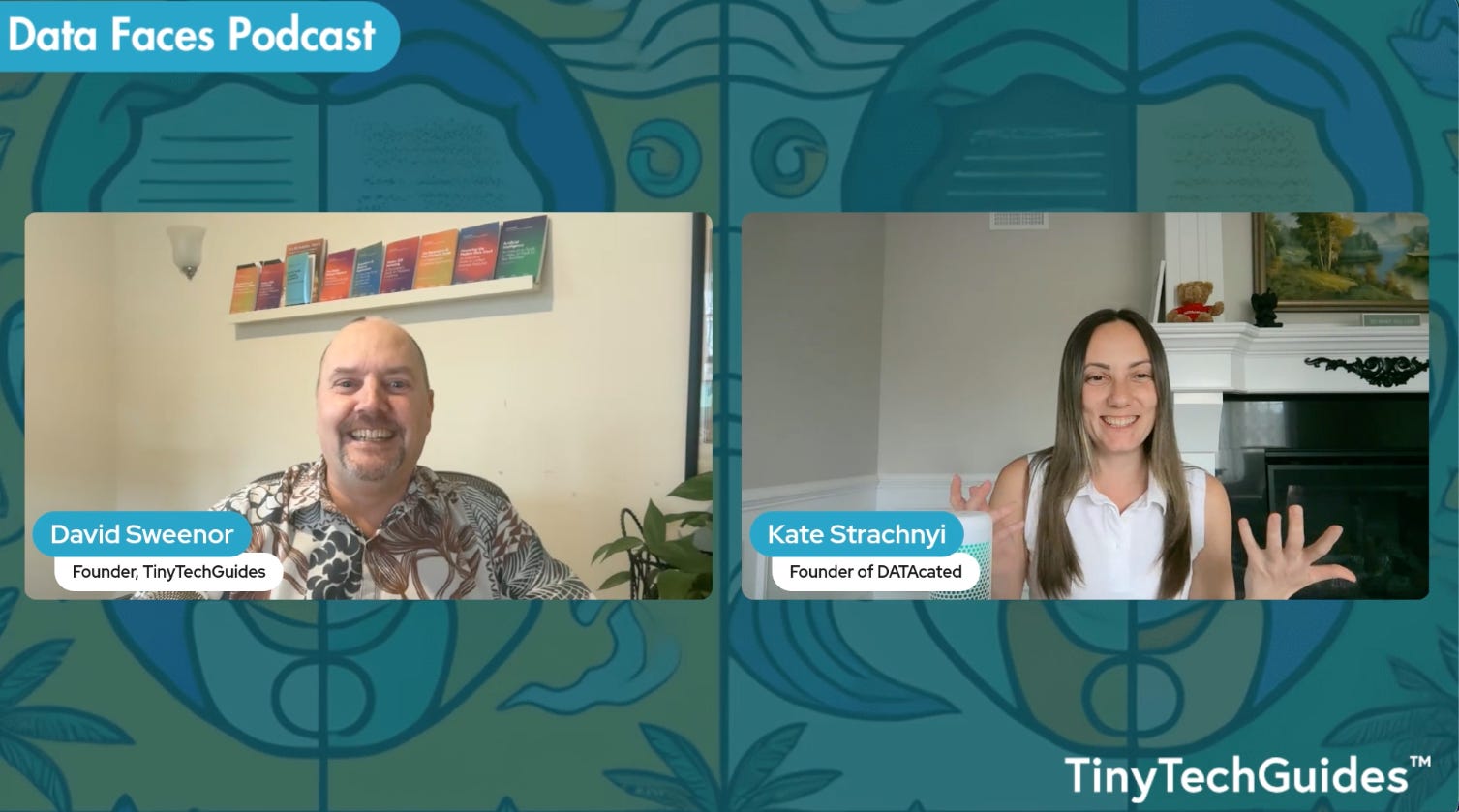
On Episode 38 of the Data Faces Podcast, I sat down with Kate to talk about how she built DATAcated from a one-person experiment into an influencer agency with 40+ creators, why she’s doubling down on authenticity as AI content takes over, and what happens to expertise itself when the humans who hold it stop doing the work.
“Keep it non-GMO. Don’t modify your content, just leave it as is.”
— Kate Strachnyi, Founder, DATAcated
About Kate Strachnyi
Kate Strachnyi is the founder of DATAcated. She started her career in finance and risk management consulting before pivoting to data visualization 12 years ago. Kate has since written five books, established one of the most connected networks of data and AI professionals in the industry, and built DATAcated into a full agency, with 40+ influencers, speakers, and subject-matter experts through her DATAcated Plus program. She is a LinkedIn Top Voice. In our conversation on Episode 38 of the Data Faces Podcast, we discuss:
- How Kate followed the revenue data from courses and books to a focused media business
- The DATAcated Plus model and how influencer campaigns work behind the scenes
- Why she’s shifting from “Kate = DATAcated” to an agency brand
- The flood of AI-generated content on LinkedIn and her “non-GMO” content philosophy
- What happens to expertise when today’s subject matter experts retire and AI fills the void
Following the data from finance to media
Kate’s path to running a media company started with a practical constraint. She was working in financial services risk management at a large consulting firm, traveling Monday through Thursday, and expecting her first child. She spent eight months searching for any role that would let her work remotely, well before remote work was mainstream. Someone eventually pointed her toward a data role that involved Tableau, visualization, and “creating pretty pictures.” She took it and fell in love with data storytelling.
“I am a data person, right? So I would look at the numbers and see what is driving more revenue and what is allowing me to have more time to myself.”
— Kate Strachnyi, Founder, DATAcated
What followed was a period of deliberate experimentation. Kate wrote books and launched an academy. She created courses, ran her own conferences, and built a community called DATAcated Circle. As a business of one with nobody to stop her, she could try anything, and she tracked the results. The revenue data and the work she enjoyed most both pointed to media and content creation. That’s where DATAcated lives today.
Building DATAcated Plus — from personal brand to influencer agency
When Kate started getting more client work than she could handle, she brought in the content creators she already knew. DATAcated Plus was born.
The program now spans data, analytics, and AI, with the agentic AI space growing fastest. When a client comes to Kate with a product launch, an event, or a brand awareness campaign, she matches them with creators based on their audience, expertise, and the success metrics the client is targeting. She reviews every piece of content before it goes to the client for approval. The day-to-day project management runs underneath, with UTM links, calls to action, and timelines coordinated across every moving piece. None of the work is glamorous, but it’s what keeps the whole operation running.
The DATAcated Plus roster also includes speakers and experts that companies can hire for keynotes and panels, as well as webinars and thought leadership papers. Kate has placed people across major industry events, including multiple years at the Gartner Data & Analytics Summit, where her team creates what she calls “FOMO-inducing content” on-site.
Scott Taylor, the Data Whisperer, joined Kate at last year’s Gartner event to co-lead a sold-out breakfast session on personal branding for data leaders. One question from the audience: “I want to post, but my company said no.” Kate’s advice was to follow your company’s rules but find the leeway. Talk about your perspective on industry topics rather than your specific projects or tools. When there’s no leeway at all, I suggested it might be time to find a company that sees your personal brand as an asset rather than a risk.
At Big Data London, a group of DATAcated Plus creators went to a tattoo parlor and got fake data tattoos for a video so convincing that Kate’s neighbors congratulated her on the new ink.
“People will unfollow instantly if we just keep promoting things. It’s more of letting my audience know about here’s a product that exists, and here’s what it does, in case you need it.”
— Kate Strachnyi, Founder, DATAcated
That creative range is what separates the DATAcated model from a traditional analyst engagement. Analyst firms produce authoritative research with independent evaluations, and content creators bring flexibility, personality, and a wider range of formats from short-form video to live event coverage.[1] Kate’s crew has done cooking shows to explain data governance and built sandcastles to illustrate strong data foundations. The content sticks with audiences, and brands gain reach from creators who have built genuine trust over years of showing up with their own voices.
More recently, Kate has changed how she positions the company itself. The old DATAcated media kit led with a big photo of Kate and a rundown of what she could do. The new version leads with the influencer roster. She’s deliberately moving from “Kate equals DATAcated” to an agency brand that doesn’t depend on her being in every room. Some clients still ask for Kate specifically, and she’s learning to redirect them toward creators who are a better fit. “It’s nice to be wanted,” she told me, “but it doesn’t scale.”
The authenticity bet in an AI-saturated feed
Kate is leaning harder into genuine human voices at the exact moment AI-generated content is flooding LinkedIn and every other platform. LinkedIn added a “rewrite with AI” button to the post editor, while its own users complain that AI-generated slop is taking over their feeds. Kate’s view is that if you know a person well enough, you can spot AI-written content immediately. The vocabulary is off, the phrasing is too polished, and the voice sounds like everyone else’s. She calls people out on it, and she expects the same standard from her DATAcated Plus creators. For Kate, authentic content means it was written by the credited human, reflects their expertise and opinions, and hasn’t been reprocessed through an AI rewriter.
That doesn’t mean she’s anti-AI. Kate recently spent an entire day automating her invoicing process in Claude Code. The task itself takes two minutes, but she never has to do it by hand again. She and I compared notes about automating YouTube uploads, scheduling content, and eliminating the repetitive copy-paste work that eats up a solopreneur’s day. She draws the line between back-office operations and audience-facing content. AI can handle the invoices. It should not rewrite your LinkedIn posts.
“What are we going to do 20 years from now, when we don’t have those subject matter experts? They’re retired or not working anymore. Because if you don’t work with this stuff, whatever that might be in the medical field, in construction, how are you going to fact-check it?”
— Kate Strachnyi, Founder, DATAcated
Part of our discussion focused on a question Kate had heard at a recent event. Right now, subject matter experts can look at AI-generated output and spot what’s wrong because they’ve spent decades doing the work firsthand. But what happens in 20 years, when those experts have retired? If the next generation learns from AI output instead of from direct experience, the ability to verify and correct that output disappears.
The humans who make genuine content valuable are also the humans who keep AI honest. Kate sees her business as part of the answer. Invest in real experts now, amplify their voices, and make sure the knowledge doesn’t evaporate into a feedback loop of machine-generated content. The window to establish yourself as a real authority, someone whose voice carries weight because it’s grounded in lived experience, won’t stay open forever.
I started the Data Faces Podcast to have real conversations with the people doing the work. The messy, honest, sometimes funny exchanges that you can only get from humans who have opinions and aren’t afraid to share them. Kate’s business is built on the same conviction. In a world filling up with synthetic content, she’s betting that real voices will only become more valuable. When I asked her about deepfakes and AI versions of herself, her answer was four words.
“I plan to remain authentic.”
— Kate Strachnyi, Founder, DATAcated
Listen to the full conversation with Kate Strachnyi on the Data Faces Podcast.
Based on insights from Kate Strachnyi, Founder at DATAcated, featured on the Data Faces Podcast.
Frequently asked questions
What is DATAcated, and what does the company do?
DATAcated is a media company founded by Kate Strachnyi, author of five books, including ColorWise and Journey to Data Scientist, that helps brands in data, analytics, and AI reach their target audiences through authentic content creators and thought leaders. The company runs the DATAcated Plus program, a roster of 40+ influencers, speakers, and subject-matter experts who create thought-leadership content, amplify product launches, and represent brands at industry events such as the Gartner Data & Analytics Summit. DATAcated operates as an agency that matches creators to client campaigns based on audience fit and success metrics.
What is the DATAcated Plus program?
DATAcated Plus is Kate Strachnyi’s influencer and speaker program for the data and AI industry. It includes content creators, speakers, and subject matter experts across data analytics, AI, and agentic AI. Companies hire DATAcated Plus members for brand awareness campaigns, event coverage, webinars, thought leadership papers, and on-site content creation. Kate manages the program by vetting creators for authenticity, reviewing all content before client approval, and coordinating timelines and deliverables across campaigns.
How does influencer marketing differ from analyst relations in B2B tech?
Analyst firms like Gartner and Forrester produce authoritative research and independent evaluations. Influencer content creators offer more creative flexibility and can be guided toward specific messaging for a campaign. Kate Strachnyi’s DATAcated Plus creators have done cooking shows to explain data governance and built sandcastles to illustrate data foundations. They’ve also produced viral video content at industry events. Both approaches build credibility with B2B audiences, and many companies now use influencers and analysts together at the same events.
What does “non-GMO content” mean in the context of AI and social media?
“Non-GMO content” is Kate Strachnyi’s phrase for content that hasn’t been run through an AI rewriter. Just as non-GMO food is unmodified, non-GMO content preserves the author’s original voice and phrasing. Kate advocates for this approach because AI-rewritten posts lose the personality and authenticity that make content creators valuable to their audiences. She actively calls out AI-washed posts on LinkedIn and holds her DATAcated Plus creators to the same standard.
Will AI replace subject matter experts in data and AI content?
Kate Strachnyi raises a concern about long-term expertise. Today’s subject matter experts can spot errors in AI-generated content because they have decades of hands-on experience. In 20 years, when those experts have retired, the ability to fact-check and verify AI output may disappear if the next generation learns from AI-generated content rather than direct experience. Kate’s business model is built around investing in real human experts now and amplifying their voices before that institutional knowledge erodes.
Podcast highlights
[0:05] Kate’s background and what DATAcated does
[2:10] Pre-finance Kate: what she wanted to be before data found her
[3:05] The career pivot from risk management consulting to data visualization
[5:03] How DATAcated evolved from training and books to a focused media company
[7:27] How the influencer model works behind the scenes
[9:33] Automating business operations with Claude Code
[11:01] Walking the line between brand amplification and spam
[14:11] The fake tattoo story from Big Data London
[15:03] How DATAcated Plus compares to analyst firm engagements
[17:14] The sold-out personal branding session at Gartner with Scott Taylor
[22:15] Shifting from “Kate = DATAcated” to an agency brand
[24:02] What works on LinkedIn now vs. five years ago
[27:01] AI-generated content flooding feeds and the “non-GMO” philosophy
[29:04] The 20-year question: who fact-checks AI when the experts retire?
[30:20] Deep fake Dave and why Kate plans to remain authentic
[31:24] Why Kate hasn’t hired a team and is betting on AI for operations
[33:57] Does AI make you more productive or just busier?
[36:19] Where to find Kate and DATAcated
About David Sweenor
David Sweenor is the founder and host of the Data Faces podcast, where he talks with the people who are making data, analytics, AI, and marketing work in the real world. He is also the founder of TinyTechGuides and a recognized top 25 analytics thought leader and international speaker who specializes in practical business applications of artificial intelligence and advanced analytics.
With over 25 years of hands-on experience implementing AI and analytics solutions, David has supported organizations including Alation, Alteryx, TIBCO, SAS, IBM, Dell, and Quest. His work spans marketing leadership, analytics implementation, and specialized expertise in AI, machine learning, data science, IoT, and business intelligence. David holds several patents and consistently delivers insights that bridge technical capabilities with business value.
Books
- Artificial Intelligence: An Executive Guide to Make AI Work for Your Business
- Generative AI Business Applications: An Executive Guide with Real-Life Examples and Case Studies
- The Generative AI Practitioner’s Guide: How to Apply LLM Patterns for Enterprise Applications
- The CIO’s Guide to Adopting Generative AI: Five Keys to Success
- Modern B2B Marketing: A Practitioner’s Guide to Marketing Excellence
- The PMM’s Prompt Playbook: Mastering Generative AI for B2B Marketing Success
Follow David on Twitter @DavidSweenor and connect with him on LinkedIn.
[1]Sweenor, David. “Stop Writing AI Content That Sounds Like Everyone Else’s.” TinyTechGuides, February 7, 2025. https://insights.tinytechguides.com/p/stop-writing-ai-content-that-sounds


