

Listen now on YouTube | Spotify | Apple Podcasts | Amazon Music
Data leaders have been pitching “data quality” to executives for decades. For just as long, executives have nodded politely, approved a fraction of the requested budget, and moved on to whatever initiative sounds more exciting. Gartner estimates that poor data quality costs the average enterprise $12.9 to $15 million per year, yet data leaders still struggle to connect that cost to the language executives actually use.[1]
“I can boil my entire data philosophy down to those three words: truth before meaning. You got to determine the truth in your data before you derive any kind of meaning out of it. It’s not chicken or egg here. This is egg and omelet.”
— Scott Taylor, Founder, MetaMeta Consulting
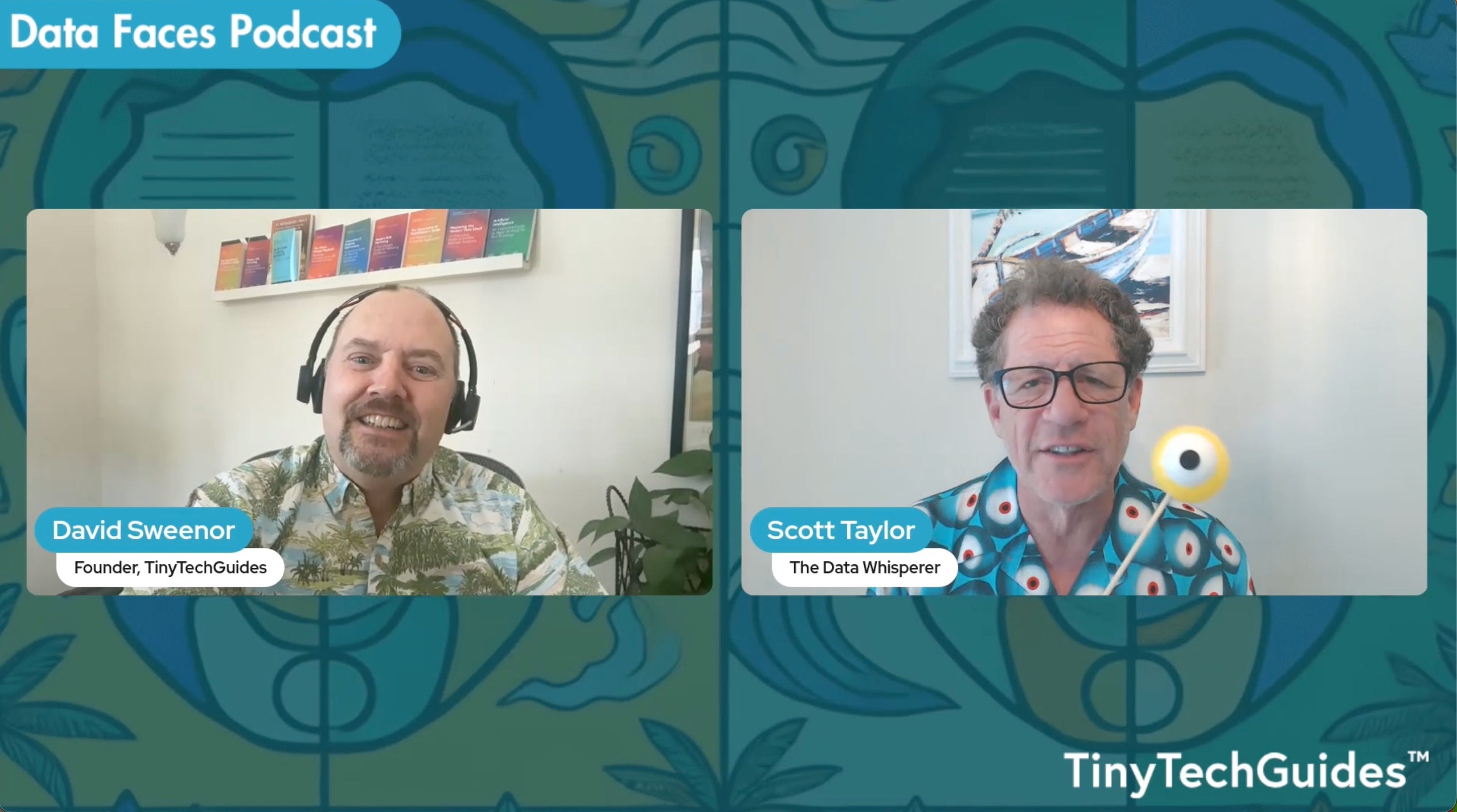
On Episode 34 of the Data Faces Podcast, I sat down with Scott Taylor to talk about why data management keeps getting sidelined and what data leaders can do about it. Scott has spent 30 years in the data space and now runs MetaMeta Consulting, where he helps organizations craft business-accessible narratives about data management. His central argument is that you have to establish truth in your data before you try to derive any meaning from it. Getting there requires storytelling, a skill that most data practitioners were never trained in.
About Scott Taylor
Scott Taylor is the founder of MetaMeta Consulting and is known across the data industry as “the Data Whisperer.” He has spent 30 years in the data space, including 25 years in corporate roles before becoming a full-time content creator, speaker, and consultant. Scott is also the creator of Data Puppets, a satirical puppet series that uses humor to expose common enterprise data problems, and the author of Telling Your Data Story. In our conversation on Episode 34 of the Data Faces Podcast, we discuss:
- Why “truth before meaning” is the foundational principle for every data initiative
- How data leaders can craft a one-sentence pitch that resonates with a skeptical CFO
- The 3V framework for data storytelling: Vocabulary, Voice, and Vision
- Why the vendor landscape at Gartner D&A looked “horrifyingly consistent”
- How Data Puppets uses satire to expose organizational dysfunction that executives resist hearing directly
Truth before meaning: egg and omelet, not chicken and egg
Every major trend in the data space follows the same cycle. A new technology arrives with enormous promise; organizations rush to adopt it; and at some point, someone in the room realizes that none of it works unless the underlying data is in good shape. Scott has watched this play out with big data, data mesh, data fabric, and now agentic AI over three decades. He frames the challenge with a phrase he has distilled into the fewest possible words: truth before meaning.
The “truth” part refers to the foundational work that most organizations know they need to do but struggle to prioritize: master data, reference data, metadata, MDM, data governance, and all the structural activities that ensure your data is curated, trusted, and fit for purpose. The “meaning” part is everything that gets the budget and the boardroom attention, from BI dashboards and AI models to analytics platforms and the latest agentic AI initiative.
Organizations consistently skip truth and jump straight to meaning. They invest in AI without verifying that their customer master is reliable. They build analytics on hierarchical structures that don’t hold up across departments.[2] Research from IBM and MIT Sloan Management Review suggests that companies lose 15 to 25 percent of revenue because of poor data quality, and that cost only grows as organizations scale their AI investments without fixing the underlying data.[3]
Scott illustrates the point with a supermarket example. Every time you take a product off a shelf and scan it at the register, that beep is a confirmation of truth. The system knows exactly what that product is, how it’s priced, and how it’s tracked. The challenge for enterprises is building that same level of confidence across hundreds of systems and millions of records.
“If the pitch that we need better data quality worked, then I wouldn’t be on your show, because people would be doing it. It would have been done. It wouldn’t be something that we’re still talking about.”
— Scott Taylor, Founder, MetaMeta Consulting
Why data leaders lose the room (and how storytelling wins it back)
I spent the first half of my career as a data practitioner and the second half in product marketing, so I’ve seen this from both sides. Data professionals are trained in hard skills, and nobody starts their data career with a course on how to pitch metadata management to a CFO. Marketing and sales teams learn to tell stories because their results depend on it, but data leaders tend to explain the mechanics first, walking into a meeting to describe the technical approach and losing their audience before they ever get to the business case.
“Data people love to get technical. They love to explain how it’s going to get done. And you just lose the business folks right away. A CEO, if you want money from them, they don’t care how it’s done until they understand why it’s important to the organization.”
— Scott Taylor, Founder, MetaMeta Consulting
Scott advises flipping the sequence. Every business leader has stated goals around growth, market expansion, customer experience, or operational efficiency. The data opportunities are already embedded in those objectives. If you listen to what your business leaders say they want to accomplish, you will find where the discipline fits. Their conversations focus on customers, brands, and markets, and all of those have a data element to them.
The 3V framework: Vocabulary, Voice, and Vision
Scott structures his advice around a framework he calls the 3V of data storytelling for data management. Most data practitioners already know the 3V of big data, and the parallel is deliberate.
Vocabulary. Get the words right. The language you use to describe data management to a CFO should be different from the language you use with your data engineering team. Terms like “master data management” and “reference data governance” mean nothing to someone whose primary concern is revenue growth or margin improvement. Scott recommends using words like strength, structure, and foundation rather than quality, because quality can feel subjective and emotional, almost like a complaint when what you need is a business case.
Voice. Everyone involved in making the case for data management needs to tell a consistent story. If the data team, the IT team, and the business analysts are all framing the problem differently, the message gets diluted before it reaches the people who control the budget. Scott calls this harmonizing to a common voice across the organization.
Vision. Connect every data activity to the strategic intentions of the enterprise. The pitch becomes impossible to ignore when you frame data investment as the enabler of business outcomes the leadership team has already committed to achieving.
“You’ve got to connect those dots between why we need metadata management in the context layer to the CEO’s initiative of expanding to new markets and becoming better partners with our customers.”
— Scott Taylor, Founder, MetaMeta Consulting
AI is not the Ozempic for data governance
At the Gartner D&A Summit in Orlando, Scott and I both noticed the same thing on the show floor. The vendor messaging was, in Scott’s words, “horrifyingly consistent.” Nearly every booth was leading with agentic AI, AI-native architecture, and context layers. Scott’s tongue-in-cheek response was classic Scott. As people posted about vendor after vendor emphasizing “context,” he started commenting on their posts with the same line: “context is the new oil.”
This hype cycle mania repeats every few years, from data mesh and data fabric three years ago to big data before that, and the cycle always ends with organizations realizing the new thing doesn’t work without solid data management underneath it.[4] Scott’s colleague Malcolm Hawker coined a name for it: the “semantic pedantic cycle.”
The way Scott sees it, the belief that AI will solve the data management problem on its own is the latest version of this thinking. He calls this “AI is the Ozempic for data governance,” a line that got plenty of laughs at Gartner and in our bonus Data Puppets segment. AI can assist with certain data management tasks, and the organizational discipline of establishing truth in your data before deriving meaning from it still requires human leadership and commitment.
Data Puppets: using satire to say what executives need to hear
Think of it as Dilbert for the data world, except with puppets. The cast includes the CDO (Chief Dog Officer), his sidekick ITB who speaks exclusively in buzzwords, and a “Cat Sultant” from Meow-kinsey whose primary initiative is to generate more billing. Just as Scott Adams captured the absurdity of corporate life in ways that employees pinned to their cubicle walls, Scott Taylor captures the absurdity of enterprise data management in ways that data teams share in their Slack channels.
What started as a collection of data jokes has turned into a communication tool that Scott didn’t anticipate. People use the episodes in internal presentations to illustrate how the data team sounds to the business side. A Chief Dog Officer can say things that would come off as harsh from a human consultant, and people laugh first and then recognize the pattern in their own organization.
In the bonus Data Puppets segment at the end of our recording, Scott introduced A-Eye, a puppet character who attended the Gartner D&A Summit and had opinions about everything. When asked about data quality, A-Eye’s response captured an attitude that data leaders encounter constantly: “They’ve been whining about data quality ever since there was data. If it was that important, it would have been solved by now.”
“The number one reaction I got was, ‘this is just like my organization.’ People were really taking it seriously. They were like, ‘I showed this to my team to show this is how we sound to the business side.’”
— Scott Taylor, Founder, MetaMeta Consulting
Next steps
Scott’s approach offers a practical starting point for data leaders who are struggling to get executive support for foundational data work. The investment is in changing the conversation, which costs nothing beyond the willingness to rethink how you communicate.
- Craft your one-sentence pitch. Distill why data management matters to your organization into the fewest possible words. Frame it as a business statement that connects to what leadership has already said they want to accomplish, because a technical explanation won’t land. If you can’t say it in one sentence, you haven’t refined it enough.
- Audit your storytelling sequence. Are you leading with how (the technical approach) or why (the business impact)? If your presentations start with architecture diagrams and technology stacks, consider flipping the order. Open with the business objective, show how data enables it, and save the technical details for the appendix.
- Apply the 3V framework. Review the vocabulary you’re using with executive stakeholders. Swap subjective terms like “data quality” for structural language like “data foundation” and “data trust.” Align your team to a common voice so the message doesn’t fragment across departments. Make sure every data initiative you propose connects to the organization’s stated strategic vision.
Listen to the full conversation with Scott Taylor on the Data Faces Podcast.
Based on insights from Scott Taylor, Founder at MetaMeta Consulting, featured on the Data Faces Podcast.
Frequently asked questions
What does “truth before meaning” mean in data management?
Truth before meaning is the principle that organizations must establish trustworthy, well-governed foundational data before attempting to derive business insights from it. The “truth” layer includes master data, reference data, metadata, and data governance. The “meaning” layer includes BI, analytics, AI, and everything that interprets data for business decisions. Scott Taylor argues that skipping the truth layer is the primary reason AI and analytics initiatives underperform. Gartner estimates that poor data quality costs the average enterprise $12.9 to $15 million per year.
What is the 3V framework for data storytelling?
The 3V framework is Scott Taylor’s approach to helping data leaders communicate with executive stakeholders. It stands for Vocabulary (choosing business language over technical jargon), Voice (aligning the entire data organization around a consistent narrative), and Vision (connecting every data initiative to the company’s strategic objectives). The framework is designed to shift data management conversations from technical how-to discussions to business-impact narratives that resonate with CFOs and CEOs.
Why do data leaders struggle to get executive buy-in for data management?
Data leaders are trained in hard skills and tend to lead presentations with technical approaches rather than business outcomes. Executives in marketing, sales, and the C-suite are better storytellers by training and practice. When data leaders explain master data management architecture before explaining how it connects to revenue growth or market expansion, they lose their audience. Scott Taylor recommends flipping the sequence and leading with why the work matters to the business before explaining how it gets done.
Can AI fix data quality problems on its own?
No. Scott Taylor calls the belief that AI can solve data management problems without organizational discipline “AI is the Ozempic for data governance.” While AI can assist with specific data management tasks, it cannot replace the foundational work of establishing trusted master data, standard hierarchies, and consistent taxonomies. Research from IBM and MIT Sloan Management Review suggests companies lose 15 to 25 percent of revenue from poor data quality, and that cost scales as AI investments grow without addressing the underlying data.
What are Data Puppets, and why do they matter for data management?
Data Puppets is a satirical puppet series created by Scott Taylor that uses humor to expose common enterprise data dysfunction. Characters include the CDO (Chief Dog Officer), a buzzword-fluent sidekick named ITB, and a consultant from “Meow-kinsey.” The series works as a communication tool because satire creates a layer of separation that lets audiences absorb uncomfortable truths about their own organizations. People use the episodes in internal presentations to illustrate how data teams sound to business stakeholders.
Podcast highlights
[0:06] Scott’s background as the Data Whisperer and 30 years in the data space
[3:59] Truth before meaning: Scott’s entire data philosophy in three words
[6:04] Why data truth isn’t philosophical, and the supermarket scanner example
[7:56] The importance of storytelling and why data practitioners aren’t trained in it
[10:27] Has AI changed the conversation about data management, or is it the same cycle?
[13:08] How vendors performed at the Gartner D&A Summit in Orlando
[16:27] “Context is the new oil” and the semantic pedantic cycle
[19:54] Crafting a one-sentence data management story for a skeptical CFO
[22:59] The 3V framework: Vocabulary, Voice, and Vision
[25:37] Data Puppets: how satire reveals organizational dysfunction
[31:48] Why humor helps executives hear truths they’d otherwise dismiss
[34:24] Where to find Scott Taylor and the Data Puppets
Bonus: Data Puppets segment — A-Eye attends the Gartner D&A Summit
About David Sweenor
David Sweenor is the founder and host of the Data Faces podcast, where he talks with the people who are making data, analytics, AI, and marketing work in the real world. He is also the founder of TinyTechGuides and a recognized top 25 analytics thought leader and international speaker who specializes in practical business applications of artificial intelligence and advanced analytics.
With over 25 years of hands-on experience implementing AI and analytics solutions, David has supported organizations including Alation, Alteryx, TIBCO, SAS, IBM, Dell, and Quest. His work spans marketing leadership, analytics implementation, and specialized expertise in AI, machine learning, data science, IoT, and business intelligence. David holds several patents and consistently delivers insights that bridge technical capabilities with business value.
Books
- Artificial Intelligence: An Executive Guide to Make AI Work for Your Business
- Generative AI Business Applications: An Executive Guide with Real-Life Examples and Case Studies
- The Generative AI Practitioner’s Guide: How to Apply LLM Patterns for Enterprise Applications
- The CIO’s Guide to Adopting Generative AI: Five Keys to Success
- Modern B2B Marketing: A Practitioner’s Guide to Marketing Excellence
- The PMM’s Prompt Playbook: Mastering Generative AI for B2B Marketing Success
Follow David on Twitter @DavidSweenor and connect with him on LinkedIn.
[1]Gartner. “How to Improve Your Data Quality.” Gartner, 2021. https://www.gartner.com/smarterwithgartner/how-to-improve-your-data-quality.
[2]David Sweenor. “AI in 2025: Why 90% of Gen AI Projects Will Fail.” TinyTechGuides, March 22, 2025.
https://insights.tinytechguides.com/p/ai-in-2025-why-90-of-gen-ai-projects
[3]IBM. “The True Cost of Poor Data Quality.” IBM Think, 2024. https://www.ibm.com/think/insights/cost-of-poor-data-quality.
[4]David Sweenor. “AI in 2025: Why 90% of Gen AI Projects Will Fail.” TinyTechGuides, March 22, 2025.
https://insights.tinytechguides.com/p/ai-in-2025-why-90-of-gen-ai-projects
.


