

Listen now on YouTube | Spotify | Apple Podcasts | Amazon Music
The data, analytics, and AI industry is currently obsessed with production velocity. Every vendor is promising that their AI agents can automate workflows, draft emails, order your groceries, and analyze your pipeline in seconds. It sounds great on paper, but when push comes to shove, there’s certainly room for improvement. In my work with clients who are building custom agents, they have some serious concerns and reservations about agentic AI, which are certainly justified. While the agents are fast and dutifully execute tasks assigned to them, they are often confidently wrong more often than not. This occurs because your AI likely has a data-context problem, and context serves as the anchor for accuracy, which agents often lack. This disconnect is reflected in recent research from MIT (2025), which found that 95% of enterprise AI projects fail to deliver measurable P&L impact, often due to a failure to integrate the model with actual business context and workflows.[1]
When a human being looks at a flawed quarterly business review (QBR) report, they can often spot errors immediately. They understand the business and know that a merger happened last quarter, and that the currency conversion for the EMEA region is manual, and that the “Total Revenue” field excludes services. They understand the relationships between the data and the business outcomes.
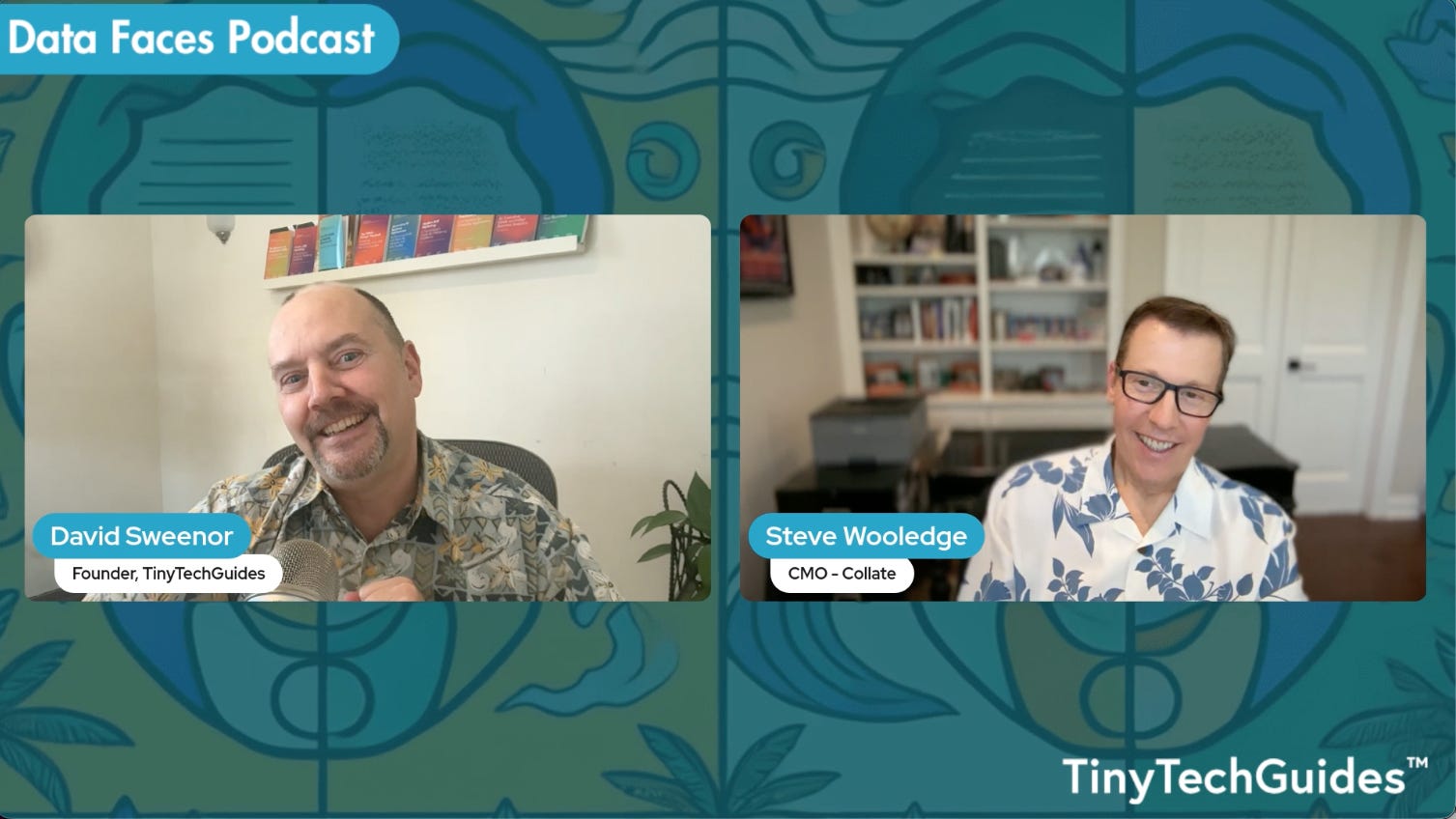
AI agents lack this baseline intuition. Without a rich layer of metadata to provide this context, an agent operates as a fast guesser. Sometimes it’s no better than the predictive text capability on my iPhone, which I must admit, is not that great. I recently sat down with Steve Wooledge, CMO at Collate, on the Data Faces Podcast. Steve has spent 20+ years in the datasphere, from Teradata and SAP to leadership roles at Alteryx and Alation. He has seen the hype cycles move from big data to generative AI, and he believes we have reached a shift in how we manage data. To move from experimental AI to reliable, agentic operations, we must treat metadata as the foundational instruction manual for machine intelligence.
About Steve Wooledge
Steve Wooledge is the Chief Marketing Officer at Collate, the company behind the OpenMetadata project. His career spans over 25 years in enterprise sales and marketing leadership at industry giants, including Teradata, SAP, and Business Objects. Steve is a recognized expert in technical product marketing and category creation, having previously built global partner programs at Alteryx and led product marketing at Alation. Outside of the data industry, Steve is a dedicated guitar player with a passion for melodic hard rock and blues.
In our conversation on the Data Faces Podcast, we discuss several hot topics for the agentic era. These include the transition from chemical engineering to product marketing leadership and how to build a “Switzerland” strategy for metadata across multi-vendor ecosystems. We also explore the shift from Data Intelligence to Semantic Intelligence for AI agents and the “Taste Squared” formula for maintaining marketing quality in an automated world.
The evolution of metadata. From inventory to foundation
Metadata spent twenty years as the ignored part of the primordial data stack and remained the least interesting part of the infrastructure. It served as a technical inventory, used to confirm that a specific column was an integer or that a timestamp used a specific format. It served as a technical necessity for database administrators but rarely provided direct, observable business value.
In our conversation, Steve identified three distinct stages in the move toward semantic intelligence. The “Technical Inventory” stage used metadata as a governance checkbox. This evolved into “Data Intelligence,” which is a term popularized by Stewart Bond and companies like Alation that expanded the definition to include the “who, what, where, when, and why” of data.[2] This stage moved beyond the technical schema to include the operational context of how people used the information.
We are now entering the “Agentic” stage. In this era, metadata is a tool for machines as much as for people. Steve explained that while metadata describes your data, for AI to be accurate and intelligent, it needs that foundational context to prevent hallucinations. If you want an AI agent to pull a report or automate a task, the system must understand the rules and relationships that govern that data. This foundation transforms an automated guesser into an intelligent system.
Semantics. giving AI a “gut feel”
The separation of data from meaning creates the core challenge in modern AI architectures. A human analyst looking at a database sees a column named rev_adj and intuitively understands it refers to a manual revenue adjustment. AI agents require an explicit map to reach that same conclusion. Steve describes this map as “Semantic Intelligence,” which is a framework that provides the digital equivalent of a “gut feel.”
“Semantics is the overall structure and meaning. It includes the relationships between different data elements so an agent can traverse the graph to get at the reason and meaning.”
— Steve Wooledge, CMO, Collate
Technical metadata describes the storage, including the columns, types, and primary keys. Semantic metadata tells you about the intent, such as business rules, KPI definitions, and ontologies. When these relationships are mapped in a graph, an agent can traverse those connections to reason through a query. It can understand that a “Customer” in the CRM is the same entity as a “Subscriber” in the billing system, even if the underlying schemas look different.
By traversing this semantic graph, an AI agent can self-correct. It can recognize when a requested calculation violates a business rule or when a data point lacks the necessary context to be included in a final report. This architectural clarity allows an automated system to operate reliably in a complex enterprise environment. Without this layer, AI projects often get stuck because the models lack the fundamental ability to reason through data dependencies.
The Switzerland strategy. Why AI needs a neutral layer
Enterprise data is inherently messy. Even the most disciplined organizations suffer from fragmented ecosystems, with critical information scattered across Snowflake, Databricks, legacy on-premises databases, and SaaS applications. Each of these platforms offers its own proprietary version of metadata management, and this creates a series of disconnected silos. If your AI strategy relies on the metadata layer of a single platform, you are building on a foundation that cannot see the full picture.
This fragmentation necessitates what Steve calls a “Neutral Layer.” He argues that AI agents require a “Switzerland” strategy: an agnostic metadata layer that sits between the various data silos and the AI models. This neutral layer provides a consistent view of the business logic regardless of where the data lives. It ensures that when an agent asks for “last month’s churn rate,” the definition remains identical whether the data is pulled from a cloud warehouse or a regional database.
“There is no neutral layer that sits across all of that. You need to have this agnostic layer of metadata and semantic intelligence that sits between the data and the AI to ensure you understand the meaning of the information.”
— Steve Wooledge, CMO, Collate
Adopting an agnostic approach also provides a hedge against future architectural changes. As companies undergo mergers, acquisitions, or switch vendors, a proprietary metadata strategy elevates risk and becomes a liability. By using open standards like OpenMetadata, organizations can preserve their semantic intelligence as their underlying infrastructure evolves. Steve’s view is that this neutral layer is the primary way to ensure that your business rules remain portable and your AI remains accurate as you scale across multiple platforms.
Marketing the abstract. Lessons from a first-principles CMO
Marketing a technical product requires a unique level of architectural clarity. If you cannot map the relationships between your data elements, you will struggle to map your message to the specific problems your customers face. Steve credits much of his approach to his time at Business Objects, working under Dave Kellogg, who is a veteran leader who preached the power of first principles. This philosophy dictates that marketing exists to reduce friction in the sales process by grounding every message in clarity and logical sequence.
When you sell an abstract concept like a “metadata platform,” you cannot lead with features. A CFO or CEO rarely wakes up thinking about their cataloging needs. Instead, you must sell the business outcomes that metadata enables, such as AI safety, operational velocity, and what we call consequence management. By visualizing the invisible through semantic metadata graphs, marketers can make these complex technical structures tangible for executive budget owners.
This first-principles approach also fuels grassroots expansion through open-source communities. By allowing developers to solve immediate technical problems using tools like OpenMetadata, a company can build a foundation of trust before moving toward an enterprise-wide engagement. Steve’s experience at Alation and Alteryx confirms that when you give people the tools to prove value in their own environment, the transition to a strategic partnership becomes a logical next step.
The “taste squared” era of marketing
Velocity without judgment is just noise. The integration of AI into marketing workflows has fundamentally changed the expectations for production velocity. We can now develop content, campaigns, and landing pages at a pace that was previously impossible. However, this increased speed introduces a risk that Steve calls “lazy marketing.” While AI can generate high volumes of content, it often lacks the subtlety and judgment required to connect with a specific customer base.
To address this challenge, Steve references a formula popularized by Tom Wentworth[3], where marketing output equals AI adoption multiplied by taste squared. This perspective suggests that while adopting AI is a linear requirement for modern teams, human taste acts as an exponential multiplier for quality. Having the technical skill to use a prompt is one thing, and having the taste to know when a message is great, and when it is “average AI,” is what will differentiate the leaders from the laggards.
Maintaining this level of quality requires a commitment to the human element of marketing. In our conversation, Steve emphasized that you still have to “slave over the word” to ensure your message correctly lands. This means using AI as a tool for acceleration rather than a replacement for thinking. By combining automated velocity with rigorous peer review and high creative standards, marketing leaders can use AI to amplify their impact without sacrificing brand integrity.
The infrastructure of trust
Building an AI strategy without a solid metadata foundation is like attempting to build a penthouse on a swamp. The agents you deploy will only be as intelligent as the context you provide them. By adopting a neutral, semantic metadata layer, organizations can equip their AI systems with the digital intuition needed to move beyond simple automation and toward autonomous operations.
Metadata is the primary architectural anchor of the agentic era, supporting both governance and agentic AI. To learn more about how to build this foundation for your own organization, you can listen to the full conversation with Steve Wooledge on the Data Faces Podcast and explore the open-source community at OpenMetadata.
Listen to the full conversation with Steve Wooledge on the Data Faces Podcast.
Based on insights from Steve Wooledge, CMO at Collate, featured on the Data Faces Podcast.
Frequently asked questions
What is the difference between metadata and semantics? Metadata describes the technical properties of data, such as column names, data types, and timestamps. It acts as a technical inventory of information. Semantics represents the overall structure, meaning, and relationships between those data elements. While metadata tells an AI agent what a field is, semantic intelligence tells the agent how that field relates to business rules and KPIs across the enterprise.
Why do AI agents need a neutral metadata layer? Most organizations store data across fragmented ecosystems like Snowflake and Databricks. Each platform manages metadata in its own proprietary way. A neutral metadata layer sits between these silos and the AI models, providing a consistent, agnostic view of business logic. This strategy ensures that an agent’s understanding of the data remains accurate even if the underlying infrastructure changes.
How does semantic intelligence prevent AI hallucinations? AI hallucinations often occur because the model lacks the necessary context to interpret data correctly. Semantic intelligence provides a mapped graph of relationships that allows an AI agent to reason through a query like a human analyst. By traversing this graph, the agent can identify when a requested calculation violates a business rule or when it lacks the context required for an accurate response.
What is the taste squared formula for marketing? CMO Tom Wentworth introduced the formula. Marketing output equals AI adoption multiplied by taste squared. It suggests that while AI adoption is a linear requirement for productivity, human taste is an exponential multiplier for quality. In an era where anyone can use AI to generate average content, the differentiator for marketing leaders is the judgment required to refine AI output into something resonant.
Podcast highlights
[0:00] Introduction to Steve Wooledge and Collate
[1:08] The journey from chemical engineering to technical data sales
[3:45] Melodic hard rock and guitar shredding as a creative outlet
[5:01] Lessons from Dave Kellogg on first-principles marketing
[7:40] The reality of partner marketing with global system integrators
[10:18] Why open-source projects out-innovates proprietary enterprise software
[15:56] The shift from technical metadata to semantic intelligence for AI agents
[20:45] Building a Switzerland approach to metadata across multi-vendor silos
[24:03] How AI velocity is fundamentally changing the CMO role
[27:23] The taste squared formula and why you cannot be a lazy marketer
[32:19] Career advice for the next generation of data and marketing professionals
[36:28] Final advice on peer review and maintain quality control
About David Sweenor
David Sweenor is the founder and host of the Data Faces podcast, where he talks with the people who are making data, analytics, AI, and marketing work in the real world. He is also the founder of TinyTechGuides and a recognized top 25 analytics thought leader and international speaker who specializes in practical business applications of artificial intelligence and advanced analytics.
With over 25 years of hands-on experience implementing AI and analytics solutions, David has supported organizations including Alation, Alteryx, TIBCO, SAS, IBM, Dell, and Quest. His work spans marketing leadership, analytics implementation, and specialized expertise in AI, machine learning, data science, IoT, and business intelligence. David holds several patents and consistently delivers insights that bridge technical capabilities with business value.
Books
Artificial Intelligence: An Executive Guide to Make AI Work for Your Business
Generative AI Business Applications: An Executive Guide with Real-Life Examples and Case Studies
The Generative AI Practitioner’s Guide: How to Apply LLM Patterns for Enterprise Applications
The CIO’s Guide to Adopting Generative AI: Five Keys to Success
Modern B2B Marketing: A Practitioner’s Guide to Marketing Excellence
The PMM’s Prompt Playbook: Mastering Generative AI for B2B Marketing Success
Follow David on Twitter @DavidSweenor and connect with him on LinkedIn.
[1]MIT Project NANDA. 2025. “The GenAI Divide: State of AI in Business 2025.” MIT Sloan Management Review.
[2]Bond, Stewart. 2026. “Your AI has a data intelligence problem.” TinyTechGuides.
[3]Wentworth, Tom. 2024. “AI Adoption and the Taste Square.” incident.io.


