

Listen now on YouTube | Spotify | Apple Podcasts | Amazon Music
▶ Watch the full episode and read the transcript: Industry Data Quality Gets a D Plus | Stacie Christensen
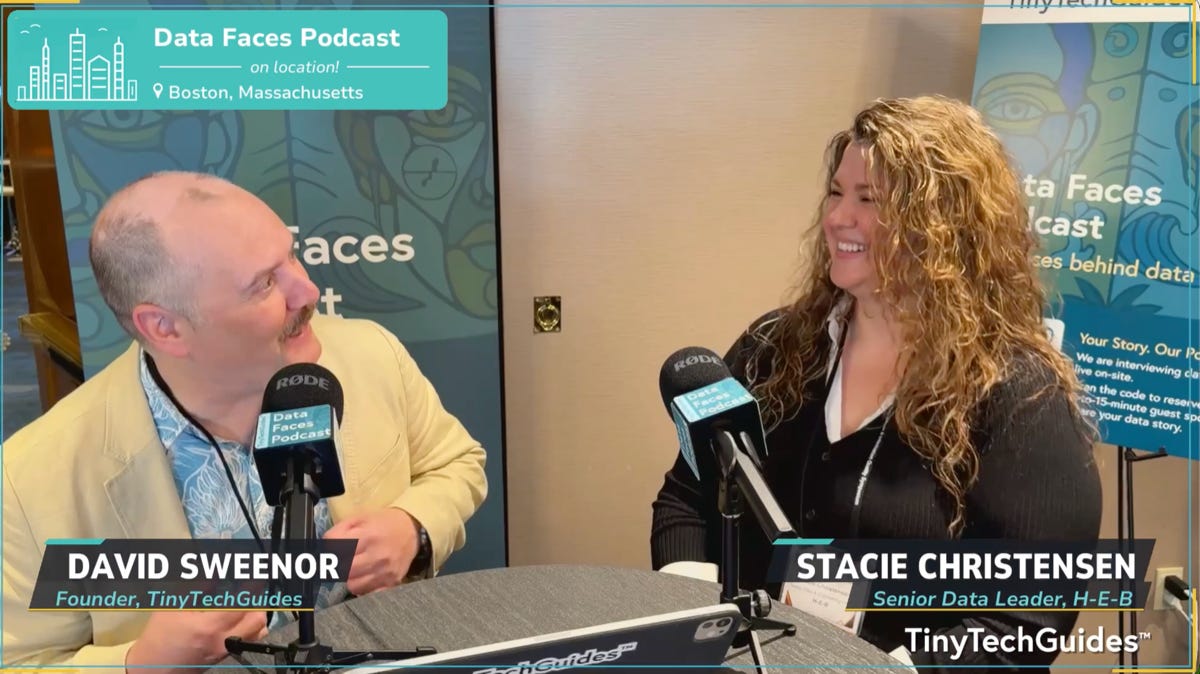
Most stalled data projects get the same postmortem. Something goes amok with the platform, you get lots of “help” to try to fix it, and then the budget is yanked. Unfortunately, the next project fizzles in roughly the same manner. Stacie Christensen has spent 22 years in the data industry watching the vicious cycle repeat, and she built her CDOIQ session around it.
I caught up with Stacie on the third day of the CDOIQ Symposium in Cambridge, Massachusetts, where her talk covered why data initiatives fail, usually long before technology is ever the problem.[1] Technology comes and goes, she told me, and the failures look the same no matter what platform is underneath.
“What usually happens is we have initiatives, and they start struggling, but tech is the first thing that we’re blaming. And it’s usually not what’s actually at fault. What’s at fault is our foundation that’s under that technology.”
— Stacie Christensen, Senior Data Leader, H-E-B
So, if the tool were the problem, why does the same project stall again on the replacement? Stacie’s answer is that the foundation under the tool never changed, and she has a practical way to find out where it’s busted.
About Stacie Christensen
Stacie Christensen is a senior data leader at H-E-B with more than 22 years in the data industry. After an undergraduate degree in computer science and mathematics, she went back for an MBA and is now deep into a doctorate specializing in data. Computer science was her choice because everyone around her called it the hardest class they had ever taken, so she decided to take it, earn an A, and prove them wrong. It turned out to be a wonderful experience, and that’s when she knew technology was her path.
She is also the author of the Data Alignment Framework, a three-book series. Built on Data came out in May, Built on Simplicity came out without an announcement the week before CDOIQ, and Built on Alignment is due this fall.[2][3] You can find more of her work at dataisnotpersonal.com.
In this episode, Stacie and I discuss:
- Why initiatives that struggle get blamed on technology first, and what is usually at fault instead
- The people-owned issues underneath every data foundation, from accountability to governance
- Circular data flows, and why data moving back upstream is a red flag for hidden complexity
- Where governance belongs in a data pipeline, and why the end of it is too late
- How to change a process without making the people who run it resist you
Watch the full conversation here:
The easy button keeps changing names
Why do organizations keep reaching for the tool? Stacie thinks it comes down to wanting an easy button, and she includes herself in that. Technology is the thing we interact with our problems through, so it’s the natural place to point the finger, and a new system feels easier than confronting the amorphous people-owned issues that caused the trouble in the first place. Every project I’ve worked through, from data warehousing to self-service analytics to data catalogs, arrived with the same promise that this platform would be the panacea that would solve world hunger.
Today, the easy button has a new name. I asked Stacie whether we could just AI it and solve all of our ills, fully expecting her to play along. She said no, flatly, and then explained that AI scales whatever foundation you already have, which means it has nothing positive to scale when the foundation is missing. I opened my CDOIQ field notes with that line, because nobody at the event said it more plainly.
The research agrees with her about where the fault usually sits. RAND interviewed 65 experienced data scientists and engineers about why AI projects fail, and it notes that by some estimates, more than 80 percent of them do, twice the rate of IT projects that don’t involve AI.[4] Eighty-four percent of those interviewees named leadership-driven causes, such as optimizing for the wrong business problem, as a primary reason. RAND calls them the most frequent cause of failure. In other words, the technology tends to take the blame because it’s the easiest part of a project to replace.
What “foundation” means in practice
When Stacie says foundation, she means a short list of words that make most people wince: accountability, ownership, alignment, and governance. I tried to summarize that on air as “people are the problem,” and she gently corrected me. She pins the trouble on people-owned issues, which is different, and when I brought my line back up later in the conversation, she was quick to point out that those were my words, not hers.
I think her wording matters, because an issue that someone owns is an issue that someone can fix, and blaming people usually just makes them defensive. The same idea runs through her first book, Built on Data, whose subtitle makes the argument for her: How Discipline Creates Usable Data, Not Technology.[5] She means organizational discipline, the kind of foundational work that keeps governance, data quality, and investment decisions honest.
“It’s the stuff that still needs that human touch that AI cannot come in and answer for us today.”
— Stacie Christensen, Senior Data Leader, H-E-B
Part of that discipline is deciding what data is worth the effort of cleaning up and streamlining. Not every dataset earns that investment, and she says the answer depends on the company, the organization, and the industry. That’s the kind of call that no tool can make on your behalf.
Three questions that expose a foundation problem
Before anyone evaluates a platform, Stacie asks questions that separate a technology problem from a people-owned one, and three of them came up in our conversation. None of them requires a vendor, a budget request, or a steering committee to answer.
Does your data ever flow back upstream?
Circular data flows are the complexity marker Stacie comes back to again and again in her books. A circular data flow happens when data reaches the end of the pipeline, usually analytics and reporting, and someone changes or creates data there and then pushes it back to the top of the pipeline. The consumer does this because the data they received wasn’t what they needed, so they transformed it themselves and now want it back in the warehouse. In Stacie’s view, sending data upstream means something is wrong with the process.
She admits that she gets “a little judgy” when she hunts for complexity, and she thinks you have to. She tests it by asking whether anyone can explain why the loop exists. When the best answer is “we just decided to do this down here,” she treats it as a red flag, and she tackles those outer edge cases before touching the harder work of the pipeline itself.
“Simplicity is probably the most underrated skill in all of technology.”
— Stacie Christensen, Senior Data Leader, H-E-B
That belief is the premise of Built on Simplicity, which covers how to make processes, data flows, and data models simple enough to describe and understand, and from there to govern and scale.[6] It’s also why the question matters more now. Once those flows are handed to AI, a loop that nobody can explain gets scaled right along with everything else.
Where does governance sit in your pipeline?
Stacie has worked at both extremes. One company invested heavily in data governance and had trustworthy data throughout the pipeline. At another, the term was so taboo you didn’t dare say it in a meeting. Her view is that governance belongs at the beginning of the pipeline, at data creation, and at the critical transitions where data is transformed, because bad data becomes exponentially more expensive the further downstream it travels.
She pushes back hardest on governance that lives only at the end, in analytics and reporting, which she considers far too late in the process. She has seen two structures work well, a centralized governance team deployed upstream and distributed ownership broken up by stage, and she’s cautious about calling either one the right answer. She cares most about whether governance exists where the data is created and changed. I covered why governing at creation keeps coming up in my CDOIQ data quality write-up, so I won’t repeat the whole case here.
Are you collecting data nobody uses?
When I pushed Stacie for a letter grade on the industry’s data quality, she eventually settled on somewhere between a D plus and a C minus, and she pinned it on sheer volume. She thinks we gather so much data that most of it never informs the critical business decisions we need to make. It turns into noise, and then it turns into a backlog of cleanup that nobody needs to run the company.
I told her that people are hoarders, especially with data, because they might need it someday. She agreed that the habit also introduces risk. Her advice on unstructured data followed the same logic. Before investing in it, ask what it’s being used for, because some companies have important data sitting unstructured, and others leave it that way because it isn’t worth the investment. Malcolm Hawker made a similar case on the show when he argued that AI-ready data is the wrong question, since readiness depends on the use case in front of you.
Fixing the foundation without a revolt
Once you find the problem, you still have to fix it with the people who own it. As Stacie put it, people hate to be governed, and walking into an organization to announce that its processes look ridiculous is the fastest way to guarantee resistance. Some of those processes will look ridiculous at first, and she thinks it’s important not to approach them that way.
Her method starts with understanding. She spends time with the people who run a process to learn why they do it that way, because there’s always a reason an organization got where it is. Then she partners with them and helps lead them to the conclusion, so they own the decision rather than having it handed to them. She calls herself a go-with-the-flow person, and she’s wary of any one-size-fits-all answer for how a company should function.
I’ve seen plenty of data programs stall because the change arrived as a mandate from the top, and her approach runs the other way. The next time an initiative stalls, ask a people question before you buy anything. Who owns this data, who can explain why it moves the way it does, and who was never asked?
Listen to the full conversation with Stacie Christensen on her Data Faces Podcast episode page.
Based on insights from Stacie Christensen, Senior Data Leader at H-E-B, featured on the Data Faces Podcast.
Podcast highlights
- [0:00] David welcomes Stacie Christensen to Data Faces, on location on day three of the CDOIQ Symposium in Cambridge, Massachusetts
- [0:29] Stacie on 22 years in data, computer science, and math, an MBA, and a doctorate in progress
- [1:23] Why she took the class everyone said was the hardest on campus
- [1:58] Her CDOIQ session, and why technology gets blamed before the foundation underneath it
- [2:49] Accountability, ownership, alignment, and governance, the people-owned issues
- [3:10] Why everyone wants an easy button
- [3:35] “Just AI it,” and why AI scales a foundation rather than fixing it
- [4:01] Built on Data and the Data Alignment Framework series
- [4:35] Organizational discipline, and the work that still needs a human touch
- [5:16] Grading industry data quality, and whether we gather too much data
- [6:50] Unstructured data, and deciding what is worth the investment
- [7:35] Data governance at both extremes
- [8:30] Governance at data creation, and why the end of the pipeline is too late
- [9:51] Centralized or distributed governance teams
- [10:59] Built on Simplicity, and simplicity as the most underrated skill in technology
- [11:40] Circular data flows, and getting “a little judgy” about complexity
- [13:16] Getting people on board by understanding why they do things
- [14:26] Where to find Stacie’s books and her website
Frequently asked questions
Why do data initiatives fail?
Most data initiatives fail because of the foundation under the technology, not the technology itself. Stacie Christensen, a senior data leader at H-E-B with 22 years in the industry, points to people-owned issues such as accountability, ownership, alignment, and governance. Organizations blame the tool first because it is the easiest part to replace. RAND’s 2024 study of AI projects found that 84 percent of the practitioners it interviewed named leadership-driven causes as a primary reason for failure.
What is a circular data flow?
A circular data flow happens when data reaches the end of a pipeline, usually analytics and reporting, and someone changes or creates data there and pushes it back to the top of the pipeline. It usually means the data that consumers received wasn’t what they needed, so they transformed it themselves. Stacie Christensen treats circular data flows as a red flag for hidden complexity, especially when nobody can explain why the loop exists.
Where should data governance sit in a data pipeline?
Data governance works best at data creation and at the critical transitions where data is transformed, according to Stacie Christensen of H-E-B. Bad data becomes exponentially more expensive the further downstream it travels, so governing it before it enters the pipeline prevents the most costly errors. She considers governance that exists only at the end of the pipeline, in analytics and reporting, far too late. Both centralized upstream teams and stage-by-stage ownership can work.
Can AI fix a weak data foundation?
AI does not fix a weak data foundation. Stacie Christensen describes AI as a multiplier and a scaler of the foundation an organization already has, so it has nothing positive to scale when governance, ownership, and data quality are missing. Complexity, such as circular data flows, scales along with everything else once those processes are handed to AI, which is why she recommends simplifying data flows before automating them.
How do you get people to accept data governance?
People resist being governed, so the approach matters as much as the policy. Stacie Christensen recommends taking time to understand why a team runs a process the way it does before changing it, because there is always a reason. Then partner with the people who own the process and lead them to the conclusion, so they own the decision rather than having it imposed on them. She avoids one-size-fits-all answers.
What is the Data Alignment Framework?
The Data Alignment Framework is a three-book series by Stacie Christensen, a senior data leader at H-E-B. Built on Data (May 2026) argues that organizational discipline, not technology, creates usable data. Built on Simplicity (July 2026) covers reducing complexity in processes, data flows, and data models before technology scales it. A third book, Built on Alignment, is planned for fall 2026. More of her work is at dataisnotpersonal.com.
About David Sweenor
David Sweenor is the founder of TinyTechGuides and host of the Data Faces Podcast. He is an international speaker, advisor, and the author of eleven books on artificial intelligence, analytics, and B2B marketing, including Generative AI Business Applications, The CIO’s Guide to Adopting Generative AI, and Modern B2B Marketing. With more than twenty-five years in analytics and AI at companies including Alteryx, Tableau, TIBCO, SAS, IBM, and Dell, David advises technology companies on product marketing, content strategy, and go-to-market execution. He holds several patents and has been named a top influencer in data and analytics by Onalytica, Thinkers360, and Analytics Insight.
Connect with David on LinkedIn and subscribe to the Data Faces Podcast for conversations with the people shaping enterprise data and AI.
Footnotes
[1]CDOIQ Symposium. “The 20th Annual CDOIQ Symposium.” July 21–23, 2026, Hyatt Regency Cambridge, Massachusetts.
https://2026cdoiq.org/
[2]Christensen, Stacie. Built on Data: How Discipline Creates Usable Data, Not Technology. The Data Alignment Framework. Independently published, May 6, 2026. https://www.amazon.com/dp/B0GXCFL5ZH
[3]Christensen, Stacie. Built on Simplicity: Rebuilding Data Systems Without the Complexity. The Data Alignment Framework. Independently published, July 15, 2026. https://www.amazon.com/dp/B0H91663NS
[4]Ryseff, James, Brandon De Bruhl, and Sydne J. Newberry. “The Root Causes of Failure for Artificial Intelligence Projects and How They Can Succeed: Avoiding the Anti-Patterns of AI.” RAND Corporation, August 13, 2024. https://www.rand.org/pubs/research_reports/RRA2680-1.html
[5]Christensen, Stacie. Built on Data: How Discipline Creates Usable Data, Not Technology. The Data Alignment Framework. Independently published, May 6, 2026. https://www.amazon.com/dp/B0GXCFL5ZH
[6]Christensen, Stacie. Built on Simplicity: Rebuilding Data Systems Without the Complexity. The Data Alignment Framework. Independently published, July 15, 2026. https://www.amazon.com/dp/B0H91663N


