

Listen now on YouTube | Spotify | Apple Podcasts | Amazon Music
▶ Watch the full episode and read the transcript: Matt Hayes on trust and freedom in enterprise AI
I have spent 25+ years around data software, first as a practitioner building predictive models, data warehouses, and analytics reports, and later in product marketing, exclusively for data, analytics, and AI companies. In every one of those roles, a similar pitch kept recurring. Get your data ready. For most of that time, ready meant ready for a dashboard, where a person could look at the report, catch the number that seemed off, and fix it before it did any harm. That safety net is disappearing. Once an AI agent acts on the data instead of a person, no one is there to spot the error and correct it.
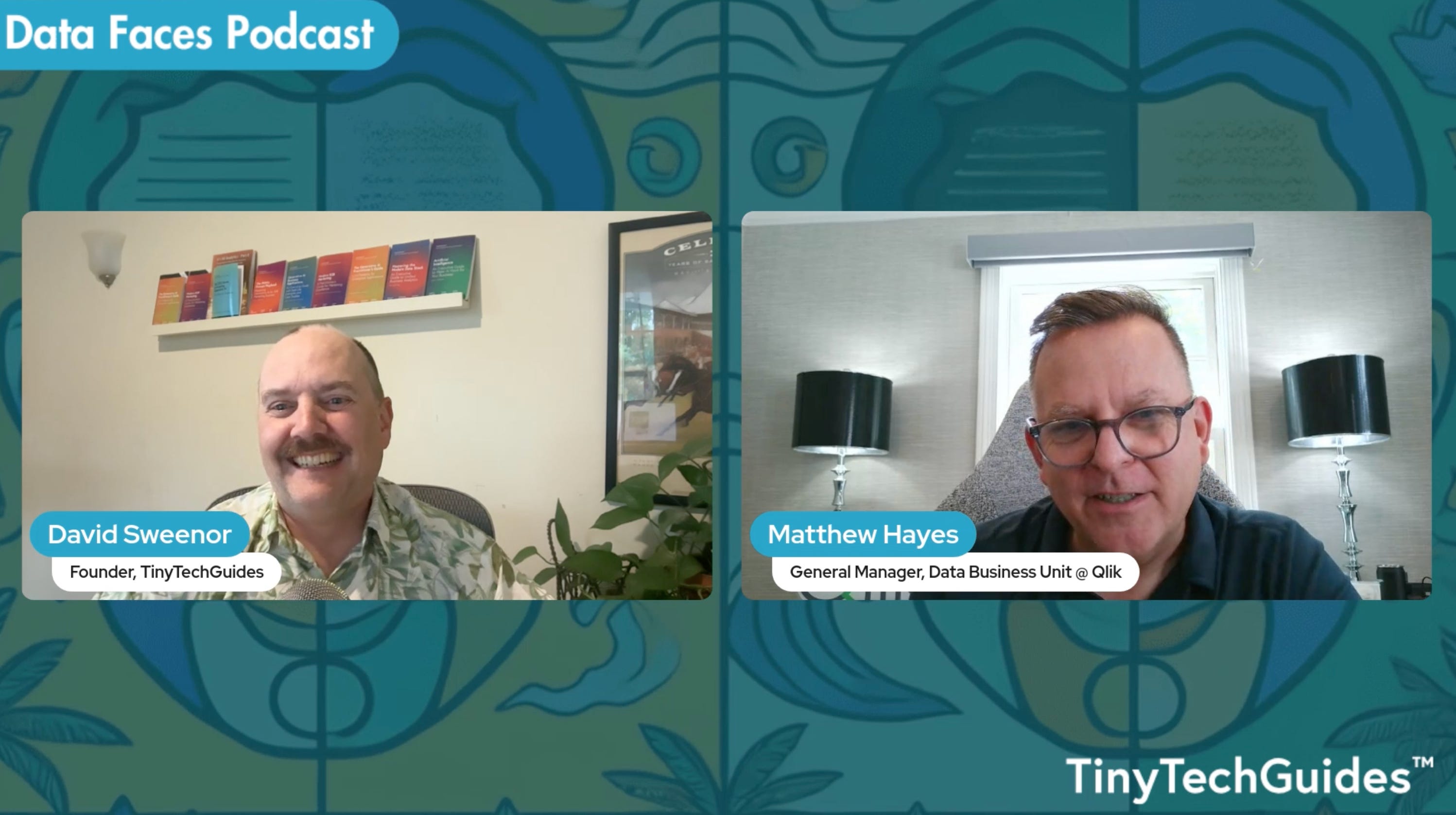
Matt Hayes joined me on the Data Faces Podcast to dig into the difference between getting data ready for analytics versus AI. As General Manager of Qlik’s Data Business Unit, he owns the data layer underneath everything the analytics side touches, from ingestion and transformation to the open lakehouse below it. His argument is that getting data ready for AI is a much higher bar than getting it ready for analytics.
“A human will look at an analytics application and say, wait a minute, this doesn’t add up. An agent will just assume the data is all good and move forward.”
— Matt Hayes, General Manager, Data Business Unit, Qlik
Most data leaders already accept that trust is what decides whether enterprise AI scales or stalls out. Brendan Grady, EVP and General Manager of Analytics and AI at Qlik, made that case from the decision side in an earlier Data Faces conversation, so we won’t repeat ourselves here. The discipline that makes enterprise AI trustworthy turns out to be the same discipline that keeps it affordable, and Matt has one word for it. Freedom.
About Matt Hayes
Matt Hayes is the General Manager of the Data Business Unit at Qlik, where he leads product management, product marketing, and engineering across the company’s data integration, transformation, and open lakehouse portfolio. He came to Qlik through its acquisition of Attunity and previously ran Qlik’s SAP business and strategy. He has worked in and around SAP since 1998, starting as a basis consultant and later building Gold Client, a test data management product for SAP environments. Outside of work he is a private pilot who flies a Piper Archer and a Saratoga out of the Chicago area, and he will tell you there is something special about breaking through a gray Chicago cloud layer into blue sky while eight million people below are stuck under it.
In this episode, Matt and I discuss:
- Why data that was fine feeding a dashboard can break the moment an agent acts on it
- The difference between analytics-ready and AI-ready data, and why AI sets the higher bar
- Context, trust, and freedom as operating principles, and why Matt ranks freedom first
- How a customer-defined trust score turns data quality into a signal an agent can act on
- Why the economics of enterprise AI trace back to decisions about where data lives
Watch the full conversation here:
AI-ready is a higher bar than analytics-ready
For years, well before AI took over every roadmap, the goal was to get your data analytics-ready. Now every conversation is about getting it AI-ready. Is there a real difference between the two, or is AI-ready just analytics-ready with a fresh coat of paint?
According to Matt, analytics-ready data is data a person can sanity-check before acting on it, whereas AI-ready data has to clear a higher bar, because that human pause is gone. Hand a business process to an agent, and it takes whatever the data says and runs with it.
So what happens when it goes awry? For example, a customer means to order ten thousand units and fat-fingers the entry as a million. In a world of connected agents, that bad number does not stay put in one field. An agentic workflow reads it as real demand and starts sourcing raw materials from five or ten suppliers. Trucks and ships get loaded with material nobody ordered before a person catches it. Nobody, as Matt said, wants to be a news story.
The trust scores and quality checks that catch that number before an agent acts are exactly what Brendan Grady and I got into on the analytics side. What matters here is the asymmetry. Bad data used to cost you a correction and a hand slap. Once an agent acts on it, bad data costs you whatever the agent already did before anyone noticed.
Context, trust, and freedom
Matt runs his business unit on three principles, context, trust, and freedom. When I asked which matters most, he didn’t flinch. Freedom. He means something very specific by it. Customers should be free to define their own architectures and use their own data however they want, with whatever tools fit the job.
He traces that conviction to his years in the SAP world, and he is careful about how he frames it. SAP is a company he respects, one that does a lot well for its customers. His concern is a pattern that can show up at any large platform vendor as it broadens its scope. Once a vendor possesses your data, it can be tempted to treat that data as a bargaining chip, nudging you toward its own tools because switching gets harder the more you hand over. The real question is who holds the keys to your data kingdom.
“People want to do things with their vendors. They don’t want their vendors to do things to them.”
— Matt Hayes, General Manager, Data Business Unit, Qlik
This is where Matt plants Qlik’s flag. The company does not persist your data, so it has no reason to lock you in. In his telling, freedom is a property of the architecture, something a buyer can check for rather than take on faith.
The data factory and the finished good
Matt thinks about data integration as a manufacturing process. You pull raw material from many sources, combine it with other materials, inspect the quality, and deliver a finished product to the people who need it. The data contract sets the specification, the fields the product must contain and the service levels it has to meet, and the data product is what comes off the line.
“When we look at the data integration business, that’s a manufacturing business. The data product is a finished good of that process.”
— Matt Hayes, General Manager, Data Business Unit, Qlik
I spent my early career in a literal version of this. At IBM I did yield characterization in semiconductor manufacturing, watching dashboards that flagged every tool drifting out of spec, and nearly everything showed up red. There were never enough engineers to chase that many red lights, so people stopped chasing them. A quality signal that flags everything ends up flagging nothing.
That is the trap a trust score has to avoid, and it is why Qlik lets the customer define the trust score. You weight the measures that matter for a use case, things like freshness, completeness, and whether every source is reporting, then set a threshold where an agent pauses rather than act on data that has slipped. Nobody panics at two percent scrap, but past five or ten percent it eats into margins. A trust score points the same logic at data, telling you when the finished product is good enough to ship, the discipline behind Qlik being named a Leader in the 2026 Gartner Magic Quadrant for Augmented Data Quality Solutions.[1]
Freedom is the economics argument
Up to this point the risk has been a wrong decision, an agent acting on a number it should have questioned. A second risk has nothing to do with accuracy. It is the right decision you cannot afford. Matt described the CFO who walks into a project six months in and points out that the experiment everyone is proud of is now burning a million dollars a month. The work is sound, but the bill is not sustainable.
Freedom shows up directly on the budget. If you do not lean into the freedom of your own data, it costs you, in flexibility, in infrastructure, and in the architecture you get boxed into. Storing everything in a proprietary format runs up your storage bill and your switching cost at once, so he points customers toward open formats instead.
Qlik Open Lakehouse is built on Apache Iceberg, an open table format that keeps data queryable by any engine and shrinks the storage footprint instead of trapping it in one vendor’s system.[2] Compute gets the same treatment, since Qlik’s analytics engine does much of its work in memory to hold down cost as workloads grow. On the day we recorded, Qlik shipped agentic data engineering capabilities aimed squarely at this, letting teams describe a pipeline in plain language and stand up trusted, AI-ready data faster.[3]
A vendor that does not hold your data cannot pad your bill to keep you, and an architecture built on open formats can show you the savings instead of promising them. So Matt’s counsel to data leaders is to claim that ground on purpose.
“Lean into that concept of freedom. Take the position with all your vendors that this is our data and we want to do a lot with it.”
— Matt Hayes, General Manager, Data Business Unit, Qlik
A business case that survives the pilot
A lot of AI projects stall after the demo, and Matt doesn’t count that as failure. He compares this moment to 2007, when the iPhone arrived and everyone downloaded the app that turned the screen into a pint of beer or a lighter. It was thrilling and mostly useless, and it was also the start of something real. Enterprise AI is in that phase now, where experimentation is the work rather than a detour from it.
A project dies when cost outruns value before the use case is proven. Expect three, four, or five iterations before a use case earns its keep, and protect the economics while you get there. Gate every agent behind a data product that clears its trust score, so nothing autonomous runs on data you have not vetted. Build on open formats like Iceberg so storage cost and lock-in do not compound. Put the shared terms in a data contract, so the word revenue means the same thing to five departments instead of five different things in the same meeting.
Human oversight belongs in that design, though not as a rubber stamp on every decision. Your job is to decide where a human hand changes the outcome and where it only slows things down. Keeping AI reliable and keeping it affordable look like competing goals. Matt’s whole argument is that they are the same goal, reached by owning your data instead of renting it back from the vendor that holds it.
Listen to the full conversation with Matt Hayes on the Data Faces Podcast.
Based on insights from Matt Hayes, General Manager of the Data Business Unit at Qlik, featured on the Data Faces Podcast.
Podcast highlights
- [0:05] Introduction and welcome to the Data Faces Podcast
- [0:52] Who Matt is and the Qlik data portfolio, from Attunity to open lakehouse
- [1:46] Life outside work: flying a Piper over Chicago
- [3:25] Lessons from the SAP world on why enterprise data is hard to move and trust
- [5:14] Context, trust, and freedom, and the case against vendor lock-in
- [7:41] AI-ready versus analytics-ready data
- [8:11] Why an agent acting on bad data is different from a human reviewing a dashboard
- [11:05] What AI-ready means, and the trust score
- [14:08] Data products as the finished good of a data factory
- [16:31] A supply-chain near-miss and the limits of a human in the loop
- [21:28] Making trust scores meaningful instead of ignored
- [25:36] Where the data side meets the decision side
- [29:09] Context, semantics, and meeting customers where they are
- [31:51] Building an AI business case that survives the pilot
- [36:17] Close
Frequently asked questions
What is AI-ready data?
AI-ready data is data trustworthy enough for an autonomous AI agent to act on without a person checking it first. It clears a higher bar than analytics-ready data because there is no human in the loop to catch a number that looks wrong. Reaching that bar means the quality, governance, and freshness of the underlying data product are strong enough that an agent can read the data, make a decision, and pass that decision downstream without introducing a costly error.
How is AI-ready data different from analytics-ready data?
Analytics-ready data is data a person can sanity-check before acting on it. When a dashboard shows a number that looks off, a human pauses and investigates. AI-ready data removes that pause, because an autonomous agent takes the data at face value and acts on it. As Qlik’s Matt Hayes frames it, the bar is higher for AI because a bad number no longer costs you a quick correction. It costs you whatever the agent already did before anyone noticed.
What is a data trust score?
A data trust score is a customer-defined, weighted measure of whether a data product meets the quality bar for a specific use case, across signals like freshness, completeness, and source availability. Teams set a threshold, and when the score drops below it, the right people are alerted and can take action. The goal is to keep the score meaningful, so it flags what genuinely matters rather than turning everything red and getting ignored.
How does data architecture affect the cost of enterprise AI?
Where your data lives and how it is stored drives much of the cost of enterprise AI. Storing everything in a proprietary format runs up both storage bills and switching costs. Open formats like Apache Iceberg and an open lakehouse shrink the storage footprint and avoid lock-in, while in-memory processing holds down compute. Matt Hayes calls this data freedom, and it is why the discipline that keeps enterprise AI trustworthy is also the discipline that keeps it affordable.
Where should data leaders start when building an AI business case?
Start by expecting several iterations before a use case proves its value, and protect the economics along the way. Gate every AI agent behind a data product that clears its trust score, so nothing autonomous runs on unvetted data. Build on open data formats so storage cost and vendor lock-in do not compound. Define shared business terms in a data contract, so a word like revenue means one thing across departments before an agent ever uses it.
About David Sweenor
David Sweenor is the founder and host of the Data Faces podcast, where he talks with the people who are making data, analytics, AI, and marketing work in the real world. He is also the founder of TinyTechGuides and a recognized top 25 analytics thought leader and international speaker who specializes in practical business applications of artificial intelligence and advanced analytics.
With over 25 years of hands-on experience implementing AI and analytics solutions, David has supported organizations including Alation, Alteryx, TIBCO, SAS, IBM, Dell, and Quest. His work spans marketing leadership, analytics implementation, and specialized expertise in AI, machine learning, data science, IoT, and business intelligence. David holds several patents and consistently delivers insights that bridge technical capabilities with business value.
Books
- Artificial Intelligence: An Executive Guide to Make AI Work for Your Business
- Generative AI Business Applications: An Executive Guide with Real-Life Examples and Case Studies
- The Generative AI Practitioner’s Guide: How to Apply LLM Patterns for Enterprise Applications
- The CIO’s Guide to Adopting Generative AI: Five Keys to Success
- Modern B2B Marketing: A Practitioner’s Guide to Marketing Excellence
- The PMM’s Prompt Playbook: Mastering Generative AI for B2B Marketing Success
Follow David on Twitter @DavidSweenor and connect with him on LinkedIn.
Footnotes
[1]Qlik. “Qlik Named a Leader in the 2026 Gartner Magic Quadrant for Augmented Data Quality Solutions.” Qlik Press Release, February 2026. https://www.qlik.com/us/news/company/press-room/press-releases/qlik-named-a-leader-in-the-2026-gartner-magic-quadrant-for-augmented-data-quality-solutions.
[2]Qlik. “Qlik Open Lakehouse Now Generally Available, Giving Enterprises Rapid, AI-Ready Data on Apache Iceberg.” Qlik Press Release, 2026. https://www.qlik.com/us/news/company/press-room/press-releases/qlik-open-lakehouse-now-generally-available.
[3]Qlik. “Qlik Delivers Agentic Data Engineering in Qlik Cloud to Help Enterprises Build Trusted Data for AI.” Business Wire, June 30, 2026. https://www.businesswire.com/news/home/20260630874468/en/Qlik-Delivers-Agentic-Data-Engineering-in-Qlik-Cloud-to-Help-Enterprises-Build-Trusted-Data-for-AI.


