

Listen now on YouTube | Spotify | Apple Podcasts | Amazon Music
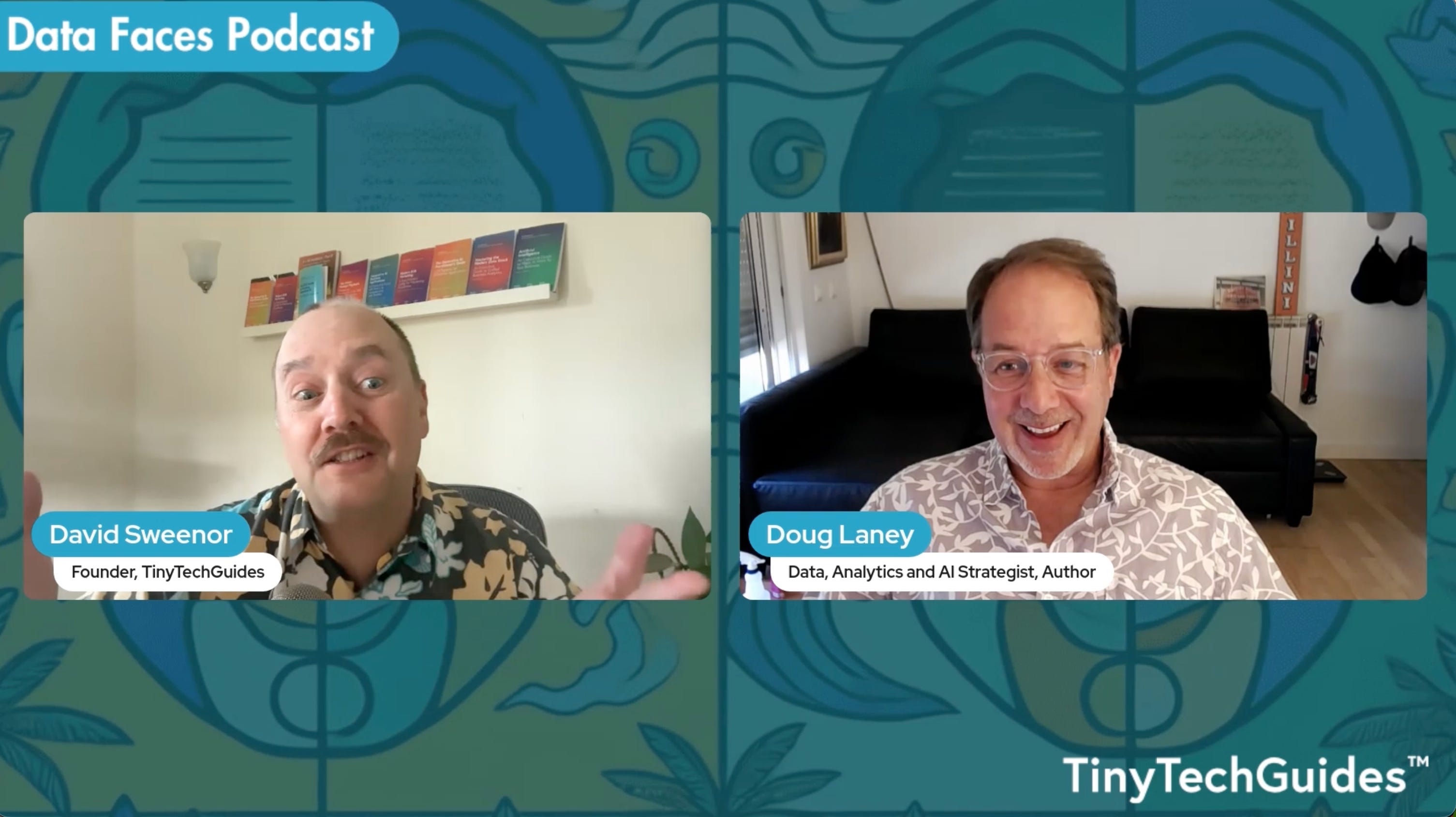
Twenty-five years ago, Doug Laney wrote a short research note at META Group that handed the industry three words it has never let go of. Volume, variety, and velocity. He was describing the strain that new kinds of data were putting on traditional data management, and those three V’s became the working definition of big data for a whole generation. People kept trying to add more V’s to the mix. Doug has fielded pitches for nine V’s, twenty-five V’s, and he has a name for the folks who do that. He calls them wanna-V’s.
So when he came on the Data Faces podcast and named three new V’s for the agentic AI era, I started taking notes—volition, visibility, and viscosity. The original set measured how hard data was to wrangle. This new set measures something thornier, the challenge of giving software the authority to make and act on real decisions on its own.
“The first three Vs were about big data. The next three are probably about big autonomy.”
— Douglas Laney, Innovation Fellow, West Monroe
Almost every executive deck has the same slide on it right now, the one promising that agents will soon run the business with little human oversight and enormous savings to show for it. Press on that promise, though, and most people cannot tell you what “autonomous” really means, or where their own company sits on the road to becoming an agentic business. Doug has spent a career making fuzzy ideas measurable, first with data and now with agents, and the three V’s are where he starts.
About Douglas Laney
Douglas Laney is the Innovation Fellow for Data and Analytics Strategy at West Monroe. In a 2001 META Group note, he named the volume, variety, and velocity that became the 3 V’s of big data, and he later coined the term “infonomics” to describe information as an economic asset you can measure, manage, and monetize.[1] He is the best-selling author of Infonomics and Data Juice, a former Gartner Distinguished Analyst, and he teaches infonomics to MBA and accounting students at the University of Illinois. These days, he runs his three R’s, retirement, relaxation, and reading, from Portugal, though the volume of work he is still putting out suggests the first R has not fully taken.
In this episode, Doug and I discuss:
- The three new V’s of agentic AI: volition, visibility, and viscosity
- His seven levels of autonomy, from a basic chatbot to a business that runs itself
- Why labor savings are the least imaginative way to value an agent
- What it would take for a billion-dollar company to run on a handful of people
- Why the brakes, not the accelerator, decide how fast you can go
Watch the full conversation here:
Three new V’s for big autonomy
Doug’s three new V’s are not a clever relabeling of the old ones. They map to the three things a leader has to get right before letting an agent act on its own. Here they are at a glance.
The three V’s of agentic AI
- Volition: what the agent is permitted to do, and whether it earns more authority as it proves itself.
- Visibility: whether you can inspect an agent’s logic, and whether agents can see what other agents are doing.
- Viscosity: the friction between an agent’s recommendation and the business action that follows.
Volition
Doug’s first question for any agent is about permission. What permissions does it carry, what rights does it have, and how much autonomy should it get on day one? Those are governance questions rather than engineering questions, and most companies have not answered them because they jumped straight to building the thing.
“What does the agent have permission to do? What rights does it have? Should it gain more authority over time as it proves itself?”
— Douglas Laney, Innovation Fellow, West Monroe
Visibility
Can management see inside the black box and inspect the logic behind an agent’s actions, and can that behavior be audited, repeated, and checked for consistency? Doug adds a wrinkle that most people miss. As you move toward swarms of agents working together, the agents need visibility into what the other agents are doing, or the whole arrangement turns into a room full of confident strangers making decisions with no idea what the others just decided.
Viscosity
Doug defines it as the friction between an agent’s recommendation and the actual business action. Friction here is not only technical. It includes change management, corporate culture, plain old fear of job loss, and everything else that slows a recommendation from becoming a decision. Get viscosity wrong in either direction, and you have a real problem, which is exactly where this conversation heads later on.
Taken together, volition, visibility, and viscosity give leaders a vocabulary for the part of agentic AI that the demos skip over. A demo shows you the capability. These three V’s are about control, accountability, and the speed with which an organization can safely absorb its agents’ recommendations.
Automation is not autonomy: the seven levels
To better illustrate this point, Doug uses a self-driving car. A car does not become autonomous because somebody bolts a chatbot onto the dashboard. It needs sensors, maps, perception, planning, controls, and fail-safes for when something goes wrong. He argues that a self-driving business needs that same architecture, translated into enterprise terms, and that most companies have done nothing of the sort. They installed some automated dashboards and started calling them “autonomy”.
“Most companies have installed automated dashboards and call it autonomy. That’s more like cruise control, not self-driving.”
— Douglas Laney, Innovation Fellow, West Monroe
To give people a way to understand where they are on the journey, Doug lays out seven levels of agentic autonomy:
Chatbot: answers questions, summarizes, and drafts text.
Co-pilot: helps a person finish work inside a single app or function.
Task agent: handles bounded work independently.
Workflow agent: plans and runs multi-step processes.
Functional agent: manages an entire business function, such as revenue cycle or procurement, against real goals and constraints.
Cross-functional agents: networks, or swarms, of agents coordinating across functions such as finance and operations.
Self-driving business: agents sense conditions, reallocate resources, and adapt strategy with little or no human involvement.
So, where does the typical company sit? Doug puts most of them between levels two and three, co-piloting and running the occasional task agent. That tracks with what Andreas Welsch described a couple of episodes back, where most enterprise agent work still has a person doing the driving.[2] Doug is working with one consultancy that is building an agentic operating model for its entire consulting function, learning from past proposals to generate new winning ones and speed up delivery. That effort is pushing toward level four, and it is the exception rather than the rule. Then comes the part leaders do not want to hear. You cannot pilot your way to level six. At some point a person has to sit down and redesign the operating model, and the AI might help with that, too, but the redesign does not happen by running one more proof of concept.
Stop measuring agents by the hours they save
Ask most companies how their agents are performing, and you will hear about hours saved, tickets closed, and emails drafted. Doug understands the appeal of those numbers, since they are easy to count, but he thinks they sell the whole enterprise short. Labor savings sit at the bottom of the value ladder. The more interesting question is whether the agent is creating new capacity to sense, coordinate, and act that the business did not have before.
He breaks the value of an agent into three layers, and a hospital system he is advising illustrates each one:
Substitution: the agent handles work such as authorizations, scheduling, and documentation.
Amplification: a discharge planning agent coordinates the pharmacy, the transportation, and the follow-up care so that nothing falls through the cracks.
Invention: the agent enables care models that the hospital could not run at scale before, such as chronic care management between visits or continuous trial matching.
The first layer shows up on a cost report. The third one barely fits in the accounting system at all.
“Labor savings are probably the least imaginative measure of the value of an agent.”
— Douglas Laney, Innovation Fellow, West Monroe
This is where Doug and I share the same frustration. Everyone is measuring the denominator. Costs have always been the easiest thing to squeeze, and there is only so much juice you can squeeze out of an orange. The numerator, the revenue, and the new business models have no bounds, and it is exactly the part nobody puts on a slide because it is hard to forecast. His advice mirrors what he has long said about data. Do not try to value a single agent any more than you would value a single row of data. Measure the agentic functions instead, the capabilities that compound across the business.
Doug sees the human cost of this up close. He teaches infonomics to MBA and accounting students at Illinois, and the mood in his classroom is not theoretical. Some of his students accepted offers from big consulting firms only to have their start dates deferred. I told him that is part of why I run my own shop, because the job market is brutal right now, and he did not sugarcoat where it is heading. The roles most exposed are those that do not involve physical work or the coordination of people, which covers a wide range of white-collar work.
There is a reason Doug keeps circling back to data underneath all of this. The agents are only as valuable as the information feeding them, a point Josh Howard made on an earlier episode when he argued your AI is dumb without your data.[3] And data, Doug argues, behaves unlike any asset on a balance sheet. It does not deplete when you use it; several teams can put it to work at once, and using it tends to create even more valuable data. The companies that built those qualities into their business models are the ones sitting at the top of the market today, the data-driven names that pushed the oil giants and the automakers down the list.[4] The fuel for a self-driving business is the strangest and most renewable resource a company owns, and most still treat it like exhaust.
The brakes, not the accelerator
Viscosity is the V that decides how fast any of this can go. Set it too high, and the agent never gets to do anything that matters, so it stays a glorified assistant that drafts memos and waits for a human to push the send button. Set it too low, and you have software taking consequential actions faster than the organization can understand or stop them. You have to fine-tune that friction on purpose, function by function, rather than leave it to chance.
Doug thinks the popular habit of treating this as a trust problem is a mistake. Trust is the wrong unit of analysis. He would rather talk about delegation, and more precisely, warranted delegation. Leaders should not hand real business authority to an agent until that agent works inside clear limits, with permissions, provenance, observability, escalation rules, economic targets, audit trails, and a kill switch. None of it is exciting, and it is the reason you can let the agent run at all.
“Autonomy without controls is negligence with better software.”
— Douglas Laney, Innovation Fellow, West Monroe
He has a good line about cars. The accelerator is not what lets a car go fast. The brakes are. A car with no brakes only gets driven once. The same logic holds for the enterprise, which is why Doug expects the companies that move fastest on agents to be the ones with the best delegation architecture, not the ones with the most trusting executives. You earn speed by installing controls, and you get there by stepping through the levels, from recommendations to bounded actions to supervised ownership and on toward real autonomy.
All of this sits under a prediction Doug has been making, that within the next few years, we will see a billion-dollar company run by one person or a handful of people. He does not think that is far-fetched, and he points to frontier AI models roughly doubling the length of the tasks they can handle every seven months, a pace that pulls the idea much closer than it sounds.[5] He is careful, though, about what you are actually counting. He singled out a company often held up as the proof, a telehealth startup framed as a nearly $2 billion business with two employees, a pair of brothers, and a stack of AI tools. Look closer, and it is a thin veneer sitting atop outsourced clinicians, pharmacies, and marketing platforms, so the formal headcount stays tiny. At the same time, the real work is spread across many other people. The $1.8 billion figure is annual revenue rather than a valuation, and since we recorded, that same company has drawn an FDA warning letter and a wave of scrutiny over how it used AI to promote itself.[6] It works as a cautionary example more than a template, and as Doug puts it, the denominator is doing a lot of quiet work.
Climb to autonomy on purpose
Autonomy is not a switch you flip once the technology is good enough. You climb to it deliberately, you earn each level by building the controls that let you trust the one below it, and at some point, a person has to redesign the operating model rather than run another pilot. Start by naming where you sit on the seven levels, get honest about your volition, visibility, and viscosity, and treat your data like the appreciating asset it is instead of exhaust. Doug left me with a line from Marvin Minsky, one of the fathers of AI, whom he once watched lecture at the University of Illinois. We are living in the thousand years between no technology and all technology, so listen to the experts, but remember that we are all still ignorant savages. The companies that thrive will be the ones brave enough to use AI for something bigger than scanning their email.
Listen to the full conversation with Douglas Laney on the Data Faces Podcast.
Based on insights from Douglas Laney, Innovation Fellow for Data and Analytics Strategy at West Monroe, featured on the Data Faces Podcast.
Podcast highlights
- [1:55] The Risky Business icebreaker, Junior Achievement, and how Doug claims Tom Cruise played him
- [4:05] Whether the original 3 V’s still hold up in the agentic era
- [4:30] Coining the new three V’s: volition, visibility, and viscosity
- [7:06] Why labor savings are the least imaginative way to value an agent
- [9:43] The hospital example, from substitution to amplification to invention
- [11:23] Cost versus revenue, and why the numerator has no ceiling
- [13:44] What MBA students grasp about data that executives miss
- [17:27] Who actually owns your data, and the post-9/11 insurance story
- [20:18] The seven levels of autonomy, from chatbot to self-driving business
- [25:47] The billion-dollar company with almost no employees
- [29:58] Warranted delegation, the brakes, and the human in the loop
- [33:04] Parting wisdom, Marvin Minsky, and thinking bigger than email
Frequently asked questions
What are the three V’s of agentic AI?
The three V’s of agentic AI are volition, visibility, and viscosity, a framework Douglas Laney introduced on the Data Faces podcast. Volition is what an AI agent is permitted to do and whether it earns more authority over time. Visibility is whether you can inspect an agent’s logic and whether agents can see what other agents are doing. Viscosity is the friction between an agent’s recommendation and the business action that follows. Laney coined the original 3 V’s of big data: volume, variety, and velocity, in a 2001 META Group note.
What are the seven levels of agentic AI autonomy?
Douglas Laney maps agentic AI onto seven levels of autonomy, modeled on self-driving car ratings. They run from a basic chatbot at level one, to a co-pilot at level two, task agents at level three, workflow agents at level four, functional agents that manage a business function at level five, cross-functional agent swarms at level six, and a fully autonomous self-driving business at level seven. Laney estimates most companies sit between levels two and three today, and he argues you cannot pilot your way to level six.
How should companies measure the value of an AI agent?
Douglas Laney argues that labor savings are the least imaginative way to value an AI agent. He proposes three layers of value: substitution, the work an agent absorbs; amplification, the work it coordinates and improves; and invention, the new products, services, and business models it makes possible. Cost savings have a floor, while new revenue has no ceiling. Laney also advises measuring agentic functions rather than individual agents, much as you value a collection of data rather than a single record.
What is the difference between automation and autonomy in business?
Automation follows fixed rules, while autonomy senses conditions and decides what to do about them. Douglas Laney compares most corporate AI to cruise control rather than to a self-driving car, since companies install automated dashboards and call the result “autonomy”. Real autonomy, in his framework, needs the same architecture a self-driving car requires, including perception, planning, controls, and fail-safes, translated into enterprise terms. Without those controls, he warns, autonomy is “negligence with better software.”
Where should leaders start with agentic AI?
Leaders should start by naming where their company sits on Douglas Laney’s seven levels of autonomy, then pressure-test their volition, visibility, and viscosity. Laney stresses warranted delegation over blind trust: an AI agent should not receive real business authority until it operates inside clear limits, with permissions, audit trails, and a kill switch. He expects the fastest movers to be the companies with the best delegation architecture, especially as frontier AI models keep doubling the length of the tasks they can handle roughly every seven months.
About David Sweenor
David Sweenor is the founder and host of the Data Faces podcast, where he talks with the people who are making data, analytics, AI, and marketing work in the real world. He is also the founder of TinyTechGuides and a recognized top 25 analytics thought leader and international speaker who specializes in practical business applications of artificial intelligence and advanced analytics.
With over 25 years of hands-on experience implementing AI and analytics solutions, David has supported organizations including Alation, Alteryx, TIBCO, SAS, IBM, Dell, and Quest. His work spans marketing leadership, analytics implementation, and specialized expertise in AI, machine learning, data science, IoT, and business intelligence. David holds several patents and consistently delivers insights that bridge technical capabilities with business value.
Books
- Artificial Intelligence: An Executive Guide to Make AI Work for Your Business
- Generative AI Business Applications: An Executive Guide with Real-Life Examples and Case Studies
- The Generative AI Practitioner’s Guide: How to Apply LLM Patterns for Enterprise Applications
- The CIO’s Guide to Adopting Generative AI: Five Keys to Success
- Modern B2B Marketing: A Practitioner’s Guide to Marketing Excellence
- The PMM’s Prompt Playbook: Mastering Generative AI for B2B Marketing Success
Follow David on Twitter @DavidSweenor and connect with him on LinkedIn.
Footnotes
[1]Laney, Douglas. “3D Data Management: Controlling Data Volume, Velocity and Variety.” META Group Research Note 949, February 6, 2001.
[2]Sweenor, David. “Agentic AI: The Question That Separates Value From Sunk Cost.” TinyTechGuides, June 16, 2026. https://tinytechguides.com/blog/data-faces-andreas-welsch-ep41-agentic-ai/.
[3]Sweenor, David. “Forget AGI. Your AI Is Dumb Without Your Data.” TinyTechGuides, June 2, 2026. https://tinytechguides.com/blog/forget-agi-your-ai-is-dumb-without-your-data/.
[4]Visual Capitalist. “Ranked: The World’s 50 Most Valuable Companies in October 2025.” Visual Capitalist, October 2025. https://www.visualcapitalist.com/ranked-the-worlds-50-most-valuable-companies-in-october-2025/.
[5]METR. “Measuring AI Ability to Complete Long Tasks.” METR, March 19, 2025. https://metr.org/blog/2025-03-19-measuring-ai-ability-to-complete-long-tasks/.
[6]Original reporting by Erin Griffith, The New York Times, April 2, 2026 (Medvi reported $401 million in 2025 sales and projected $1.8 billion for 2026 with two employees). The company subsequently drew an FDA warning letter and scrutiny over its AI-generated promotion. See Yahoo Finance, “A $1.8 billion startup with just 2 employees was hailed as the future. Now, the negative allegations are piling up,” April 2026. https://finance.yahoo.com/sectors/healthcare/articles/1-8-billion-startup-just-190000841.html.


