

Listen now on YouTube | Spotify | Apple Podcasts | Amazon Music
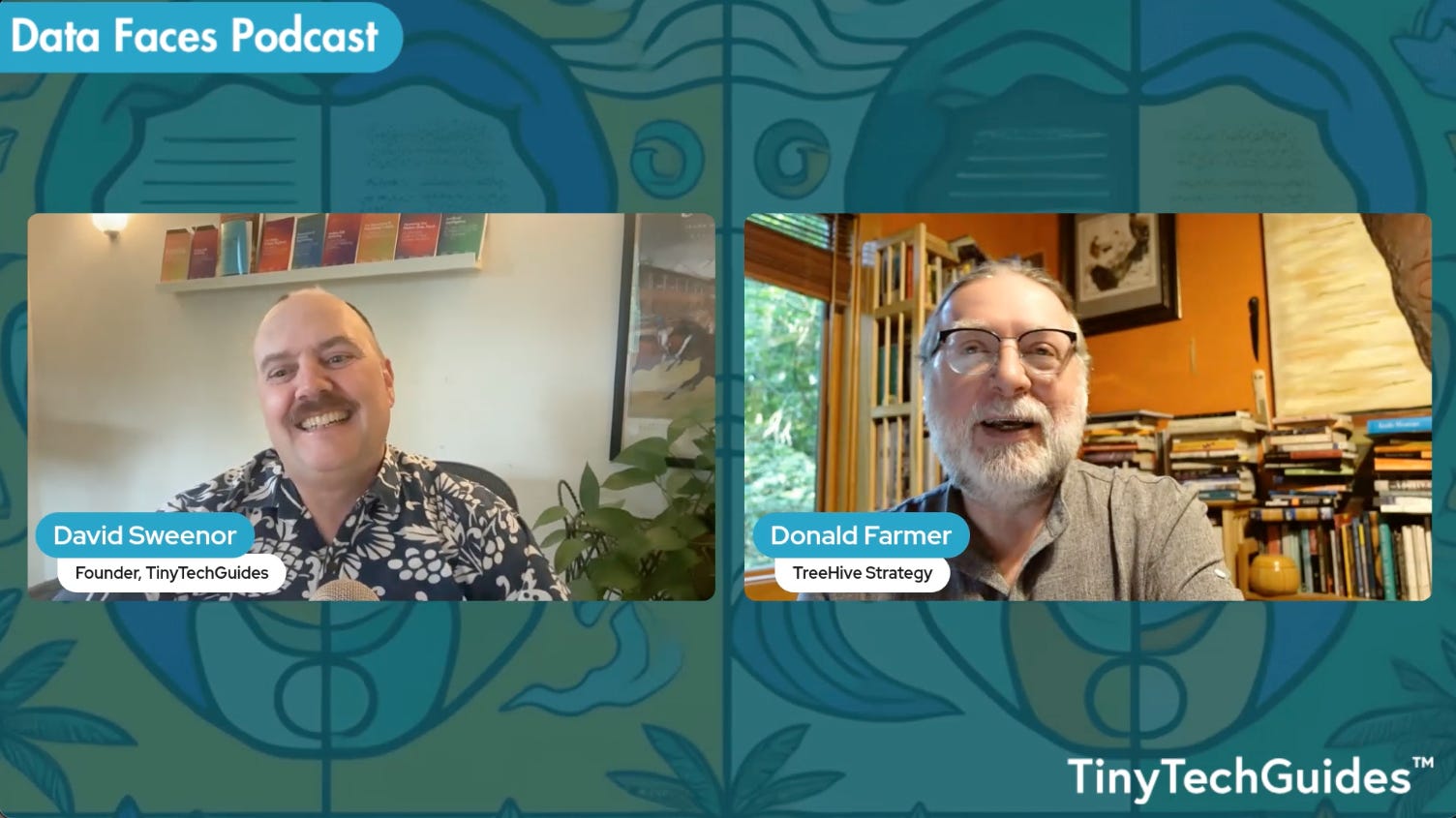
Donald Farmer told me a Tesla is probably a better driver than he is. After a bit of research, the data support his claim. Self-driving cars have become measurably safer than people behind the wheel, and Waymo’s driverless cars, measured across tens of millions of miles, were involved in roughly 91% fewer serious-injury crashes than human drivers on the same roads.[1] So if the machine drives better, what does it still lack?
You never switch on the car and hear it say, not today, it’s a lovely day, let’s skip the office and drive out to Whidbey Island instead. The machine takes you anywhere you point it, and it never once decides where to go of its own volition.
AI is getting genuinely good at the how, the driving, the producing, and the doing. The why is still ours. Donald has spent his whole career building data products, first at Microsoft and then at Qlik, and he came on the show with an idea that I found super fascinating. For decades, a data vendor’s edge came from two things: a feature nobody else could match, and the community of practitioners who grew up around the product, who identified with it and built a whole way of working around it. AI has copied the features, and it is now taking over the interpretation and judgment that those practitioners used to own. That leaves software vendors with a choice most have not yet made.
“The AI is nowhere close to bringing the why.”
— Donald Farmer, Principal, TreeHive Strategy
About Donald Farmer
Donald Farmer is the Principal of TreeHive Strategy and VP of Innovation at Nobody Studios. He has spent more than thirty years designing data and analytics products, including a long run as a design and innovation leader at Microsoft and at Qlik, where he helped build the second-generation product, Qlik Sense. His first data analytics products date back to the 1980s, which, as his son likes to point out, puts the start of his career closer to the Second World War than to today. He is the author of Embedded Analytics from O’Reilly, and he writes the excellent Creative Differences newsletter on Substack.
In this episode, Donald and I discuss:
- Why buying a data platform used to mean buying into a practice, not just a product
- How AI erased the feature moat, and what is left for a vendor to compete on
- Why a Tableau analyst stays a Tableau analyst, and an Oracle DBA stays an Oracle DBA
- Why “a human in the loop” is so often a cop-out
- The four human attitudes a system can model but never feel
Watch the full conversation here:
Practice is not process
Early in our conversation, I asked Donald to help me understand the difference between process and practice. Process is easy, he said. A business process is the way you do something, the steps you run from start to finish. In fact, my Claude Code setup is full of processes or workflows. Practice is a different beast. Think about the businesses in your town. There are retailers, builders, and contractors. You talk about the doctor’s practice, the lawyer’s practice, the architect’s practice, yet you would never call the local builder’s work a building practice, even though the builder is skilled and careful. Something separates the two. What is it?
A practice carries professional standards, a code of conduct, and an ethical stance. It carries a community and a point of view. People define themselves by it, which is why a lawyer will tell you they are a lawyer long before they tell you where they work. A practice is something you are, not just something you do between nine and five.
“A practice is more than just a business process that you do from nine to five. It’s an attitude to the world, and it’s an ethical approach.”
— Donald Farmer, Principal, TreeHive Strategy
When an organization runs on SAP, SAP does not just record what the business does. It defines how the business works, because the set of capabilities it offers steers you into operating a particular way. The same goes for the big ERP and CRM systems. Donald’s wry aside was that the humble spreadsheet has survived all of them because it imposes no methodology at all and fills in every space the big systems leave behind. The technology and the business process get so tightly bound together that the software becomes a working definition of the company itself.
When you can clone any feature with a prompt
At the BARC Data and Analytics Retreat where Donald and I met, someone made a claim that got the whole room nodding. You can recreate almost any feature in modern software with a prompt. I believe that is largely true, and it should terrify a lot of product teams. The technical moat that vendors spent years digging, the clever feature nobody else had, can be reverse-engineered and rebuilt by lunchtime.
I hear a version of this from vendors all the time. They ask me how they are different, and more often than I would like, the honest answer is that they are not. One client pushed back and asked about their history. I had to point out that history is not much of a defense when you are competing against companies that have been selling to the enterprise since 1911. So why would a buyer pick you at all?
“Why would anyone use your software when they can just vibe-code it? The features and functions are so easily replicated now that that moat has gone.”
— Donald Farmer, Principal, TreeHive Strategy
You could try to run faster than everyone else and ship features quicker than the competition can copy them. Donald does not think it lasts. You might be different today, and then tomorrow someone reverse-engineers your prompt and the difference evaporates. Speed alone leaves you on a treadmill against a model that ships weekly and costs cents.
Why a Tableau analyst stays a Tableau analyst
Once features stop holding customers, something else has to. Donald’s answer is the practice, and the way it shows up in the real world is identity and community. He told a story from his Qlik days that makes the point with no abstraction at all.
Back in 2013, Tableau showed off a native Mac client at its customer conference and the room gave it a standing ovation. Donald carried the news back to Qlik and expected some concern. Instead the boardroom looked around and asked whether anyone knew a single customer who used a Mac. The answer was no. Two companies that every analyst firm filed under the same self-service business intelligence category turned out to serve fundamentally different practices. Tableau users saw themselves as creatives, close cousins to designers and photographers, people who happened to think visually. Qlik users saw themselves as business people and application builders working on their ThinkPads. Same category on the Gartner grid, completely different ways of seeing the work.
“It’s that shared belonging. Not just a website and a forum, but a sense of purpose that they can build around the product.”
— Donald Farmer, Principal, TreeHive Strategy
That belonging is stickier than any feature. MongoDB has binary-compatible alternatives from Amazon and Microsoft, yet MongoDB developers stay MongoDB developers because the community and the intentionality come with the name.[2] An Oracle DBA is an Oracle DBA, not a database administrator who happens to use Oracle. A SQL Server developer carries the same identity. Donald pointed to a brand-new company as the current example of someone building this on purpose. François Ajenstat, a longtime product leader from Tableau, recently launched Golden Analytics, and its signature design idea is a “slider of autonomy” that lets a person dial how much the software decides versus how much they do themselves.[3] That’s a vendor trying to grow a community of practice and engineer the human’s place in it at the same time, which is exactly the move Donald argues the rest of the industry needs to learn.
A human in the loop is a cop-out
I brought up an idea from a recent guest, Doug Laney, who described the autonomous, self-driving business, and asked Donald whether his view lined up.[4] Although we agreed there is potential, we also acknowledged that there is a long way to go. And the term human in the loop? Fuggettaboutit.
“A human in the loop is a cop-out. It’s a way of saying we haven’t really thought about this, so we’ve shoved a human in there, and that’s our answer to things.”
— Donald Farmer, Principal, TreeHive Strategy
His point is that we reach for the human in the loop because it feels responsible, when it is often the opposite. Humans do not scale, and humans are fragile. When a system is making thousands of decisions a second, a person clicking go cannot meaningfully supervise any of them, and I will admit I sometimes wave Claude through a task without fully knowing what it is doing. Donald also turned the explainability argument back on us. We demand that AI explain its reasoning, yet most of us have worked for a manager whose decisions made no sense at all and who kept the job regardless. Human judgment was never as transparent and explainable as we pretend.
For software makers, the work that stays human is not a feature, it is an attitude a system can model, recommend, and even simulate, but cannot feel. Donald names four of them, trust, doubt, ambition, and care, and he treats each one as a deliberate design choice rather than an afterthought. A system designed around doubt, for example, would not hand you a tidy, well-formatted report. It would grill you with the hardest, most skeptical questions a board member could ask, so you walk into the room prepared to defend the number rather than just present it. AI tends to smooth all of that friction away, and Donald argues we do ourselves no favors by letting it.
Build AI into a practice, or get absorbed by it
This is the choice Donald leaves vendors with, and it is the reason the practice idea is more than a nice to have. A company with a practice has a place to put AI. It integrates the technology into a workflow it already defines, with clear limits and a point of view about what the work is for. A company without one watches AI replace its value proposition one piece at a time until the product is just a thin layer the model could have generated anyway. You either build AI into a practice you own, or you get integrated into the AI.
Which brings us back to the Tesla that will not drive itself to Whidbey Island. The machine is getting genuinely intelligent, and Donald, who studied philosophy and history, happily admits Claude raises ideas in conversation that he would not have reached on his own. What it lacks is purpose, meaning, and direction. My favorite version of this came near the end, when Donald reminded me that the smartest AI anyone ever imagined is Marvin the Paranoid Android, forever asking what the point is. You will know your AI is intelligent on the day it tells you to give it all up and go meditate, and that is the one thing it will never say. A vendor’s real question was never how to compete with AI. It is what work the AI is there to serve, and the honest answer is a practice rather than a feature list.
Listen to the full conversation with Donald Farmer on the Data Faces Podcast.
Based on insights from Donald Farmer, Principal of TreeHive Strategy, featured on the Data Faces Podcast.
Podcast highlights
- [1:16] Meeting at the BARC Data and Analytics Retreat
- [3:07] The shoe shop, and spotting statistics in shoe sizes at sixteen
- [5:01] His first week at Microsoft, briefing a Japanese bank with two hours of tenure
- [8:32] Why companies still run on spreadsheets, and how SAP defines a business
- [10:13] Practice versus process, and the dimensions of a practice
- [12:52] Tableau versus Qlik, the Mac client, and two different practices
- [15:56] Can vendors still compete on features?
- [18:00] MongoDB, Oracle, and why developers identify with a practice
- [20:38] Open source, community, and what you share when you build with AI
- [22:01] Do businesses actually have an ethical stance?
- [25:13] Why “a human in the loop” is a cop-out
- [27:47] The four human attitudes, and designing doubt into software
- [30:50] Intelligence without purpose, and the car that won’t drive to the island
- [33:46] The laziest GPT ever, and Marvin the Paranoid Android
Frequently asked questions
What is the difference between a practice and a process in data and analytics?
A process is the set of steps you follow to get work done. A practice, in Donald Farmer’s sense, is bigger. It carries professional standards, an ethical stance, a community, and a way of seeing the work, the way a doctor, lawyer, or architect has a practice rather than a job. For decades, buying a data and analytics platform meant buying into a practice. People define themselves by it, which is why a practice is stickier than any single feature.
Can data and analytics vendors still compete on features?
Not for long. Donald Farmer argues the technical moat has collapsed because a general-purpose AI model can replicate almost any software feature from a prompt, and a competitor can reverse-engineer it within days. Running faster only puts a vendor on a treadmill against models that ship weekly and cost cents. What holds customers now is a practice, the community, methodology, and point of view that a prompt cannot copy.
What did Donald Farmer mean by “a human in the loop is a cop-out”?
He means that adding a human checkpoint often substitutes for real thinking about an AI system’s design. Humans do not scale and humans are fragile, so a person clicking approve cannot meaningfully supervise thousands of automated decisions a second. Farmer also notes that human judgment was never fully explainable either. Rather than bolting a person into the workflow as an afterthought, he argues vendors should design deliberately for the human attitudes a system cannot feel.
What are the four human attitudes AI cannot feel?
Donald Farmer names trust, doubt, ambition, and care. An AI system can model, recommend, and even simulate these attitudes, but it cannot hold them. Farmer treats each as a deliberate design choice for software vendors. A data and analytics tool designed around doubt, for instance, would not hand you a tidy report. It would grill you with the hardest questions a board member might ask, so you walk in ready to defend the number rather than just present it.
How should a software vendor respond when AI can replicate any feature?
Build AI into a practice you define, rather than letting AI absorb your product piece by piece. A vendor with a practice has a place to put AI, with clear limits and a point of view about what the work is for. A vendor without one watches the model replace its value proposition until the product is a thin layer anyone could generate. The strategic question is what work the AI is there to serve, and a vendor who can answer that holds a position a prompt cannot easily copy.
About David Sweenor
David Sweenor is the founder and host of the Data Faces podcast, where he talks with the people who are making data, analytics, AI, and marketing work in the real world. He is also the founder of TinyTechGuides and a recognized top 25 analytics thought leader and international speaker who specializes in practical business applications of artificial intelligence and advanced analytics.
With over 25 years of hands-on experience implementing AI and analytics solutions, David has supported organizations including Alation, Alteryx, TIBCO, SAS, IBM, Dell, and Quest. His work spans marketing leadership, analytics implementation, and specialized expertise in AI, machine learning, data science, IoT, and business intelligence. David holds several patents and consistently delivers insights that bridge technical capabilities with business value.
Books
- Artificial Intelligence: An Executive Guide to Make AI Work for Your Business
- Generative AI Business Applications: An Executive Guide with Real-Life Examples and Case Studies
- The Generative AI Practitioner’s Guide: How to Apply LLM Patterns for Enterprise Applications
- The CIO’s Guide to Adopting Generative AI: Five Keys to Success
- Modern B2B Marketing: A Practitioner’s Guide to Marketing Excellence
- The PMM’s Prompt Playbook: Mastering Generative AI for B2B Marketing Success
Follow David on Twitter @DavidSweenor and connect with him on LinkedIn.
[1]Waymo. “Waymo Safety Impact.” Accessed June 2026. https://waymo.com/safety/impact/. See also Kusano, Kristofer, et al. “Comparison of Waymo Rider-Only Crash Rates by Crash Type to Human Benchmarks at 56.7 Million Miles.” Traffic Injury Prevention, 2025. https://www.tandfonline.com/doi/full/10.1080/15389588.2025.2499887.
[2]Amazon Web Services. “Amazon DocumentDB (with MongoDB compatibility).” Accessed June 2026. https://aws.amazon.com/documentdb/. See also Microsoft, “Azure Cosmos DB for MongoDB,” https://learn.microsoft.com/en-us/azure/cosmos-db/mongodb/.
[3]Bishop, Todd. “Former Tableau product chief launches Golden Analytics, using AI to challenge the BI old guard.” GeekWire, April 7, 2026. https://www.geekwire.com/2026/former-tableau-product-chief-launches-golden-analytics-using-ai-to-challenge-the-bi-old-guard/.
[4]Sweenor, David. “The three V’s of agentic AI.” TinyTechGuides, June 30, 2026. https://tinytechguides.com/blog/data-faces-douglas-laney-ep42-three-vs-agentic-ai/.


