

Listen now on YouTube | Spotify | Apple Podcasts | Amazon Music
▶ Watch the full episode and read the transcript: Lucas Thelosen on the Data Faces Podcast
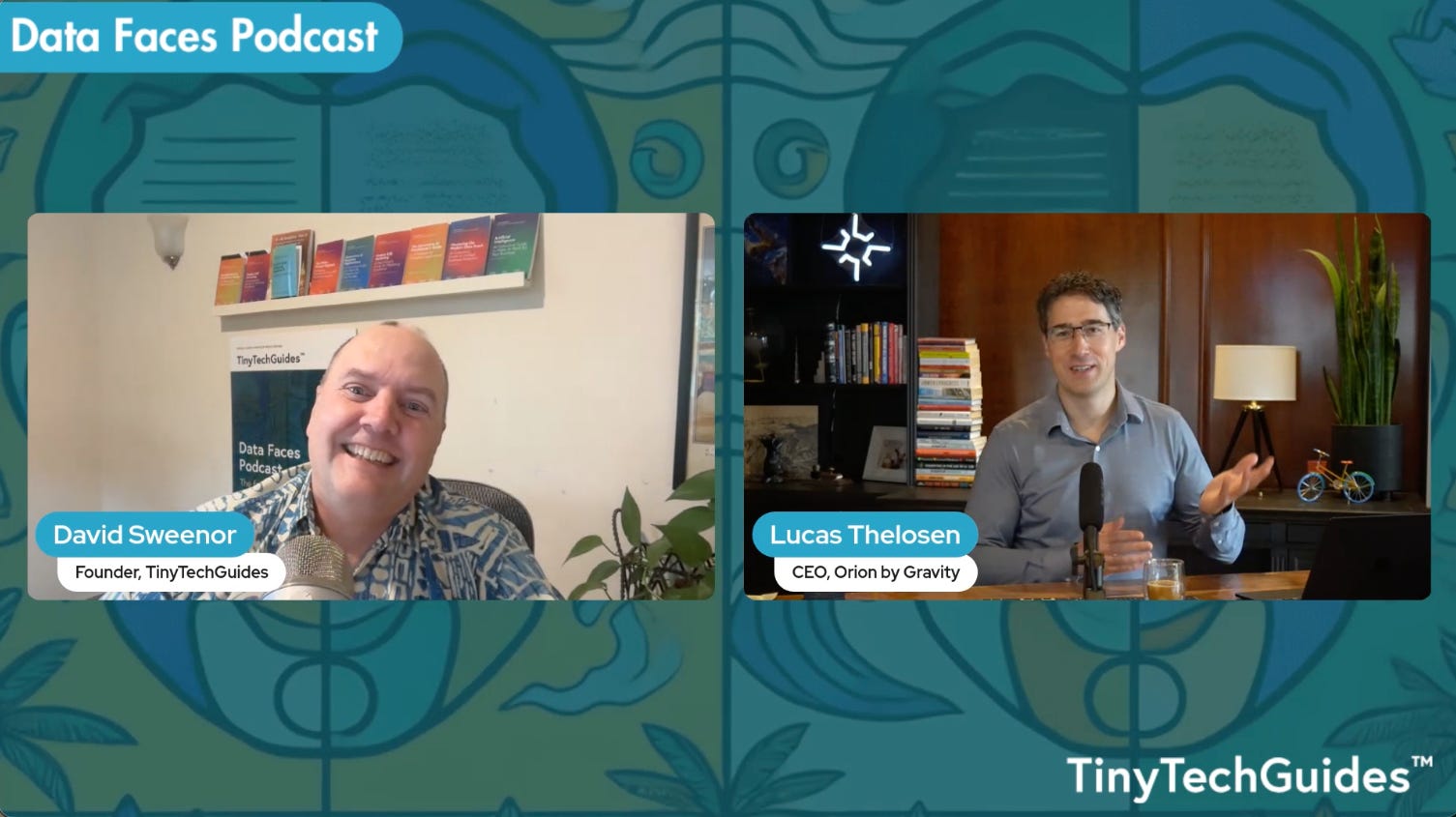
At almost every data, analytics, and AI conference I’ve attended lately, someone on stage has announced that BI is dead, so I asked Lucas Thelosen directly: is BI dead? He built one of the largest Looker consultancies, helped lead Looker into Google, and now builds an AI analyst. “It’s always evolving,” he said, but one thing is different this time. If you ask the product leaders at the major dashboarding products, “they will tell you in private that actual usage numbers are really low.”
That matches my previous experience. I’ve spent years marketing analytics software at Dell, TIBCO, Alteryx, and other vendors, and we all promised analytics for everybody. Yet most companies ended up with thousands of dashboards and little insight. The data is slightly dated but still relevant: when BARC and Eckerson Group measured it, about 25 percent of employees actively used BI and analytics tools, a figure that had barely moved in seven years.[1]
“The average employee at a company is not super excited to go and look at a dashboard.”
— Lucas Thelosen, Founder and CEO, Orion by Gravity
So, is this the end of BI as we know it? Probably, and to steal a line from R.E.M., I feel fine. Why? Well, an AI analyst can do the digging most employees never had time for. Still, it builds on the foundations BI teams already know: trustworthy math, numbers that agree, and documentation someone keeps current and maintains.
About Lucas Thelosen
Lucas Thelosen is the founder and CEO of Orion by Gravity, the company behind Orion, an AI analyst. Lucas started as an analyst during the 2008 financial crisis and put his first AI into production in 2010 for Countrywide. After founding DAS42, one of the largest Looker consultancies, he joined Looker’s executive team and, when Google acquired Looker, went on to lead Google Cloud’s data and AI product organization.
In this episode, Lucas and I discuss:
- Whether BI is dead, and why so few employees open the dashboards their company builds
- Why Orion by Gravity put deterministic code between the AI and the math
- How an AI analyst can personalize every answer and still keep everyone’s numbers the same
- What “ambient learning” means for keeping AI context up to date
- What happens to analysts, and why Lucas thinks administering AI agents is next year’s big topic
Watch the full conversation here:
Who does the digging when nobody opens the dashboard?
Lucas doesn’t expect dashboards to disappear, since teams still need them for weekly meetings and quarterly business reviews. What changes is who does the digging. Most people care about beating their quarterly goals, and an AI analyst lets them state that goal and then “run the 120 queries and permutations” to find what matters. “You don’t have the time to dig deep,” Lucas said. “You don’t have the time to understand the tools to ask the questions.” His best example is something he calls “red blindness.” People build spreadsheets as wide as their screen and dashboards as long as their screen, then look at the red numbers because that’s where the problems seem to be.
“Nobody drills down on a green number. But sometimes you can actually find really good information if you just go three layers down.”
— Lucas Thelosen, Founder and CEO, Orion by Gravity
An AI analyst looks at both colors, Lucas said, “because it has infinite time.” He used to race Orion to find the $10 million insight in a new customer’s data, and two years ago he usually won. “But it really quickly changed,” he said. The data got too messy for him to handle, while “Orion doesn’t give up. It keeps going. It finds the nuggets.” An AI analyst will keep checking green numbers long after a person stops, which also means it will find every weakness in the data underneath.
Keep the AI away from the math
But can you trust what an AI analyst finds? When I told Lucas that AI makes up a lot of crap, he agreed. Gravity started building Orion about two years ago, when the models “were even dumber than they are now,” so the team put deterministic code wherever it could. SQL and Python run the calculations, the AI interprets the question and builds the output, and agents from different AI companies check each other’s work. That design is slower and costs more to run, and Lucas thinks the trade is easy in analytics: if a correct dashboard costs ten dollars to produce rather than three, it’s worth it.
The design also makes the work auditable, which matters in finance, healthcare, and insurance. Lucas calls it a glass box, where you can see which assumptions the AI analyst made, how confident it is in each one, and every query it ran. That log matters because deterministic code protects only the math, and if the AI misreads the question, you catch it in the assumptions.
One metric tree, many personal answers
In the dashboard era, I sat in plenty of meetings where someone presented an answer, and someone else immediately had a different number from a different dashboard. An AI analyst for each person sounds like a recipe for more of the disaster we’ve already lived through, a hyper-personalized, confidently wrong answer for every employee. So how do you keep everyone’s numbers in agreement?
Lucas describes analytics as a linear workflow, with personalization at both ends. The question going in and the answer coming out are both tailored to each person. Everything in between is shared, so everyone with similar questions, metrics, and teams runs through the same SQL and Python, organized as a metrics tree. “For me, right? I’m German. I need three bullet points, four words each,” Lucas said. “For you, it might be a little different, but the numbers will be the same.”
Data teams have long put that shared middle in a semantic layer, and Lucas thinks a semantic layer covers less than its vendors claim. Along with ontologies and data dictionaries, he said, “semantic layers maybe get you 40 percent there.” Orion doesn’t need one to start. It reads the query log, checks its numbers against past reports, and asks people to clarify definitions such as revenue. Malcolm Hawker of Profisee made a related argument on an earlier episode about the limits of the semantic layer when a company holds 15 versions of the same customer.
Context is documentation with a maintenance plan
Everyone is talking about context right now, and Lucas thinks we’ve been here before. “We called it documentation back then,” he said, to which I’d add that most of it was outdated wiki pages nobody read. Context can also be overdone, like handing a new hire a stack of books on their first day and asking, “But what do you really want me to focus on?” His rule is the right context at the right time.
“Every organization that ever wrote documentation down realized that a year later it’s outdated.”
— Lucas Thelosen, Founder and CEO, Orion by Gravity
Context also needs ongoing maintenance, which Orion by Gravity handles with what Lucas calls ambient learning. Orion sits in team chat channels, and many customers also connect their meeting note-taker summaries. When it detects a change in a team’s thinking, it proposes an edit to the knowledge base. One large retailer decided to focus on apparel rather than shoes for a quarter. Without that context, the AI analyst would keep asking why the money wasn’t going to shoes, and a quarterly goal like that never makes it into a semantic layer. On Ep 53, Ken Sanford argued that tribal knowledge is the AI context layer nobody names, and ambient learning is one way to keep it current.
Dashboard sprawl becomes agent sprawl
When ChatGPT came out, every software company added a chatbot. Lucas wondered why nobody built an administrator, since he saw the biggest pain in enterprise software as administering it. “Why didn’t Salesforce, the first thing they did, build an AI that administers Salesforce for you?” he asked. Orion by Gravity built one early. It flags dashboards and slide decks nobody uses anymore and folds them into the ones people do use. It also highlights conflicting definitions for an administrator to resolve.
He expects administration to be next year’s big conversation, because agents are about to sprawl the way dashboards did and nobody is asking who governs them. Some were set up by employees who have since left the company, and as Lucas put it, “nobody knows anymore why the agent is still running.” I made a similar argument after the BARC Data & Analytics Retreat in June, where the takeaway was that governance now decides whether AI delivers value. There’s also a second kind of sprawl I don’t think anyone has answered yet. A shared metric tree keeps everyone’s numbers the same, but when everyone can generate a personalized dashboard on demand, each person decides which numbers to highlight. What happens when two executives walk into the same meeting with the same data and different stories? And who decides which view is right?
Why I feel fine
What happens to the people who do this work today? Lucas is direct about it: “There’s going to be fewer and less data scientists and just straightforward analysts, because the AIs are really good at it.” He suggests two new job titles. A context architect designs and maintains context at every level, from one person up to the whole company. A data product manager runs data like a product, “with a roadmap and a vision,” moving the organization from what happened to why it happened, then to optimization. Capital One’s data team described that role in practice on Ep 48, when they talked about building data products for the hundredth use case. For anyone who wants neither, Lucas offered a third title, “senior human in the loop,” and I’m considering it for my LinkedIn profile.
Which brings me back to R.E.M. Keeping calculations deterministic and metrics consistent is old BI work, and so is keeping documentation current and pruning what nobody uses. Any team that did that work in the dashboard era is ready for an AI analyst, and the rest will learn about their inconsistencies quickly, because an AI analyst digs through everything. Here are three checks I’d run this quarter:
Find out which dashboards anyone opens: Pull the usage logs from your BI tool. Anything nobody has opened in a quarter is a candidate for retirement or for an AI analyst.
Decide what has to stay deterministic: List the calculations you’d have to defend to an auditor or your CFO, such as revenue, churn, and forecast logic, and require any AI analyst you evaluate to run them in code it can show you.
Name an owner for the context and for every agent: Someone has to keep the knowledge base current, and every agent needs a person who can explain why it’s still running.
Get those three right, and you can sing along with Michael Stipe.
Listen to the full conversation with Lucas Thelosen on his Data Faces Podcast episode page.
Based on insights from Lucas Thelosen, Founder and CEO of Orion by Gravity, featured on the Data Faces Podcast.
Podcast highlights
- [0:06] David introduces Lucas Thelosen and the topic: the future of analytics
- [1:02] From an analyst in the 2008 financial crisis to Looker and Google
- [3:52] Is BI dead?
- [6:42] “AI makes up a lot of crap,” and why Orion by Gravity keeps the AI away from the math
- [8:50] Personalized answers with the same numbers across teams
- [11:12] Context architects and data product managers
- [13:45] Can you have too much context?
- [19:14] Red blindness: nobody drills into a green number
- [20:31] The glass box audit trail
- [21:45] The AI administrator nobody built
- [23:32] Ambient learning, and the retailer that moved from shoes to apparel
- [28:10] Do you need a semantic layer to start?
- [31:14] Repeatable workflows and the 7 a.m. executive podcast
- [32:32] Administering the agents: next year’s conversation
- [33:39] When Breath Becomes Air
Frequently asked questions
Is BI dead?
Business intelligence (BI) isn’t dead, but the way people use it is changing. Lucas Thelosen, founder and CEO of Orion by Gravity and former head of product for data and AI at Google Cloud, says dashboards will stay for team meetings and quarterly business reviews. The digging moves to AI analysts, because few employees open dashboards: a 2022 BARC and Eckerson Group study found about 25 percent of employees actively use BI and analytics tools. This figure barely moved in seven years.
What is an AI analyst?
An AI analyst is software that answers business questions by querying a company’s data, investigating the results, and producing slide decks, dashboards, or written answers. A person can give it a goal, such as hitting a quarterly target, and it runs the queries a human analyst would run. Orion by Gravity is one example. Lucas Thelosen says an AI analyst’s advantage is patience, since it checks the green numbers that people skip.
How can you trust an AI analyst’s numbers?
Keep the AI away from the math. Gravity built its Orion AI analyst so that deterministic SQL and Python run the calculations, while the AI model interprets the question and formats the answer. Agents from different AI companies check each other’s work. Lucas Thelosen also recommends a “glass box” audit trail that logs the assumptions, confidence levels, and queries behind every answer, which matters in regulated industries like finance and healthcare.
Do you need a semantic layer to use an AI analyst?
A semantic layer helps but isn’t required to start, according to Lucas Thelosen of Orion by Gravity, who estimates that semantic layers, ontologies, and data dictionaries get an AI analyst about 40 percent of the way. An AI analyst can read the database query log, match its numbers to past reports, and ask people to clarify definitions such as revenue or a new customer. Business context, like a quarterly goal, rarely lives in a semantic layer at all.
What is ambient learning in AI analytics?
Ambient learning is how an AI analyst keeps its business context up to date. Gravity’s Orion sits in team chat channels and reads meeting note-taker summaries. When it detects that a team’s priorities have changed, it proposes an edit to its knowledge base. In one example, a retailer moved its quarterly focus from shoes to apparel, and the AI analyst needed that context to stop recommending more investment in shoes.
What will data analysts do when AI does the analysis?
Lucas Thelosen of Orion by Gravity expects fewer data scientists and traditional analysts, and two growing roles. A context architect designs and maintains the business context that AI agents use, from the individual to the company level. A data product manager runs data like a product, with a roadmap, and moves the organization from reporting what happened to explaining why and then optimizing. Analysts still need business knowledge to correct and train an AI analyst.
About David Sweenor
David Sweenor is the founder and host of the Data Faces podcast, where he talks with the people who are making data, analytics, AI, and marketing work in the real world. He is also the founder of TinyTechGuides and a recognized top 10 AI thought leader and international speaker who specializes in practical business applications of artificial intelligence and advanced analytics.
With over 25 years of hands-on experience implementing AI and analytics solutions, David has supported organizations including Alation, Alteryx, TIBCO, SAS, IBM, Dell, and Quest. His work spans marketing leadership, analytics implementation, and specialized expertise in AI, machine learning, data science, IoT, and business intelligence. David holds several patents and consistently delivers insights that bridge technical capabilities with business value.
Books
- Artificial Intelligence: An Executive Guide to Make AI Work for Your Business
- Generative AI Business Applications: An Executive Guide with Real-Life Examples and Case Studies
- The Generative AI Practitioner’s Guide: How to Apply LLM Patterns for Enterprise Applications
- The CIO’s Guide to Adopting Generative AI: Five Keys to Success
- Modern B2B Marketing: A Practitioner’s Guide to Marketing Excellence
- The PMM’s Prompt Playbook: Mastering Generative AI for B2B Marketing Success
Follow David on Twitter @DavidSweenor and connect with him on LinkedIn.
[1]Bange, Carsten, and Wayne Eckerson. “Strategies for Driving Adoption and Usage with BI and Analytics.” BARC, April 5, 2022. https://barc.com/news/new-study-identifies-drivers-of-bi-and-analytics-adoption-in-companies-today/


