

Listen now on YouTube | Spotify | Apple Podcasts | Amazon Music
▶ Watch the full episode and read the transcript: Ken Sanford on tribal knowledge and AI skills
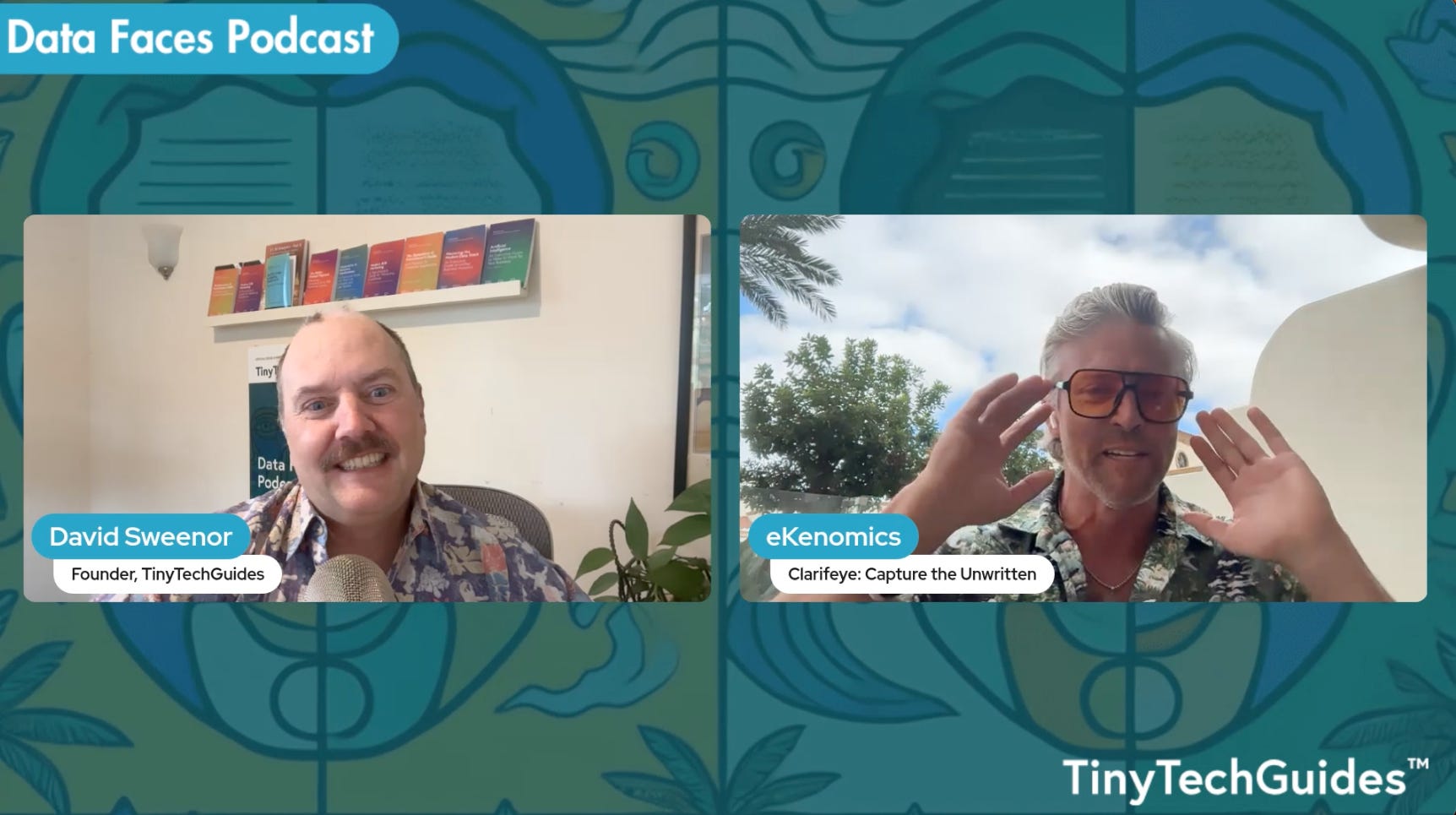
The morning I recorded this episode, I interviewed a partner of one of my clients about data quality. When I asked what was missing, the partner answered with two words: tribal knowledge. I had been circling the same idea since July, when 24 interviews with data and AI leaders at the CDOIQ Symposium left me convinced that almost nobody is focused on unstructured data.
Guests on this show keep adding to the list of what AI needs beyond a better model. Josh Howard argued that your AI is dumb without your data, and Malcolm Hawker added that context without truth just produces confident, wrong answers. Semantic layers and knowledge graphs get their turn too, but I rarely hear anyone name the judgment that sits in the heads of the people who have done the job for 25 years.
I have a personal stake in this one. I run most of TinyTechGuides on Claude Code and a folder of skills, the instruction files that tell the AI how I write, publish, and produce the podcast. Those skills are my tribal knowledge written down, and they work because I wrote them myself. So I asked Ken Sanford, an old colleague from our SAS days, how a company gets that kind of knowledge out of its experts and into a form that any AI harness, the tool that runs the model, can use.
About Ken Sanford
Ken Sanford, Ph.D., leads go-to-market and commercial strategy at Clarifeye, a Paris-based startup that captures the unwritten knowledge in experts’ heads and makes it available to AI. A self-described reformed academic economist with a Ph.D. from the University of Kentucky, Ken spent years in data science at SAS, H2O.ai, and Dataiku, and he and I worked together at SAS about 15 years ago.
In this episode, Ken and I discuss:
- Why near-perfect document retrieval still leaves AI without the judgment to interpret what it finds
- How an AI interviewer that hunts for edge cases pulls expertise out of people who never wrote it down
- Why the most tech-forward people in a company are the wrong ones to write its AI skills
- How the memories your AI harness builds are your judgment, and why you should own them
- Where the next generation of experts comes from, and why Ken hires for agency
Watch the full conversation here:
The judgment that never got written down
Ken starts from a premise that sounds backward at first: document retrieval is close to solved. When AI can find nearly any passage in any document, the hard part becomes deciding what that passage means for the decision in front of you. A solid retrieval-augmented generation (RAG) system is only the starting position, in his view, and every company still has to add context around it.
One way to get that context is indirect capture, which means mining Slack, Teams, and Confluence to reconstruct how people think. Ken sees value in it, and he also sees where it stops. Those tools hold what people typed, and the reasoning behind a senior person’s decisions rarely makes it into a chat thread.
“Most of the really important things, most of the intuition, the judgment, was never written down.”
— Ken Sanford, Go-to-Market and Commercial Strategy, Clarifeye
When I suggested that this is a third layer, sitting on top of the data and the context, Ken’s answer was immediate: “That’s exactly it.” He divides a company’s knowledge into the explicit and the implicit, and until recently, the implicit half lived only in experts’ heads. Clarifeye’s job, as he describes it, is to elicit the parts of that knowledge that were never documented.
Interview for the exceptions
Every company I’ve worked at had a wiki that was out of date the day someone finished writing it, because a wiki waits for people to push knowledge into it. Ken’s team started from the other end. Clarifeye’s assistant, Clara, interviews experts the way a consultant would, and she arrives already knowing what the existing documents say, so she only asks about what’s missing.
Clara spends her questions on the edges of a process. She pushes edge cases and hunts for exceptions, often by posing a hypothetical for the expert to rule on, and each ruling makes the AI’s behavior more predictable. The sessions run five or ten minutes a day. When two experts would handle the same situation differently, Clara flags the disagreement, and a designated knowledge owner decides which answer stands.
I asked Ken why Clarifeye’s output looks like old-school enterprise architecture for a generative AI startup: process blueprints, versioned business rules, and reasoning workflows, rather than everything stuffed into a vector store. His answer comes down to readability. People need to be able to read the rules, and the simpler the representation, the more likely a large language model (LLM) is to follow them. For unwritten knowledge, his advice is to “write it old school, pen and paper, write it down.”
The wrong people are writing your AI skills
When I asked whether leaders ever consider that AI could replace them, Ken turned the question toward who builds the AI skills in the first place. Inside most organizations today, skills and custom agents come from the most tech-forward employees, the people staying up late experimenting with ChatGPT. Ken doesn’t think that’s all bad, but it creates a problem he came back to more than once.
“Those people are likely not the ones with the 25 or 30 years of intuition.”
— Ken Sanford, Go-to-Market and Commercial Strategy, Clarifeye
I’ve seen this from the inside. My own skills behave the way they do because of the judgment I put into them, and a colleague writing them on my behalf would have gotten a different result. A skill encodes the judgment of whoever wrote it, so when the author is the person who knows the tools best, the company scales that person’s judgment. Ken’s own example was close to home, since he would love to capture the tribal knowledge at a former employer we share, where plenty of veterans are approaching retirement age.
Ken wants capture to work as a pull. When a system asks the veteran targeted questions, the veteran never has to sit down and author a skill, and the intuition comes out anyway. He sees an upside for the expert, since it’s a chance to document how you think about problems. “Being able to hand that intuition over to other people, I think, is a superpower,” he told me.
Your harness already has your memories
I asked Ken whether the experts that Clarifeye’s assistant interviews push back. He sees mild resistance early on, and it tends to fade once people understand what their AI tools already do behind the scenes. Every time you work with an LLM inside a harness such as Claude or ChatGPT, the harness builds memories, and Ken argues that those memories amount to your judgment.
In Ken’s telling, Clarifeye differs by doing that capture in the open and handing the artifacts back to the customer as its own intellectual property (IP). He adds that many of Clarifeye’s customers get higher-quality answers after moving to a smaller model and using fewer tokens. I felt the cost of not owning those artifacts this summer. When Claude went down, I found out how much of my business lived inside a single harness.
“So a company now has the ability to store their own IP and move between harnesses.”
— Ken Sanford, Go-to-Market and Commercial Strategy, Clarifeye
Ken’s best example of keeping those artifacts current involves a word I’ve banned from my own writing. He was using Claude with one of Clarifeye’s internal knowledge stores to draft blog content, and it kept using the word “ship,” which drives him nuts. He told Claude never to do that again. Claude then sent a signal back to the knowledge store, and the next time he opened Clarifeye, Clara asked him to confirm the ban. He said yes, and she corrected every artifact that used the word. That made me laugh, because “ship” sits on my own banned list for the same reason.
Where the next experts come from
If an agent can run on a senior expert’s encoded judgment, where does the next generation of experts come from? Ken expects AI to speed up the climb onto the shoulders of giants and to produce ultra-specialized experts who waste less time rehashing work that has already been done. Curiosity matters, and when he hires, he looks for agency, the people who try things and ask forgiveness rather than permission.
Ken applies the same test to companies. He still talks to organizations stuck behind a VPN with nothing but Copilot, and his advice to the people inside them is blunt: “Just quit your company.” His own team is 12 people, and he believes it “could grow 50-fold and not hire a single person.”
Here’s what I took from the conversation. Most of the work on the AI context layer goes into the data, the definitions, and the retrieval, while the judgment that decides what the answer should be still lives in a few people’s heads. Get it out while those people are still around, and make sure the skills your AI runs on come from the people who earned that judgment.
Listen to the full conversation with Ken Sanford on his Data Faces Podcast episode page.
Based on insights from Ken Sanford, who leads go-to-market and commercial strategy at Clarifeye, featured on the Data Faces Podcast.
Podcast highlights
- [0:05] Introduction and welcome to the Data Faces Podcast
- [1:26] Clarifeye and capturing unwritten knowledge for AI
- [3:57] Iron Man 3 extras and delivering real estate listing books in Naples
- [5:58] Tribal knowledge, CDOIQ, and the missing focus on unstructured data
- [6:46] Near-perfect retrieval and the judgment that was never written down
- [9:26] Voice mode, five minutes a day, and context-aware interviews
- [12:12] Do experts resist? Harness memories as your judgment
- [13:48] Where customers start: onboarding and software migrations
- [16:36] Keeping knowledge current, and banning the word “ship”
- [19:50] Why the wrong people are building your AI skills
- [22:53] Where the next generation of experts comes from
- [26:16] Hiring for agency, and why Ken says “just quit”
- [29:22] Why process blueprints beat a vector store
- [31:40] End of days? Ken’s techno-optimist case
- [34:58] West of Jesus and the science of flow
- [37:15] Where to find Ken
Frequently asked questions
What is tribal knowledge in AI?
Tribal knowledge is the judgment that experts carry in their heads and never write down, such as how to handle an exception or which rule wins when two policies conflict. For AI, it is the context that retrieval-augmented generation (RAG) cannot supply, because it exists in no document. Ken Sanford of Clarifeye calls it the implicit half of a company’s knowledge and argues that capturing it is the last step to AI making decisions the way a company’s experts would.
Who should build AI skills inside a company?
The people with the deepest domain judgment should shape a company’s AI skills. Ken Sanford points out that skills usually come from the most tech-forward employees, who rarely have 25 or 30 years of intuition. Because a skill encodes the judgment of whoever wrote it, he recommends making knowledge capture a pull, where a system interviews the veteran so the expert shapes the skill without having to write it.
How do you capture tribal knowledge from experts?
Interview them about exceptions. Clarifeye’s assistant, Clara, reads the existing documentation first, then asks experts short questions about edge cases and hypotheticals for five or ten minutes a day. When two experts disagree, a knowledge owner decides which answer stands. The results become readable process blueprints, versioned business rules, and reasoning workflows, which Ken Sanford says large language models follow more reliably than loosely retrieved text.
Can AI skills and knowledge move between AI harnesses?
They can when the company owns the artifacts. Ken Sanford argues that every AI harness, the tool that runs the model, such as Claude or ChatGPT, already builds memories that amount to a user’s judgment. Clarifeye captures that knowledge in the open and returns it to the customer as intellectual property, so a company can switch harnesses or models when it chooses. Ken adds that many customers get higher-quality answers after moving to a smaller model.
About David Sweenor
David Sweenor is the founder and host of the Data Faces podcast, where he talks with the people who are making data, analytics, AI, and marketing work in the real world. He is also the founder of TinyTechGuides and a recognized top 10 AI thought leader and international speaker who specializes in practical business applications of artificial intelligence and advanced analytics.
With over 25 years of hands-on experience implementing AI and analytics solutions, David has supported organizations including Alation, Alteryx, TIBCO, SAS, IBM, Dell, and Quest. His work spans marketing leadership, analytics implementation, and specialized expertise in AI, machine learning, data science, IoT, and business intelligence. David holds several patents and consistently delivers insights that bridge technical capabilities with business value.
Books
- Artificial Intelligence: An Executive Guide to Make AI Work for Your Business
- Generative AI Business Applications: An Executive Guide with Real-Life Examples and Case Studies
- The Generative AI Practitioner’s Guide: How to Apply LLM Patterns for Enterprise Applications
- The CIO’s Guide to Adopting Generative AI: Five Keys to Success
- Modern B2B Marketing: A Practitioner’s Guide to Marketing Excellence
- The PMM’s Prompt Playbook: Mastering Generative AI for B2B Marketing Success
Follow David on Twitter @DavidSweenor and connect with him on LinkedIn.


