

Listen now on YouTube | Spotify | Apple Podcasts | Amazon Music
▶ Watch the full episode and read the transcript: Christopher Chen on the Data Faces Podcast
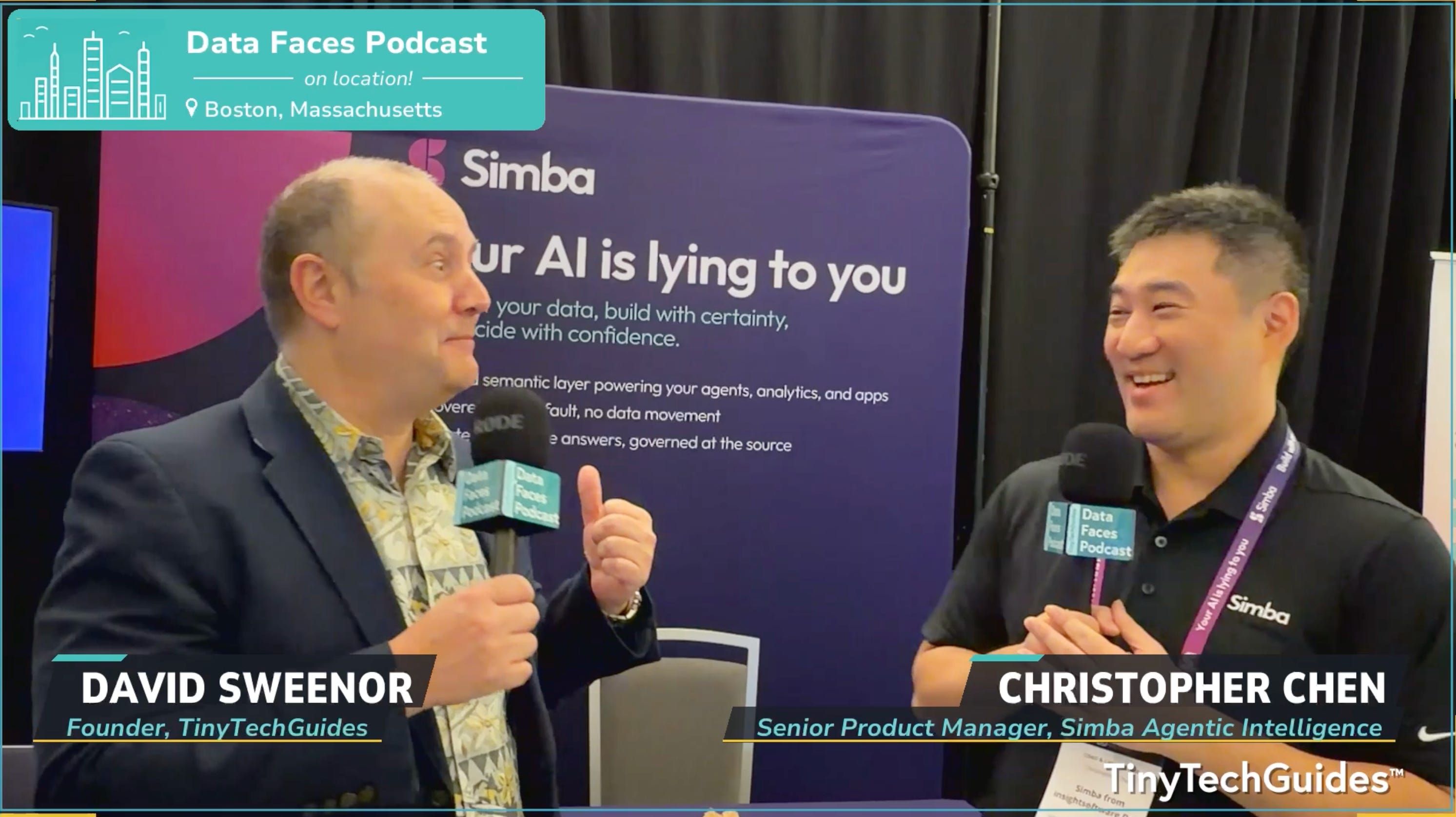
At almost every booth I walked past at CDAO Fall, somebody promised to fix AI hallucinations. The Simba booth took the opposite approach. The banner behind it read, “Your AI is lying to you.” It’s a bold sign to put on a booth, so I sat down with Christopher Chen, the senior product manager behind Simba Agentic Intelligence, and asked whether he believed it.
He didn’t, at least not in those words. “Maybe it’s not true that your AI is lying to you, but it could be giving you the wrong answer,” he said. The data isn’t lying. The model isn’t lying either. Between them, a shared layer of business context either does its job or is missing entirely, and that’s where the wrong answer comes from.
“Maybe it’s not true that your AI is lying to you, but it could be giving you the wrong answer.”
— Christopher Chen, Senior Product Manager, Simba Agentic Intelligence
Chris and a growing number of vendors call that missing layer an AI semantic layer. He argues that it’s the foundation most programs skip on the way to a demo, and once you cut through the vendor hype, that’s what the booth sign was about.
About Christopher Chen
Christopher Chen is a senior product manager for Simba Agentic Intelligence, insightsoftware‘s semantic-layer and agentic AI platform. Simba is a portfolio of data connectivity, embedded analytics, and agentic intelligence products, and Chris owns the roadmap for the agentic intelligence side. He presented a session titled “Built for Change: AI Architecture That Outlasts Uncertainty” on the Leadership track at CDAO Fall Boston. Connect with Chris on LinkedIn.
In this episode, Chris and I discuss:
- Why “your AI is lying to you” is the wrong way to frame hallucinations
- The revenue-defined-three-ways story that explains why context matters
- The three pillars most agentic AI programs drop for speed: sovereignty, governance, and contextual grounding
- What a semantic layer does that a database or a model can’t
- How to start without a six-month program plan, and what to prove in the first use case
Watch the full conversation here:
Neither side is lying
I’ve watched this scene a dozen times. An AI pilot answers wrong, and the room splits into two camps. The data people blame the model. The model people blame the data. Both are usually wrong.
“When you look at the data, that’s not lying to you. That’s not a problem. It is what it is. On the model side, it’s not intentionally lying to you. It’s not trying to do that. It’s just trying to find the first best answer that it thinks is right.”
— Christopher Chen
What’s missing, Chris told me, is the layer that tells the model what the business means. “It needs that extra layer of context knowledge, of semantics, of defined metrics, of how your business works in order to find you that right answer.” Pull that layer out, and the model has nowhere to anchor. It still answers, confidently, and often wrong. On Ep 39, Steve Wooledge made the same case: metadata is the foundation most AI programs underbuild.
A June 2025 Gartner forecast predicts that more than 40 percent of agentic AI projects will be canceled by the end of 2027, with escalating costs, unclear business value, and inadequate risk controls among the cited causes.[1] That middle layer — not the model, not the data on either end — is where most pilots never built anything.
Revenue defined three ways
I asked Chris what “context” means when a vendor says it, since every booth at the show was using the word and most of them meant something different. He skipped the abstract definition and told a story.
“Revenue can be defined in several different ways,” he said. “If you ask a salesperson versus a marketing person versus an operations person, they’re all going to define revenue differently. So how is AI going to know how you define revenue?”
I said the obvious thing. We can’t get people to agree. Chris laughed. “Exactly. So the model’s just going to find the first one. It’s going to guess. It’s going to have to infer every time that you prompt it.”
That’s where the hallucinations come from. The model doesn’t know your business, so it picks the first plausible shape of an answer and runs with it. I spent years in product marketing at Dell, TIBCO, Alteryx, and Alation watching the same meeting play out with dashboards. Finance showed one number. Sales showed another. Marketing had its own. Each was correct by its own math, and none agreed. Those arguments only slowed down when someone owned a shared definition, and the rest of the organization pointed at it. We’re about to replay it with agents, except they’ll each defend a different answer with more confidence than any BI dashboard ever did. Ken Sanford called that tribal knowledge on Ep 53, and the semantic layer is built to codify it.
A semantic layer, as Chris describes it, is where you write down the shared definition. Not a glossary nobody reads. A machine-readable, enforced layer that sits between the data and whatever model you’ve pointed at it, with the metrics defined once and the access rules attached.
The three pillars most programs drop
Chris’s CDAO Fall session was titled “Built for Change: AI Architecture That Outlasts Uncertainty,” and his argument there was that an architecture built for today’s constraints breaks the first time a model, a regulation, or a dataset changes. He names three pillars that have to hold: data sovereignty, AI governance, and contextual grounding.
“Everyone is very eager to get started, very eager to get to the end of ‘oh, here’s how we can use AI.’ But one of the problems with that speed is that they drop governance, they drop trust, they drop auditability.”
— Christopher Chen
I’ve watched teams do that. The agent returns a wrong answer in a leadership meeting, somebody asks how it got there, and nobody can show the work. Chris calls it the black box. “You can’t, because it’s a black box of AI,” he said. “What you need is a semantic layer where you can define a lot of those things. You can implement some of those guardrails, and then you’ll be more successful. You can trust your answer. You can audit your answer.”
Sovereignty is the pillar most teams underweight. Chris means more than where the data physically sits. “You want to know who’s controlling it, who’s governing it, what policies are affecting it,” he said. The policy question matters because the policies are moving. The European Commission’s enforcement powers over general-purpose AI model providers under the EU AI Act kick in on August 2, 2026, with fines reaching €15 million or 3 percent of global turnover for infringements.[2] While the EU extended certain deadlines for high-risk AI systems, enforcement of general-purpose AI model obligations remains in effect. An AI stack that didn’t know where its data went last quarter will have a harder conversation with a regulator next quarter.
All three live in the semantic layer. It holds the metric definitions, so an auditor or an accountable owner can see what the system was told. It enforces access controls, so the agent only acts on what the user is cleared to see. Because it sits above any one model, swapping the model doesn’t rewrite the governance.
What makes a semantic layer different
Semantic layers aren’t new. Business intelligence tools have shipped versions for decades, usually as glossaries, metric stores, or data catalogs that documented what the fields meant and prayed somebody kept the documentation current. The AI semantic layer Chris is describing is a different animal. It enforces definitions at query time rather than suggesting them, and it does so in a way the model has to use rather than ignore.
In practice, that means a few things. The revenue metric is a definition the layer owns, so when sales, marketing, and operations ask the agent for revenue, they get the same number with the same math. Access controls at the semantic layer travel with the metric, so an agent asking for a customer segment inherits the row-level permissions of whoever is asking. The query log is auditable, so when the answer comes back wrong, you can see the exact chain of definitions and data the agent walked.
Chris described Simba Agentic Intelligence’s own flavor of this in a few sentences. On the data side, ODBC and JDBC connectors reach into most warehouses, databases, and SaaS apps. On the deployment side, it runs on-premises, in the cloud, or air-gapped. On the model side, Chris called out a bring-your-own-LLM design, so a team can route simple questions to a cheaper model and harder ones to a more capable one, keeping token cost under control. Simba Intelligence also pairs with insightsoftware’s embedded analytics, so someone staring at an unexpected dashboard number can query the data behind it instead of filing a ticket. His point was that a stack locked into one data source, one deployment, and one model breaks the first time any of those three changes.
Start small, prove value, then expand
Toward the end of the interview, I asked Chris what a data and analytics leader should do on Monday morning. He didn’t reach for a maturity model. “First I’d say not to get overwhelmed,” he said. “There’s been a flood of tools and agents and advice and workflows.”
“Just start small. Build out a small use case, focus on a small set of data that you need help with, so that you can set all this stuff up. You can set up your governance, you can set up your semantic layer, kind of understand all the implications, and then it’ll make it much, much easier to justify your value and then expand your use case.”
— Christopher Chen
Three concrete moves translate Chris’s advice into something you can start this quarter.
Pick one question your business asks every week. Something a human still fields today, that two or three teams disagree about, and that the agent would answer dozens of times a week. Revenue by territory. Customer churn by product. Pipeline coverage by segment. Pick one.
Define the metric once, in a semantic layer, before you connect the agent. Not after the demo. Before. Write down the formula, the filters, the ownership, and the access rules. When your organization carries three definitions of the metric, pick the one the CFO signs off on and leave the other two for a conversation with the business, not with the agent.
Set governance, auditability, and sovereignty from day one. Decide where the data goes, who sees the logs, and what the agent can touch. Build the trail you’d want in front of a regulator or an auditor before you need it, so that the first time something goes sideways you have a transcript to walk through instead of a shrug.
None of that is new, which is Chris’s point. You can’t skip the shared definition and expect the model to invent it. Most teams skip the semantic layer because it’s unglamorous, and most pilots stop there. So, is your AI lying to you? Chris’s answer at CDAO Fall was no. The model gives you the wrong answer because it was never told what counts as right, and a semantic layer gives it that definition.
Listen to the full conversation with Christopher Chen on his Data Faces Podcast episode page.
Based on insights from Christopher Chen, Senior Product Manager for Simba Agentic Intelligence, featured on the Data Faces Podcast.
Learn more:
- Read Simba’s ungated resource, Eliminate AI Hallucinations with Governed, Verifiable Answers
- Register for the Simba webinar, Beyond the AI Hype: Future-Proofing Your Data Stack for 2027 and Beyond
Podcast highlights
- [0:01] David welcomes Chris to Data Faces, on location at CDAO Fall in Boston
- [1:35] The CDAO Fall session: Built for Change, AI Architecture that Outlasts Uncertainty
- [2:23] The booth banner: “Your AI is lying to you”
- [2:41] The reframe: the data isn’t lying, the model isn’t lying
- [4:02] Context, defined: revenue three ways
- [5:14] Sovereignty, geopolitics, and the EU AI Act
- [7:24] Three pillars dropped for speed: governance, trust, auditability
- [8:35] What a semantic layer does that a model can’t
- [11:04] Bring your own LLM and orchestrate across models
- [13:12] Off-topic break: Dark Matter on HBO
- [14:27] Start small: the practitioner playbook
- [15:00] Where to find Simba
Frequently asked questions
What is an AI semantic layer?
An AI semantic layer is a governed middle layer that sits between your data and your AI agents or models. It stores shared metric definitions, access controls, and business rules so that every agent asking for the same metric gets the same answer with the same math. On the Data Faces Podcast, Simba’s Christopher Chen described it as the piece most AI stacks skip. Without it, a model has to guess what your business means by terms like revenue, churn, or customer, which is where many hallucinations start.
What causes AI hallucinations in enterprise data?
Hallucinations in enterprise AI usually aren’t a data problem or a model problem on their own. As Simba’s Christopher Chen explained on Data Faces, the data isn’t lying, and the model isn’t intentionally lying. The model picks the first plausible answer and runs because it doesn’t know how your business defines its metrics. A June 2025 Gartner forecast predicts that more than 40 percent of agentic AI projects will be canceled by the end of 2027, with inadequate risk controls among the top causes. A semantic layer gives the model the shared definitions it needs.
How does a semantic layer prevent AI hallucinations?
A semantic layer prevents a class of hallucinations by removing the guesswork. Agents query the semantic layer rather than raw tables, so metrics like revenue, churn, and customer are already defined, governed, and consistent. Access controls and audit logs sit at the same layer so that you can trace a wrong answer back to a specific metric definition, dataset, and query. Simba’s Christopher Chen told Data Faces that this is the layer most AI stacks drop in the rush to connect a model to data.
Why does AI governance matter for agentic AI?
AI governance matters because an agent that can act on your business needs guardrails your business can defend. Simba’s Christopher Chen named three pillars at CDAO Fall: data sovereignty (knowing who controls the data and under which policies), AI governance (access, auditability, and accountability), and contextual grounding (the shared definitions in the semantic layer). The EU AI Act’s enforcement powers over general-purpose AI model providers take effect on August 2, 2026, with fines up to €15 million or 3 percent of worldwide annual turnover for infringements.
Where should a data and analytics leader start with agentic AI?
Start small, Simba’s Christopher Chen told Data Faces. Pick one business question with disagreement across teams, define the metric once in a semantic layer, and set up governance and auditability from day one rather than day thirty. A narrow, well-governed first use case gives you something to expand from.
How is Simba Agentic Intelligence different from other semantic layers?
Simba Agentic Intelligence is a flexible semantic layer built on insightsoftware’s long-standing ODBC and JDBC data connectivity heritage. On the Data Faces Podcast, Simba’s Christopher Chen highlighted three dimensions of flexibility: data source (connects to most warehouses, databases, and SaaS systems), deployment (on-premises, cloud, or air-gapped), and model (bring your own large language model, with orchestration across simpler and more capable models to manage token cost). Governance, access, and auditability are governed at the semantic layer, so swapping a model doesn’t rewrite the controls.
About David Sweenor
David Sweenor is the founder and host of the Data Faces podcast, where he talks with the people who are making data, analytics, AI, and marketing work in the real world. He is also the founder of TinyTechGuides and a recognized top 10 AI thought leader and international speaker who specializes in practical business applications of artificial intelligence and advanced analytics.
With over 25 years of hands-on experience implementing AI and analytics solutions, David has supported organizations including Alation, Alteryx, TIBCO, SAS, IBM, Dell, and Quest. His work spans marketing leadership, analytics implementation, and specialized expertise in AI, machine learning, data science, IoT, and business intelligence. David holds several patents and consistently delivers insights that bridge technical capabilities with business value.
Books
Artificial Intelligence: An Executive Guide to Make AI Work for Your Business
Generative AI Business Applications: An Executive Guide with Real-Life Examples and Case Studies
The Generative AI Practitioner’s Guide: How to Apply LLM Patterns for Enterprise Applications
The CIO’s Guide to Adopting Generative AI: Five Keys to Success
Modern B2B Marketing: A Practitioner’s Guide to Marketing Excellence
The PMM’s Prompt Playbook: Mastering Generative AI for B2B Marketing Success
Follow David on Twitter @DavidSweenor and connect with him on LinkedIn.
Footnotes
[1]Gartner. “Gartner Predicts Over 40% of Agentic AI Projects Will Be Canceled by End of 2027.” Gartner press release, June 25, 2025. https://www.gartner.com/en/newsroom/press-releases/2025-06-25-gartner-predicts-over-40-percent-of-agentic-ai-projects-will-be-canceled-by-end-of-2027
[2]European Parliament and Council of the European Union. “Regulation (EU) 2024/1689 (Artificial Intelligence Act), Articles 88 and 113.” Official Journal of the European Union, July 12, 2024. https://artificialintelligenceact.eu/article/88/


