

Three words defined the Qlik Connect 2026 keynote: context, trust, and freedom. Former Qlik CEO Mike Capone framed the stakes for enterprise AI on day one. It is not enough to produce a fluent answer. AI has to understand the business in context, run on a trusted foundation, and connect insight to action in the systems teams already use.[1]
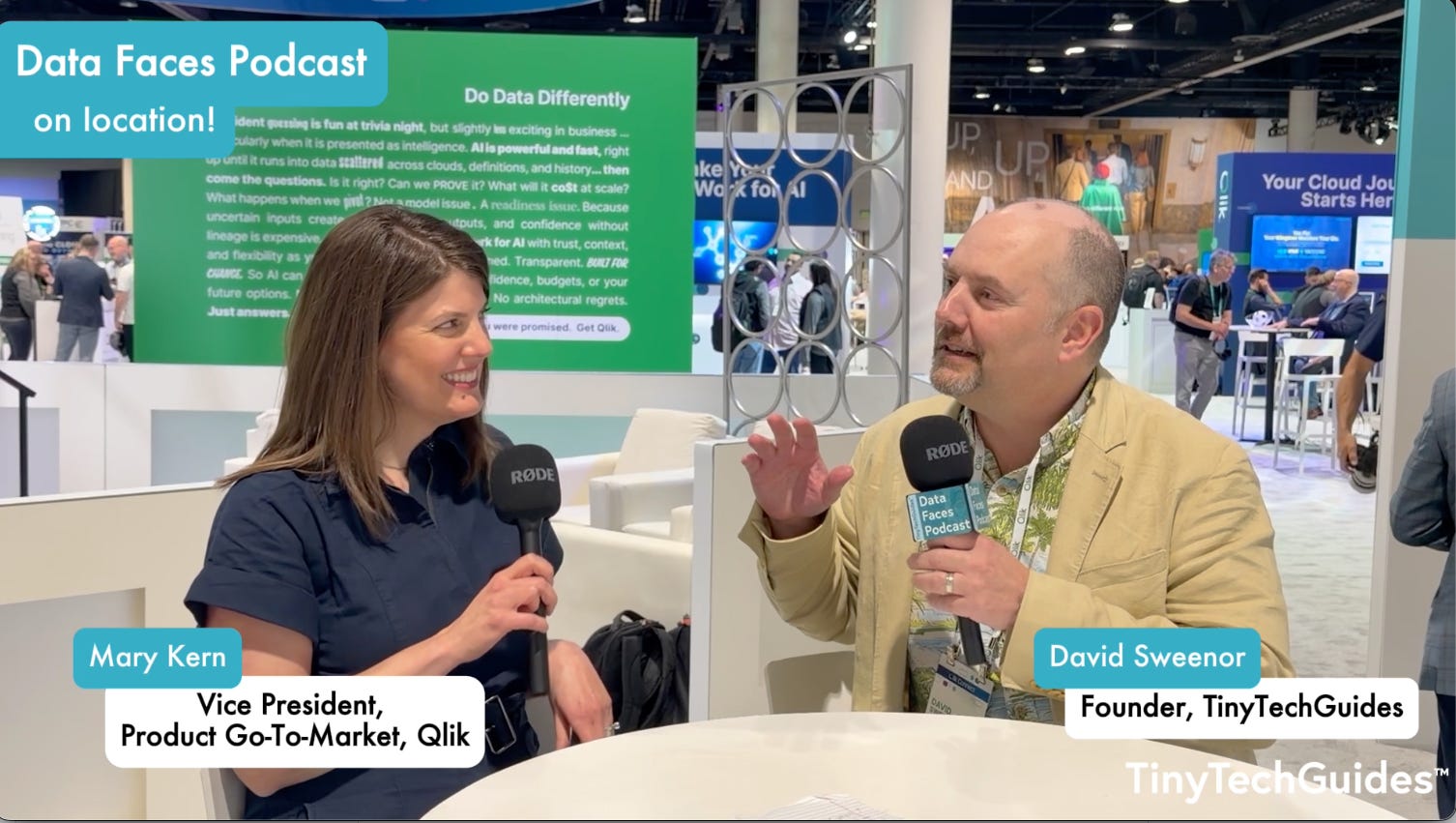
Capone’s larger thesis was that AI is moving from showcase to operating model.[2] The way Qlik talks about users is part of that shift. In the back-to-back Data Faces conversations I did on the show floor with Mary Kern (VP Product Go-to-Market) and Brendan Grady (EVP and GM of Analytics & AI), old industry frames did not survive the table test. Mary said she was “never a fan” of “citizen data scientist,” and Brendan called the term “crazy” when it came up in his own Data Faces conversation.[3] That is a signal worth paying attention to.
“I was never a fan of citizen data scientists for the record or citizen analyst.”
— Mary Kern, Vice President, Product Go-to-Market, Qlik
About Mary Kern
Mary Kern is Vice President, Product Go-to-Market at Qlik, where she leads marketing, launches, and product-led growth across the entire Qlik portfolio. She joined Qlik in 2023 leading product marketing for analytics and has since expanded her scope to cover the full product portfolio, including data integration, cloud, analytics, and AI. Before Qlik, she held marketing leadership roles at Varicent, SDL, TIBCO Software, and IBM, and holds an MBA from the Kellogg School of Management. Mary and I worked together at TIBCO years ago. When she isn’t shipping product keynotes she is running a suburban-Chicago wildlife cam and competing with me in an annual vegetable garden weigh-off.
In this episode, we discuss:
Why “citizen data scientist” never worked as an industry frame
How generative AI changes the question from “train users” to “meet users where they are”
Designing for the user already in the seat, not the one we wish were there
Where data quality and trust shift once natural language becomes the interface
Qlik Connect 2026 themes and what practitioners should watch next
A design premise, not an enablement story
For 15 years, BI vendors pitched “citizen data scientist” as the answer for enabling non-data people. After endless debates about citizen dentists and citizen pilots, the term fizzled away. Most business users have no interest in becoming part-time data scientists. They want answers and recommendations on how to improve their business operations. Mary was direct about why. “It puts a lot of onus on people when that may not be their calling or aptitude,” she said.
Mary’s reply to that was a different design premise.
“Most people are horrible prompters. You have to bake that into the experience.”
— Mary Kern, Vice President, Product Go-to-Market, Qlik
Citizen data scientist asked the user to get better. With “horrible prompters,” the design question shifts to how the tool can get smarter about the user sitting in front of it. That reframes the work from enablement to design. For 15 years, self-service BI pushed the cognitive load onto the end user, who was expected to learn the data model, the query language, and the tool. Mary’s view is that generative AI changes the equation. It “really meets everybody where they’re at and their skill set.” Users don’t have to level up before getting an answer.
That design premise lines up with what Capone, Qlik’s former CEO, had been telling the market all year. Before the event, he described Qlik’s approach as helping teams engage data “through agentic conversations that lead to action, with governance and efficiency built in.”[4] Mary’s design premise is the former CEO’s operating-model thesis at the UX layer.
Meeting users where they are
Mary’s design premise has a logical consequence. If the tool absorbs the skills burden at the UX layer, the quality and trust burden shifts one layer deeper.
“It really gets pushed down to one step behind analytics, which is the data product.”
— Mary Kern, Vice President, Product Go-to-Market, Qlik
With natural language as the interface, users stop worrying about field names or SQL syntax. The tool handles that. What users are actually depending on is the foundation underneath, whatever data the tool reaches for, and whether that data is correct.
Qlik’s Connect 2026 announcements make the shift concrete. Qlik Answers is the entry point, combining structured analytics and unstructured content. Discovery Agent surfaces anomalies before humans think to ask about them. Predict Agent builds models and answers forward-looking questions. Automate Agent pushes insights into downstream workflows. Analytics Agent accelerates development tasks.[5] Together they form a continuous path from question to action.
Mary walked through what this looks like at the user level. The system takes a messy question and reframes it. It surfaces relevant data without requiring users to name fields or tables. When a question is ambiguous, the system flags it and asks for clarification instead of silently guessing.
Delivery matters as much as the pipeline. Rather than asking users to come to Qlik, the platform reaches users in whatever environment they already work in. MCP Server lets users invoke Qlik’s analytics engine from Claude, ChatGPT, Gemini, or whatever assistant their organization has standardized on. Brendan said Qlik is already seeing roughly 50/50 usage between its native interface and MCP for agentic capabilities. Agents run in the background, surfacing what matters without a dashboard login. The pane of glass is wherever the user already is.
That is “meeting users where they are” at the product level, not just the UX level. It is Capone’s “freedom” pillar executed in shipping code. For 15 years, the question was how to train more business users to work with data. Now the question is how to put trustworthy, governed data in front of users in the environments they already trust, including AI assistants that never ran inside the analytics stack.
Trust as a hard requirement
If the onus has shifted one layer deeper, that layer has to be trustworthy. Capone, who has since left Qlik, put it bluntly in the run-up to the event.
“AI is moving from an interesting capability to an operational expectation. The moment it touches real decisions, trust becomes a hard requirement, not a slogan.”
— Mike Capone, former CEO, Qlik
In an agentic era, the urgency is sharper. An agent doesn’t pause to gut-check a suspicious number. It takes the data, acts on it, and passes the result to the next step. By the time anyone notices a problem, the decision has already shipped.
Qlik’s response is to make trust operable. The Connect 2026 announcements on data products include a Trust Score that evaluates data products across accuracy, timeliness, diversity, and completeness. Data contracts define what a data product is expected to provide. The Data Product Agent helps teams create, manage, and evaluate data products using natural language.[6] They turn trust into a visible operational signal rather than an assumed quality.
This reflects a deeper shift Capone signaled throughout his time leading Qlik. The old pendulum between tight central control and chaotic self-service is breaking down.[7] What replaces it is controlled decentralization, with governed data products distributed to wherever users, human or agent, can make use of them. That requires governance, data contracts, semantic layers, lineage, and access controls to stop being back-office hygiene.[8] They become the place where AI succeeds or fails.
Retire “citizen data scientist.” Invest in the data foundation and the delivery mechanisms that meet users in the environments they already work in.[9]
Near the end of our interview, Mary captured the shift in one line. “We just have new ways of solving these old problems.” The hard part just stopped being the user’s job.
Listen to the full conversation with Mary Kern on the Data Faces Podcast.
Based on insights from Mary Kern, Vice President, Product Go-to-Market at Qlik, featured on the Data Faces Podcast.
Frequently asked questions
What does it mean to meet users where they are in product design?
Meeting users where they are is Mary Kern’s design philosophy for the agentic era. Instead of training users to phrase questions better, the tool absorbs the skills burden. Qlik’s agentic experience reframes messy questions, surfaces relevant data without requiring field names, and flags ambiguous questions instead of silently guessing.
What were the keynote themes at Qlik Connect 2026?
Former Qlik CEO Mike Capone framed the keynote around three words: context, trust, and freedom. AI has to understand the business in context, run on a trusted foundation, and connect insight to action in the systems teams already use. Qlik’s announcements at Connect 2026 extended this with MCP servers, agentic experiences, and an open ecosystem that meets users in whatever environment they already work in.
Where should D&A leaders invest to prepare for agentic AI?
D&A leaders should shift investment from end-user enablement programs to the data foundation underneath. Governance, data contracts, semantic layers, lineage, and access controls stop being back-office hygiene when AI becomes the interface. Agents don’t pause to gut-check suspicious data, so whatever they read has to be trustworthy before they touch it. That is where AI succeeds or fails.
How does natural language interface shift the burden away from users?
When natural language becomes the interface, users stop worrying about field names or query syntax. The tool handles that. What users actually depend on is the foundation underneath, whatever data the tool reaches for and whether it is correct. The burden moves from the user one layer deeper, to the data product layer that serves every question.
Podcast highlights
- [0:00] Introduction on the Qlik Connect 2026 show floor
- [0:24] Mary’s expanded role at Qlik
- [0:50] Gardens and a suburban raccoon cam
- [2:14] Qlik Connect 2026 keynote highlights
- [4:10] Qlik’s agentic experience and “a couple toggles to production”
- [6:30] What is different about enabling business users this time
- [8:20] Flexibility and meeting users where they are
- [11:15] The Qlik community
- [12:11] Cutting through the agentic noise
- [14:42] Storytelling and customer validation
- [16:13] What is next for Qlik in 2026
- [17:30] The “dare to be different” theme
About David Sweenor
David Sweenor is the founder and host of the Data Faces Podcast, where he talks with the people who are making data, analytics, AI, and marketing work in the real world. He is also the founder of TinyTechGuides and a recognized top 25 analytics thought leader and international speaker who specializes in practical business applications of artificial intelligence and advanced analytics.
With over 25 years of hands-on experience implementing AI and analytics solutions, David has supported organizations including Alation, Alteryx, TIBCO, SAS, IBM, Dell, and Quest. His work spans marketing leadership, analytics implementation, and specialized expertise in AI, machine learning, data science, IoT, and business intelligence. David holds several patents and consistently delivers insights that bridge technical capabilities with business value.
Books
- Artificial Intelligence: An Executive Guide to Make AI Work for Your Business
- Generative AI Business Applications: An Executive Guide with Real-Life Examples and Case Studies
- The Generative AI Practitioner’s Guide: How to Apply LLM Patterns for Enterprise Applications
- The CIO’s Guide to Adopting Generative AI: Five Keys to Success
- Modern B2B Marketing: A Practitioner’s Guide to Marketing Excellence
- The PMM’s Prompt Playbook: Mastering Generative AI for B2B Marketing Success
Follow David on Twitter @DavidSweenor and connect with him on LinkedIn.
Footnotes
[1]Qlik. “Qlik Extends Analytics from Answers to Agentic Action.” Press release, April 14, 2026. https://www.qlik.com/us/news/company/press-room/press-releases/qlik-extends-analytics-from-answers-to-agentic-action.
[2]Qlik. “Qlik Connect 2026 Shows Enterprises Are Closer to Agentic AI Than They Think.” Press release, April 15, 2026. https://www.qlik.com/us/news/company/press-room/press-releases/qlik-connect-2026-shows-enterprises-are-closer-to-agentic-ai-than-they-think.
[3]Sweenor, David. “Why Bad Data Didn’t Matter Until Now.” TinyTechGuides, April 2026. https://tinytechguides.com/blog/why-bad-data-didnt-matter-until-now/.
[4]Qlik. “Jesse Cole, Creator of the Savannah Bananas, to Keynote Qlik Connect 2026.” Press release, January 28, 2026. https://www.qlik.com/us/news/company/press-room/press-releases/jesse-cole-creator-of-the-savannah-bananas-to-keynote-qlik-connect-2026.
[5]Qlik. “Qlik Extends Analytics from Answers to Agentic Action.” Press release, April 14, 2026. https://www.qlik.com/us/news/company/press-room/press-releases/qlik-extends-analytics-from-answers-to-agentic-action.
[6]Qlik. “Qlik Makes Trust Operable for Data Products.” Press release, April 14, 2026. https://www.qlik.com/us/news/company/press-room/press-releases/qlik-makes-trust-operable-for-data-products.
[7]Qlik. “Qlik CEO: Enterprises Are Underachieving on AI, With Islands of Value in a Sea of Noise.” Press release, January 15, 2026. https://www.qlik.com/us/news/company/press-room/press-releases/qlik-ceo-enterprises-are-underachieving-on-ai-with-islands-of-value-in-a-sea-of-noise.
[8]Sweenor, David. “Why Bad AI Governance Kills 95% of Enterprise Projects Before Production.” TinyTechGuides, September 9, 2025. https://tinytechguides.com/blog/why-bad-ai-governance-kills-95-percent-enterprise-projects/.
[9]Sweenor, David. “Why 80% of AI Projects Fail (And the Three Boring Decisions That Save the Other 20%).” TinyTechGuides, October 21, 2025. https://tinytechguides.com/blog/why-80-of-ai-projects-fail-and-the-three-boring-decisions-that-save-the-other-20/.


