

Listen now on YouTube | Spotify | Apple Podcasts | Amazon Music
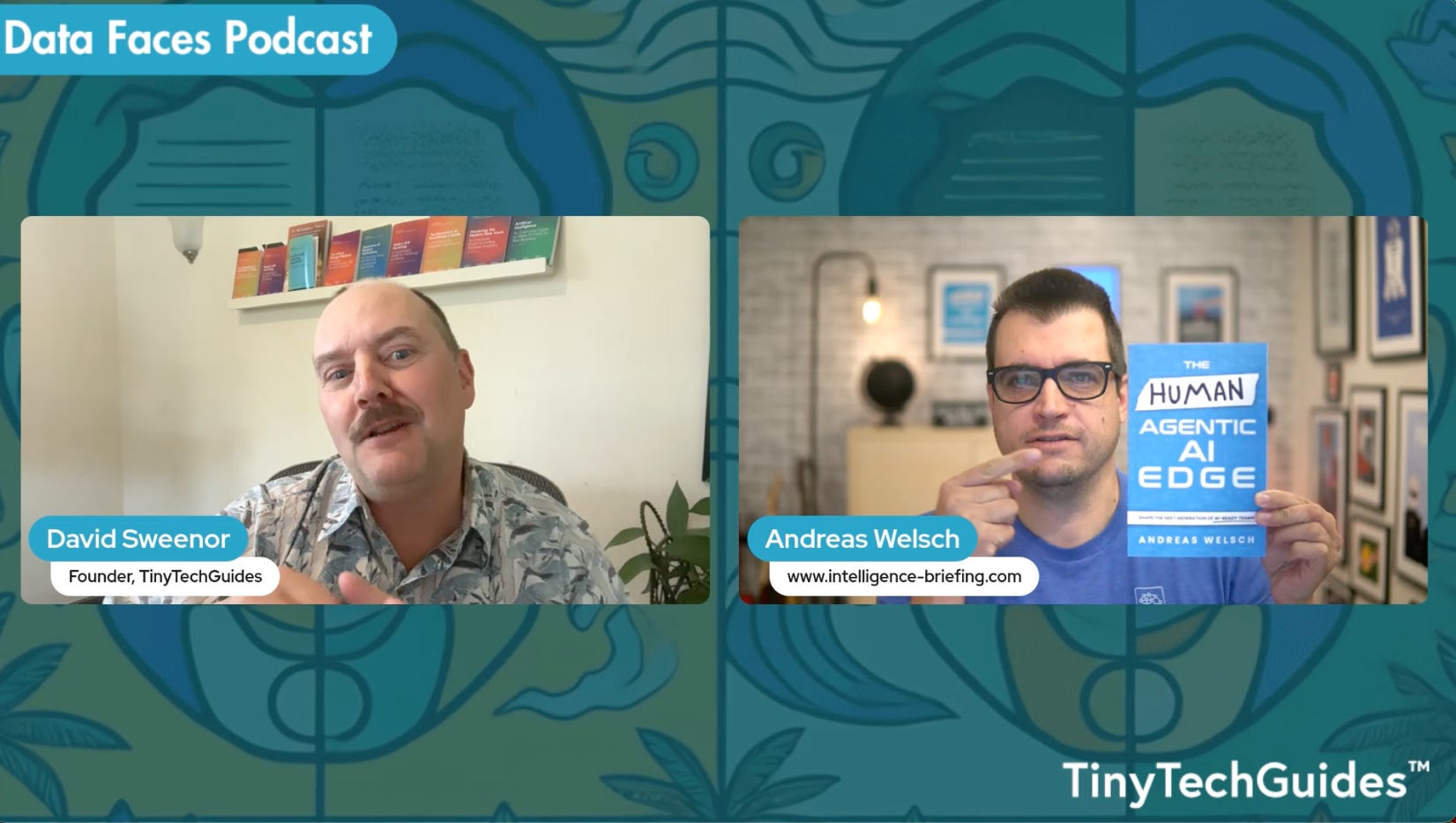
I spent the first half of my career at IBM, where I built dashboards, predictive analytics solutions, and complained about our data warehouse. Then, I joined the EDW team to try to fix it, ran an analytics development team, and eventually landed in their analytics center of excellence (CoE). Similarly, Andreas Welsch spent close to twenty years at SAP, finishing as the VP who ran their AI Center of Excellence. We both left to run our own businesses and learned similar lessons. When you’re an independent entrepreneur, you become the CXO of everything, from revenue to legal to accounting to the marketing that nobody else is going to do for you.
That shared vantage point made our conversation on the Data Faces Podcast easy from the start. Andreas has watched hype-infused trends play out four times now: cloud, mobile, the first wave of machine learning, and now generative and agentic AI. Each time, the patterns that follow are similar.
“We have this new shiny object. Let’s go figure out what we can do with this. Throw spaghetti at the wall and see what sticks.”
— Andreas Welsch, Founder and Chief Human Agentic AI Officer, Intelligence Briefing
When you’re chasing the latest thing, sometimes the spaghetti sticks to the wall, while other times the house of cards comes crashing down. The companies that come out ahead, Andreas argues, are the ones that stop to ask a question most leaders skip under this much pressure. Just because you can build something with AI does not mean you should.
About Andreas Welsch
Andreas Welsch is the founder and Chief Human Agentic AI Officer at Intelligence Briefing, where he helps business leaders figure out what to do with AI. He spent close to two decades at SAP, finishing as the vice president who ran the company’s AI Center of Excellence, so he watched enterprise AI grow up from the inside. He is the author of two books, The AI Leadership Handbook and The Human Agentic AI Edge, an adjunct professor in Pennsylvania, a LinkedIn Top Voice, and the host of the What’s the BUZZ? podcast. The engineering curiosity started early. There are photos of him around four or five years old, screwdriver in hand, taking apart an RC car to see how it worked, then ending up with a small pile of leftover springs and screws.
In our conversation, Andreas and I covered:
- Why the rush to cut headcount with AI spreads like a contagion, and the revenue question almost nobody asks
- The “should we?” test that separates real value from sunk cost
- What the “SaaS is dead” crowd gets wrong about convenience, risk, and who you call at 2 a.m.
- How he used three custom GPTs to edit his book, and where AI’s help turned into noise
- Why agentic AI risk multiplies rather than adds up as you stack more agents
The race nobody’s questioning
Before we got to agents, we talked about layoffs, because Andreas sees the two as interrelated. One company announces it needs fewer people and more technology, whether or not it has figured out how. The media picks it up, investors ask the competitor down the street why it is not running as lean, and like dominoes, the next company follows, until a single press release hardens into an industry expectation.
“Having layers that continue until the morale improves isn’t really the way to success. And we know this, and leaders know this too. Yet this is happening because somebody over here said they’re doing it.”
— Andreas Welsch, Founder and Chief Human Agentic AI Officer, Intelligence Briefing
The same contagion now drives agentic AI. One company says it is building agents, true or not, and everyone else picks up the language. I told Andreas that I have not seen many agentic workflows in production. I see prototypes, pilots, and a lot of experimentation, but turning an agent loose on the real world is still rare, and plenty of those pilots stall long before they reach production.[1] He agreed we are at least past the slide-deck arguments over whether to call it “AI agents” or “agentic AI,” yet most organizations are still deciding which use cases are worth the effort.
The question that saves you
When I asked Andreas what worries him about all this posturing, he started with a claim he hears all the time. SaaS is dead. Every other LinkedIn post now declares the death of software because anyone can build their own. So he tested it. After upgrading his Claude subscription to the hundred-dollar tier, he started rebuilding the tools he pays for. He cloned DocuSign over a weekend, the signing boxes wired to an email workflow that saved the file. He rebuilt his workshop live-polling app in a few days, then knocked out four or five more, from digital sticky notes to a credentialing tool.
The experiment worked, and that is exactly what taught him the lesson.
“You’re actually paying for convenience and for peace of mind when you get a SaaS subscription. There’s somebody else who is maintaining that thing for you. For 20 dollars a month? That’s actually a pretty good deal.”
— Andreas Welsch
A twenty-dollar subscription suddenly looks cheap when you remember what it covers. Someone else handles the dependencies, security patches, data-privacy rules, and the small stuff like getting the fonts to line up. Rebuilding a non-essential app for personal use is a fun exercise, but rebuilding the core systems a business runs on is a different calculation. ERP, CRM, and finance software need auditability, and when something breaks at two in the morning on a Sunday, you want a vendor on the hook to fix it, not a teammate who vibe-coded the thing last weekend. What does not change is the question under every build-or-buy decision. Just because you can build it does not mean it belongs on your plate.
Cost, or revenue?
Underneath the layoffs and the refactoring, Andreas keeps waiting to hear leaders ask one question. How are you going to make more money? He hears plenty about trimming costs and protecting margin. He rarely hears anyone ask where new revenue is supposed to come from.
“I wish there were more people asking, so how are you making more money? Not how are you optimizing your costs? Revenue is a lot harder to achieve, and building products that people want to buy and offering services that people need, it’s a lot harder to do than taking out costs.”
— Andreas Welsch
This is where his optimism diverges from how most companies behave. The same technology leaders use to justify cuts could instead help a team do ten times more, build new products, and reach customers it could not serve before, without sacrificing the people who would create that growth. Most want the incremental win with a smaller headcount, and the people who stay do the work of five.
The market data backs up his skepticism about where the value lands. McKinsey’s 2025 State of AI survey found that only about 39 percent of organizations report any measurable effect on enterprise earnings from AI, and most of those credit it with less than five percent. Sixty-two percent say they are at least experimenting with AI agents, yet only 23 percent are scaling them.[2] The enthusiasm shows up everywhere. The financial return, for most companies, has not arrived yet.
What AI still gets wrong
The clearest picture of where AI helps and where it stops came from Andreas’s own book. He had planned to hire a human copy editor and line editor, the way he had before, because he likes the coaching and back-and-forth. Friends pushed him to let AI do it instead. So he wrote the manuscript himself with no AI, then built three custom GPTs, one a developmental editor, one a copy editor, and another a line editor, and fed his draft through all three.
The results were promising. The AI caught inconsistencies and even factual errors, things he had misremembered from news stories that a human editor would likely have missed. Then it kept going.
“AI, or in this case ChatGPT, was a helpful assistant that really didn’t know when to shut up.”
— Andreas Welsch
Every new revision came back with another five urgent fixes, then five more, until the suggestions started making the book worse instead of better. He was watching diminishing returns in real time, and he realized the skill he needed was knowing enough about his own craft to say “this far, and no further.” Without that line, you cannot tell whether the system is improving your work or making it worse.
That same limit scales up to the autonomous-enterprise vision everyone keeps selling. I asked Andreas which piece of conventional wisdom about agentic AI he thinks is most wrong, and he did not hesitate.
“It does everything for you, and it does it perfectly all the time. We’re still relying on a probabilistic system that can be confidently wrong.”
— Andreas Welsch
Even with governance, guardrails, and evaluation in place, an agent still has enough room to do something nobody wanted. And the risk does not add up the way people assume. One agent is manageable, two working together get more complex, and by the time you are orchestrating several, the risk compounds exponentially. Most companies are still building their first or second one while the industry sells them autonomous enterprises. Gartner predicts that more than 40 percent of agentic AI projects will be canceled by the end of 2027, undone by rising costs, unclear business value, and weak risk controls.[3] Plenty of that failure traces back to strategy and governance rather than the models themselves, the same conclusion behind the forecast that most generative AI projects will fall short of their goals.[4]
The human edge
Andreas gave himself a title that sounds like a contradiction, Chief Human Agentic AI Officer, and by the end of our conversation, it made sense. The leaders getting real value from AI share a habit. They treat the technology as a way to expand what their teams can do, keeping a human in the loop to decide what is worth doing at all. The most useful AI deployments I see amplify human judgment instead of replacing it.[5]
Human judgment is the whole game. A manager asks how the company will make more money before reaching for another round of cuts, and an author learns when to stop taking the model’s notes. The same instinct tells an executive to pause before automating a process just because a vendor swears it can be done. Agentic AI will keep getting more capable, and the pull to hand everything over to it will keep getting stronger. The advantage goes to the people who can look at all that capability and still ask the oldest question in business. Should we?
Listen to the full conversation with Andreas Welsch on the Data Faces Podcast.
Based on insights from Andreas Welsch, Founder and Chief Human Agentic AI Officer at Intelligence Briefing, featured on the Data Faces Podcast.
Podcast highlights
- [1:01] What Intelligence Briefing does, and helping leaders decide what to do with AI
- [1:48] From wanting to be a pediatrician to taking apart RC cars with a screwdriver
- [3:45] Leaving SAP and becoming the CXO of everything
- [9:59] The optimism gap, and why so many teams are burned out doing five jobs
- [10:40] The layoffs vicious cycle, and the revenue question nobody asks
- [13:58] Pilots versus production, and why people have gone quiet about what they are building
- [21:37] “SaaS is dead,” and vibe-coding clones of DocuSign and Mentimeter
- [25:00] When to defer risk to a vendor, and the shift away from per-seat pricing
- [27:57] Just because you can does not mean you should
- [32:47] Editing a book with three custom GPTs that would not stop talking
- [36:12] The conventional wisdom he thinks is wrong, and why agent risk compounds
Frequently asked questions
What is agentic AI, and how is it different from a chatbot or generative AI?
Generative AI produces content such as text, code, or images in response to a prompt. Agentic AI goes a step further by taking actions, connecting to other tools, and completing multi-step tasks with some degree of autonomy. In the episode, Andreas Welsch describes agents that can run parts of a workflow on their own. The catch is reliability. Because the underlying system is probabilistic, an agent can act confidently and still be wrong, which is why human oversight matters.
Why do most AI agent projects fail to reach production?
Most agent efforts stall because organizations chase the technology before defining the value. Gartner predicts that more than 40 percent of agentic AI projects will be canceled by the end of 2027 because of rising costs, unclear business value, and weak risk controls. Companies that succeed start with the workflow they want to change, decide what to eliminate, and measure value from the beginning rather than launching a pilot and hoping it finds a purpose.
Does using AI mean cutting headcount?
It does not have to. Andreas Welsch argues that the bigger opportunity is using AI to help existing teams do far more, build new products, and reach new customers, which protects future growth rather than trading it away for a short-term cost cut. McKinsey’s 2025 research found that only about 39 percent of organizations report any measurable earnings impact from AI so far, a sign that headcount cuts alone do not deliver the promised return.
Should a company build its own software instead of paying for SaaS?
It depends on whether the software is core to the business. Andreas Welsch rebuilt several non-essential personal tools to prove it was possible, then concluded that a subscription often pays for convenience and peace of mind. Someone else handles maintenance, security, and data privacy. For core systems like ERP, CRM, or finance, auditability and vendor support usually outweigh the savings from building it yourself.
Where should a leader start with agentic AI?
Start with a single high-value workflow rather than a broad rollout. Ask whether the project should be done at all, not just whether it can be. Keep a human in the loop to judge quality, and treat reliability and risk as first-order concerns because agent risk compounds as you add more agents. The goal is measurable value on one process before scaling to the next.
About David Sweenor
David Sweenor is the founder and host of the Data Faces podcast, where he talks with the people who are making data, analytics, AI, and marketing work in the real world. He is also the founder of TinyTechGuides and a recognized top 25 analytics thought leader and international speaker who specializes in practical business applications of artificial intelligence and advanced analytics.
With over 25 years of hands-on experience implementing AI and analytics solutions, David has supported organizations including Alation, Alteryx, TIBCO, SAS, IBM, Dell, and Quest. His work spans marketing leadership, analytics implementation, and specialized expertise in AI, machine learning, data science, IoT, and business intelligence. David holds several patents and consistently delivers insights that bridge technical capabilities with business value.
Books
- Artificial Intelligence: An Executive Guide to Make AI Work for Your Business
- Generative AI Business Applications: An Executive Guide with Real-Life Examples and Case Studies
- The Generative AI Practitioner’s Guide: How to Apply LLM Patterns for Enterprise Applications
- The CIO’s Guide to Adopting Generative AI: Five Keys to Success
- Modern B2B Marketing: A Practitioner’s Guide to Marketing Excellence
- The PMM’s Prompt Playbook: Mastering Generative AI for B2B Marketing Success
Follow David on Twitter @DavidSweenor and connect with him on LinkedIn.
Footnotes
[1]Herrera, Catalina. “Your Netflix Moment: Why CIOs Must Act Now on AI Agents (or Risk Becoming the Next Blockbuster).” TinyTechGuides Insights, October 7, 2025. https://insights.tinytechguides.com/p/your-netflix-moment-why-cios-must.
[2]McKinsey & Company. “The State of AI in 2025: Agents, Innovation, and Transformation.” QuantumBlack, November 2025. https://www.mckinsey.com/capabilities/quantumblack/our-insights/the-his craft well enough to say,state-of-ai.
[3]Gartner. “Gartner Predicts Over 40% of Agentic AI Projects Will Be Canceled by End of 2027.” June 25, 2025. https://www.gartner.com/en/newsroom/press-releases/2025-06-25-gartner-predicts-over-40-percent-of-agentic-ai-projects-will-be-canceled-by-end-of-2027.
[4]Carlsson, Kjell. “AI in 2025: Why 90% of Gen AI Projects Will Fail.” TinyTechGuides Insights, March 22, 2025. https://insights.tinytechguides.com/p/ai-in-2025-why-90-of-gen-ai-projects.
[5]Magne, Matt. “Augmented Intelligence: The Future of Sales Enablement.” TinyTechGuides Insights, November 4, 2025. https://insights.tinytechguides.com/p/augmented-intelligence-the-future.


